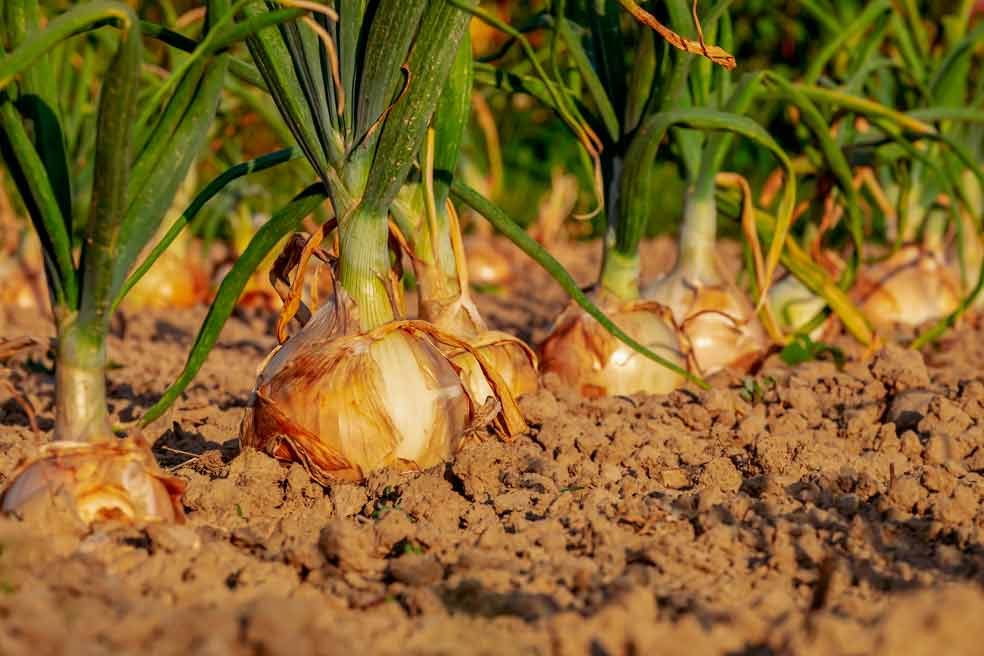
Onion is one of the most important vegetable and commercial bulb crops grown across India. It is cultivated in different seasons and regions, including Maharashtra, Karnataka, Gujarat, Madhya Pradesh, Rajasthan, Andhra Pradesh, Telangana, Tamil Nadu, and other parts of the country. Because onion has a relatively shallow root system and requires careful moisture management, irrigation plays a major role in bulb development, quality, and final yield.
Drip irrigation in onion is an efficient method of supplying water directly near the plant root zone. Instead of flooding the entire field, drip systems deliver controlled quantities of water through emitters placed along the crop rows. This helps maintain more uniform soil moisture while reducing unnecessary water loss.
Research and field demonstrations by ICAR-Directorate of Onion and Garlic Research have shown important benefits from drip irrigation in onion. Under specific experimental conditions, drip irrigation at 100% pan evaporation improved marketable bulb yield by about 15–25%, while water savings of approximately 35–40% were reported.
For farmers facing water shortages, rising irrigation costs, or uneven water distribution, drip irrigation can therefore be an important part of modern onion cultivation.
What Is Drip Irrigation in Onion?
Drip irrigation is a micro-irrigation technique in which water is transported through pipes and released slowly through emitters positioned close to the onion plants.
In conventional flood irrigation, a large quantity of water is applied across the field. Some water may move below the root zone, evaporate, or remain in areas where it is not immediately required.
With drip irrigation, the objective is different:
- Deliver water close to the onion root zone
- Maintain suitable soil moisture
- Reduce unnecessary water movement
- Improve irrigation uniformity
- Allow more precise fertigation
- Reduce weed growth between crop rows
- Improve water-use efficiency
Onion is particularly suitable for this approach because bulb development depends strongly on consistent moisture availability.
ICAR-DOGR has documented drip layouts for onion and garlic using broad-bed furrow systems, including two drip laterals per bed in one recommended configuration, with emitter spacing and discharge selected according to the system design.
Why Is Irrigation Important for Onion Cultivation?
Onion plants require adequate moisture during establishment, vegetative growth, and especially bulb development. However, irrigation should not mean continuously wet soil.
Both insufficient and excessive irrigation can create problems.
When onion plants experience water stress, growth can slow and bulb development may be affected. On the other hand, excessive irrigation can create waterlogging, nutrient losses, poor aeration, and favorable conditions for certain diseases.
Therefore, the goal is balanced irrigation rather than maximum irrigation.
A well-designed drip system allows farmers to apply smaller quantities of water more frequently according to:
- Soil type
- Weather conditions
- Crop growth stage
- Plant population
- Evapotranspiration
- Rainfall
- Field drainage
- Available water
ICAR farmer advisories also emphasize adjusting onion irrigation according to soil and weather conditions and withdrawing irrigation before harvest.
Benefits of Drip Irrigation in Onion Farming
1. Saves Irrigation Water
One of the major advantages of drip irrigation is water conservation.
ICAR-DOGR field research reported approximately 35–40% irrigation-water savings with drip irrigation in onion under the reported conditions.
This can be particularly valuable in areas where groundwater levels are declining or irrigation water is limited.
Instead of applying a large volume of water across the whole field, water is delivered more directly to the crop root zone.
2. Improves Bulb Yield
Water availability has a direct relationship with onion growth and bulb development.
A consistent moisture supply can support:
- Root development
- Leaf growth
- Photosynthesis
- Bulb initiation
- Bulb enlargement
- Uniform crop development
ICAR-DOGR reported that drip irrigation at 100% pan evaporation significantly improved marketable bulb yield by approximately 15–25% in its reported trials.
Another National Horticulture Board report cited experiments at the National Research Centre for Onion and Garlic in Pune where drip irrigation at 100% pan evaporation produced a 23.1% higher yield than surface irrigation and saved 37.8% water under those experimental conditions.
Actual results can vary according to variety, climate, soil, irrigation scheduling, nutrient management, and farm practices.
3. Better Fertilizer Application Through Fertigation
One of the biggest advantages of a drip system is that fertilizers can be supplied through irrigation water.
This method is called fertigation.
Instead of applying all fertilizer at one time, nutrients can be supplied in smaller quantities according to crop requirements.
Potential benefits include:
- More precise nutrient application
- Better nutrient availability near roots
- Reduced nutrient losses
- Improved fertilizer-use efficiency
- Less manual fertilizer application
ICAR has reported that drip and fertigation interventions in onion and garlic improved water and fertilizer-use efficiency in farmer fields.
Fertilizer schedules should still be based on soil testing, crop requirements, local recommendations, and professional agricultural advice.
4. More Uniform Moisture
Uneven irrigation can result in uneven crop development.
Some areas of a flood-irrigated field may receive excessive water while other areas receive less.
A properly designed drip system can distribute water more uniformly along crop rows.
This is especially useful where:
- Fields are relatively large
- Soil texture varies
- Water availability is limited
- Land leveling is difficult
- Precise irrigation is required
5. Reduced Weed Growth
Flood irrigation can wet areas between onion rows, potentially encouraging weeds.
Drip irrigation primarily wets the root-zone area rather than the entire field surface.
This can reduce unnecessary moisture availability for weeds and make weed management easier.
The National Horticulture Board has also reported better weed management in drip-irrigated onion under the cited experimental conditions.
However, drip irrigation does not eliminate weeds completely. Farmers still need an appropriate weed-management program.
6. Reduced Labor for Irrigation
Traditional irrigation can require considerable labor for opening and closing field channels, moving water, and monitoring irrigation.
With a properly installed drip system, irrigation can be controlled through valves, filters, pumps, and fertigation equipment.
This can reduce manual irrigation work and make water application more manageable.
ICAR-DOGR reported approximately 25–30% labor savings in its onion drip-irrigation observations.
7. Better Water-Use Efficiency
Water-use efficiency is becoming increasingly important in modern agriculture.
The objective is not simply to use less water. The objective is to produce more useful crop output with efficiently managed water.
Drip irrigation contributes to this by:
- Applying water close to roots
- Reducing runoff
- Reducing unnecessary evaporation
- Improving irrigation control
- Supporting fertigation
- Allowing frequent and precise applications
How to Design a Drip Irrigation System for Onion
A drip system should be designed according to the actual field rather than using one fixed layout for every farm.
Important factors include:
- Field size
- Soil type
- Onion spacing
- Bed width
- Water source
- Pump capacity
- Water quality
- Available pressure
- Required discharge
- Crop season
- Local climate
- Irrigation requirement
Drip Laterals
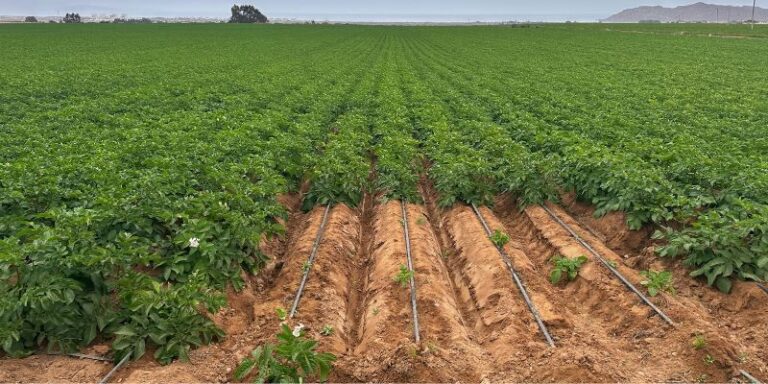
Drip laterals are installed along the onion planting rows or beds.
ICAR-DOGR’s reported onion configuration uses broad beds approximately 120 cm wide at the top with 45 cm furrows and two 16 mm drip laterals per bed, with emitter spacing and discharge specified for that system.
The exact layout should be finalized by a qualified irrigation designer based on the farm.
Mainline and Submain
Water travels from the source through the mainline and submain pipes before entering the drip laterals.
A basic system may include:
Water Source → Pump → Filter → Fertilizer Unit → Mainline → Submain → Laterals → Emitters
Filtration
Filtration is extremely important in drip irrigation.
Small emitters can become blocked by:
- Sand
- Silt
- Organic matter
- Algae
- Fertilizer residues
The filtration system should therefore be selected according to the water source and its quality.
Regular cleaning and maintenance are essential.
Best Soil Conditions for Onion Under Drip Irrigation
Onion generally performs well in well-drained soils with good physical structure.
The field should not remain waterlogged.
Good drainage is particularly important because excessive moisture around the roots can reduce root health and create conditions favorable for disease development.
Raised beds or broad-bed systems can help with drainage in suitable situations.
ICAR documentation on onion production has highlighted broad-bed systems as useful for efficient irrigation and drainage, particularly in situations where excess rainwater needs to move away from the crop.
Onion Drip Irrigation Schedule
There is no single irrigation schedule that is correct for every onion field.
A practical schedule should be based on:
- Crop age
- Soil moisture
- Temperature
- Humidity
- Wind
- Rainfall
- Soil type
- Crop growth
- Evapotranspiration
- Drip emitter discharge
A sandy soil may require more frequent irrigation than a heavier soil because water drains more quickly.
During cooler weather, crop water demand may be lower than during hot and dry conditions.
Therefore, farmers should avoid blindly following a fixed number of minutes or liters per day.
General Stage-Wise Approach
Nursery and Establishment Stage
During establishment, adequate moisture is important for young seedlings.
The objective is to prevent severe drying of the root zone while avoiding excessive water.
Light and controlled irrigation can help establish uniform plants.
Vegetative Growth Stage
As leaves develop, onion plants require consistent moisture.
The drip system should be adjusted according to soil moisture and weather conditions.
Avoid allowing the soil to become excessively dry and then applying a very large irrigation.
Bulb Formation Stage
This is one of the most important stages for irrigation management.
Adequate moisture supports bulb enlargement and helps maintain crop growth.
Frequent, controlled irrigation can be useful when weather conditions create high water demand.
Bulb Maturity Stage
As the crop approaches maturity, irrigation management becomes increasingly important.
Excessive irrigation near harvest can delay maturity and create problems with bulb quality and storage.
ICAR guidance recommends stopping irrigation before harvest; one ICAR advisory specifies approximately 15 days before harvesting under the cited conditions.
The exact timing should be adjusted according to crop maturity, soil, weather, and local recommendations.
How Much Water Does Onion Need Under Drip Irrigation?
This is one of the most common questions asked by onion growers.
There is no universal daily water quantity for every onion field.
For example, an onion crop grown in Maharashtra during a hot period on lighter soil will have different water requirements from an onion crop grown during a cooler season on heavier soil.
Therefore, irrigation should be calculated using crop evapotranspiration, soil moisture, rainfall, system efficiency, and the actual crop stage.
A simplified irrigation calculation can be represented as:
Crop Water Requirement = Reference Evapotranspiration × Crop Coefficient
The final irrigation requirement is then adjusted according to rainfall and irrigation-system efficiency.
For commercial farming, irrigation schedules should ideally be developed using local agricultural recommendations or an irrigation specialist.
Drip Irrigation and Fertigation in Onion
Fertigation is one of the most useful features of drip irrigation.
The fertilizer is dissolved in irrigation water and delivered through the drip system.
A fertigation program can be divided into crop growth stages instead of applying all nutrients at once.
Important Nutrients for Onion
Onion requires balanced nutrition involving:
- Nitrogen
- Phosphorus
- Potassium
- Sulfur
- Calcium
- Magnesium
- Micronutrients
Nitrogen is important for vegetative growth, but excessive nitrogen late in the season can interfere with desired maturity and storage characteristics.
Potassium is important for overall plant development and bulb quality.
Sulfur is particularly relevant to onion because sulfur-containing compounds contribute to the characteristic flavor and aroma of onion.
However, fertilizer application should be based on soil testing and locally recommended nutrient-management practices rather than applying nutrients indiscriminately.
Drip Irrigation for Kharif Onion
Kharif onion is grown during the rainy-season period in suitable regions.
The major challenge during this season is not always lack of water. In some regions, excess rainfall and poor drainage can become bigger problems.
Therefore, drip irrigation for kharif onion should be combined with proper drainage.
Raised beds or broad-bed furrow systems can help manage excess rainfall.
ICAR has documented kharif onion production practices involving raised beds, drip or sprinkler irrigation, and fertigation, with the raised-bed approach helping drain excess rainwater.
The irrigation system should not be operated simply because it is installed. If rainfall has already supplied adequate soil moisture, irrigation should be reduced or skipped.
Drip Irrigation for Rabi Onion
Rabi onion is an important production season in many parts of India.
During the rabi season, rainfall may be limited, making irrigation management particularly important.
Drip irrigation can help maintain controlled moisture during:
- Establishment
- Vegetative development
- Bulb formation
- Bulb enlargement
The irrigation frequency should change according to temperature and crop development.
As the crop approaches harvest, irrigation should be reduced and eventually stopped according to maturity and local recommendations.
Drip Irrigation for Onion in Maharashtra
Maharashtra is one of India’s major onion-producing regions, and drip irrigation has been promoted extensively in onion-growing areas.
ICAR-DOGR, Rajgurunagar, Pune, conducted field work on drip irrigation and demonstrated the technology among farmers in Maharashtra. Its reported results included water savings of around 35–40% and improvements in marketable bulb yield under the specified experimental conditions.
ICAR has also documented onion production initiatives in regions such as Nandurbar where drip irrigation and fertigation improved water and fertilizer-use efficiency.
For Maharashtra farmers, the exact irrigation plan should still be customized according to district, soil, season, variety, rainfall, and water availability.
Drip Irrigation for Onion in Gujarat and Madhya Pradesh
Drip irrigation can also be useful in other major onion-growing areas where irrigation water is limited.
ICAR-DOGR has reported that drip irrigation technology was demonstrated and adopted beyond Maharashtra, including Gujarat and Madhya Pradesh.
ICAR has also documented farmers in Madhya Pradesh adopting drip irrigation for onion and other vegetable crops, with technical support covering system operation, maintenance, and fertigation.
This highlights an important point: installing a drip system is only one part of successful irrigation management. Proper operation, maintenance, and crop scheduling are equally important.
Common Mistakes in Onion Drip Irrigation
Over-Irrigation
More water does not automatically mean more yield.
Excess irrigation can cause:
- Poor root-zone aeration
- Nutrient losses
- Waterlogging
- Disease-favorable conditions
- Higher pumping costs
Under-Irrigation
Severe water stress can reduce plant growth and affect bulb development.
The solution is balanced irrigation based on actual crop demand.
Ignoring Filters
A clogged filter can eventually cause emitter blockage.
Filters should be inspected and cleaned regularly.
Applying Fertilizer Without Proper Calculation
Fertigation should be based on crop requirements and fertilizer concentration.
Excess fertilizer can damage plants and increase production costs.
Using the Same Schedule Throughout the Season
Crop water demand changes with growth stage and weather.
An irrigation schedule that works during cool weather may not be appropriate during a hot period.
Irrigating During Heavy Rainfall
Drip irrigation should complement rainfall, not compete with it.
After substantial rainfall, check soil moisture before starting another irrigation cycle.
Failing to Flush Laterals
Sediment and fertilizer residues can accumulate inside the system.
Periodic flushing helps maintain system performance.
How to Maintain an Onion Drip Irrigation System
Regular maintenance improves the life and efficiency of the drip system.
Check Filters
Clean filters according to water quality and manufacturer recommendations.
Inspect Emitters
Look for:
- Blocked emitters
- Uneven discharge
- Damaged laterals
- Leakage
- Pressure problems
Flush the System
Flush mainlines, submains, and laterals periodically.
Check Pressure
Incorrect pressure can cause uneven water distribution.
Repair Damaged Pipes
Small leaks can become significant water losses over time.
Monitor Fertigation Equipment
Make sure fertilizers dissolve properly and that the injection equipment works correctly.
Drip Irrigation vs Flood Irrigation for Onion
| Factor | Drip Irrigation | Flood Irrigation |
|---|---|---|
| Water delivery | Controlled | Broad field application |
| Root-zone control | High | Lower |
| Water efficiency | Generally higher | Generally lower |
| Fertigation | Easy to integrate | More difficult |
| Weed wetting | More limited | More widespread |
| Labor | Can be lower after installation | Often higher |
| Initial investment | Higher | Lower |
| Maintenance | Requires filter and emitter care | Simpler system |
| Irrigation precision | High | Lower |
| Suitability for water-scarce areas | Strong potential | More challenging |
The National Horticulture Board has reported significant water savings and yield improvements for drip irrigation in onion under cited experimental conditions.
Economic Benefits of Drip Irrigation in Onion
The economic value of drip irrigation depends on many factors:
- Installation cost
- Government subsidy, if applicable
- Water availability
- Electricity or pumping cost
- Labor cost
- Yield improvement
- Onion market price
- Fertilizer savings
- System lifespan
- Maintenance cost
ICAR-DOGR reported additional economic benefits in its onion drip-irrigation demonstrations, including yield and labor-related gains compared with flood irrigation under the reported conditions.
Farmers should calculate economics using their own local costs rather than assuming that published results will be identical on every farm.
Role of Mulching With Drip Irrigation
Mulching can complement drip irrigation.
Organic or suitable agricultural mulch can help:
- Reduce evaporation
- Suppress weeds
- Moderate soil temperature
- Protect soil structure
- Maintain moisture
When drip irrigation and mulching are combined properly, the soil moisture environment can become more stable.
However, the mulch material and application method should be selected according to local climate, crop season, disease risk, and availability.
How Drip Irrigation Can Improve Onion Quality
Good irrigation management can contribute to more uniform bulb development.
A well-managed crop may have:
- More uniform bulbs
- Better bulb size
- Improved marketable yield
- More consistent crop development
ICAR-DOGR reported higher proportions of A-grade bulbs along with improved marketable yield under its drip-irrigation experiments.
Quality, however, is influenced by more than irrigation. Variety, nutrition, disease management, weather, harvest timing, curing, and storage conditions all matter.
Harvest Management After Drip Irrigation
Irrigation should be managed carefully as onion bulbs approach maturity.
Excess moisture close to harvest can interfere with proper maturity and drying.
Once the crop reaches maturity, irrigation should be withdrawn according to local recommendations.
After harvesting, onions should be properly cured and handled to protect bulb quality and storage life.
Good irrigation management therefore continues to matter right up to the harvesting stage.
Frequently Asked Questions About Drip Irrigation in Onion
Is drip irrigation good for onion cultivation?
Yes. Drip irrigation can be highly suitable for onion because it allows controlled water delivery near the root zone. ICAR-DOGR research has reported water savings and improved marketable bulb yield under specific experimental conditions.
How much water can drip irrigation save in onion?
ICAR-DOGR reported approximately 35–40% water savings under its onion drip-irrigation trials. Other reports have documented similar significant savings under particular conditions. Actual savings depend on soil, climate, irrigation management, and the comparison system.
Does drip irrigation increase onion yield?
Drip irrigation can increase marketable onion yield when irrigation is properly designed and managed. ICAR-DOGR reported approximately 15–25% improvement in marketable bulb yield under specific conditions.
How often should onion be irrigated through drip?
There is no universal irrigation interval. Irrigation frequency should be based on soil moisture, weather, crop stage, evapotranspiration, rainfall, and emitter discharge. Farmers should avoid using the same schedule throughout the entire crop cycle.
When should irrigation be stopped before onion harvesting?
Irrigation should generally be withdrawn before harvest so bulbs can mature properly. One ICAR advisory specifies stopping irrigation approximately 15 days before harvest under the cited conditions. Local conditions and crop maturity should be considered.
Can fertilizer be applied through onion drip irrigation?
Yes. Fertilizer can be supplied through drip irrigation using fertigation. This allows nutrients to be delivered more precisely, but fertilizer selection and dosage should follow soil-test results and local agricultural recommendations.
Is drip irrigation suitable for kharif onion?
Yes, but irrigation must be carefully managed because rainfall can be substantial during the kharif season. Proper drainage and raised-bed or broad-bed systems can be particularly useful.
What happens if onion receives too much water?
Excess irrigation can lead to poor soil aeration, nutrient losses, waterlogging, increased production costs, and conditions favorable to certain diseases. Irrigation should be based on crop demand rather than applying maximum water.
Can drip irrigation reduce weeds in onion?
Drip irrigation can reduce wetting of areas between crop rows and may therefore make weed management easier. It does not completely eliminate weeds.
Is drip irrigation profitable for onion farmers?
It can be, particularly where water, labor, and irrigation costs are significant and the system is properly designed. Profitability depends on installation costs, crop yield, market price, water availability, labor savings, and maintenance expenses.
Conclusion
Drip irrigation in onion is an important precision-irrigation method for improving water management, supporting uniform crop growth, and potentially increasing marketable bulb yield.
Its major advantages include controlled water application, water savings, improved fertigation, reduced unnecessary wetting, better irrigation management, and potential labor savings. ICAR research on onion has reported approximately 35–40% water savings and 15–25% improvement in marketable bulb yield under specified drip-irrigation conditions.
However, successful onion drip irrigation is not simply about installing pipes and emitters. The system must be correctly designed, filtered, maintained, and operated according to soil, climate, crop stage, rainfall, and water availability.
For onion growers in water-limited regions such as Maharashtra, Gujarat, Madhya Pradesh, Karnataka, Rajasthan, and other onion-producing areas of India, drip irrigation can be integrated with proper bed preparation, balanced nutrition, fertigation, weed management, drainage, and timely harvesting.
The most important principle is simple: give the onion crop the right amount of water at the right time and in the right place. When irrigation is managed precisely, every drop of water can contribute more effectively to healthy plants, better bulb development, and efficient onion production.