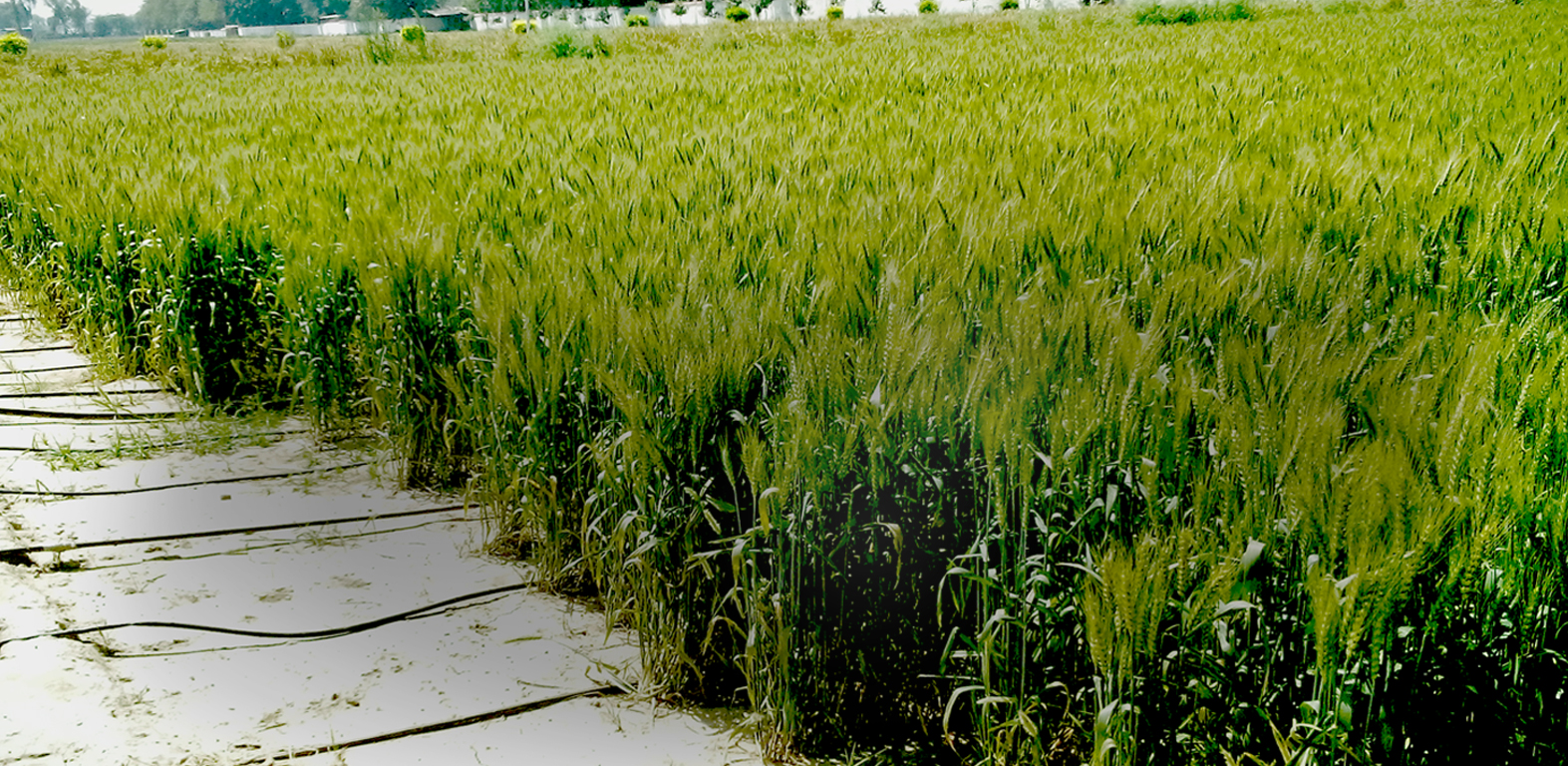
Wheat is one of the most important cereal crops grown across many agricultural regions. As water availability becomes increasingly important for sustainable farming, growers are looking for irrigation methods that can deliver water efficiently while maintaining healthy crop development. Drip irrigation in wheat is one such approach that can provide controlled water application directly to the crop root zone.
Traditional irrigation methods can distribute large quantities of water across the entire field. Depending on soil type, field leveling, climate, and irrigation management, this may lead to evaporation, runoff, deep percolation, or uneven distribution. Drip irrigation works differently by applying water slowly and frequently through emitters positioned along drip lines.
For wheat farmers, the main objective is not simply to use less water. The goal is to provide sufficient moisture at important growth stages while improving water use efficiency, irrigation control, nutrient management, and crop productivity.
Modern irrigation systems can be designed according to field size, soil conditions, water source, crop spacing, pressure requirements, and irrigation scheduling. Gajanand Irrigation provides irrigation products including drip systems, filters, pipes, fittings, valves, and other agricultural irrigation components that can be incorporated into modern irrigation networks.
What Is Drip Irrigation in Wheat?
Drip irrigation in wheat is a method of supplying irrigation water gradually near the root zone of wheat plants through a network of pipes and emitters.
Unlike conventional surface irrigation, where water is distributed across a large part of the field, drip irrigation focuses water application around the crop root zone.
A typical drip irrigation system for wheat may include:
- Water source
- Pump, where required
- Mainline pipe
- Sub-main pipe
- Control valves
- Filtration system
- Pressure regulation components
- Drip laterals
- Emitters
- Fertigation equipment
- Connectors and fittings
The system is designed so that water travels from the source through the mainline and sub-main and finally reaches the drip lines. Emitters then release controlled quantities of water.
The exact system configuration depends on the wheat planting method, field dimensions, soil type, water quality, available pressure, crop spacing, and irrigation strategy.
Can Wheat Be Grown With Drip Irrigation?
Yes, wheat can be grown using drip irrigation when the system is properly designed and managed.
Wheat is commonly cultivated as a broad-acre crop, so farmers need to consider the economics and practical installation requirements before adopting drip irrigation. Research on winter wheat has demonstrated that carefully managed drip irrigation can improve water use efficiency and can support yield and economic performance under appropriate conditions.
However, drip irrigation should not be treated as a universal solution for every wheat farm. A farmer should evaluate:
- Water availability
- Field size
- Soil texture
- Wheat variety
- Local climate
- Rainfall
- Crop establishment method
- Irrigation water quality
- System cost
- Labour availability
- Expected productivity
- Maintenance requirements
A properly planned irrigation system is more important than simply choosing a particular irrigation technology.
Why Is Efficient Irrigation Important for Wheat?
Wheat requires adequate moisture during several important stages of development. Water stress at the wrong time can affect tiller development, plant growth, flowering, grain formation, and final yield.
At the same time, excessive irrigation can also create problems.
Over-irrigation may contribute to:
- Water wastage
- Nutrient movement below the root zone
- Poor soil aeration
- Waterlogging
- Increased disease pressure in some conditions
- Higher pumping costs
- Reduced irrigation efficiency
The purpose of efficient irrigation is therefore to maintain an appropriate soil-water environment rather than continuously applying large quantities of water.
Drip irrigation can help farmers control the timing and location of water application.
Major Benefits of Drip Irrigation in Wheat
1. Better Water Management
One of the primary advantages of drip irrigation is controlled water application.
Water is delivered close to the root zone instead of being distributed randomly across the entire field. This can help farmers manage irrigation according to crop demand and soil conditions.
The ability to control irrigation frequency can be especially useful in areas where water availability is limited.
2. Improved Water Use Efficiency
Water use efficiency is an important consideration in modern wheat farming.
Drip irrigation can reduce unnecessary wetting of areas outside the crop root zone and can help reduce certain water losses associated with conventional irrigation.
Research on wheat irrigation has reported improvements in water-use performance under appropriately managed drip irrigation systems.
However, water savings depend on the irrigation schedule, system design, soil, climate, rainfall, and management practices.
3. Controlled Root-Zone Moisture
Wheat plants require adequate soil moisture for healthy root and shoot development.
Drip irrigation allows farmers to apply water in smaller quantities at controlled intervals. This can help maintain more stable moisture conditions around the active root zone.
Maintaining appropriate moisture is particularly important during sensitive crop stages.
4. Reduced Surface Runoff
When irrigation water is applied too quickly, water may move across the soil surface before infiltrating properly.
Drip irrigation applies water gradually, which can help reduce surface runoff when the system is correctly designed and operated.
This is particularly useful on fields where slope or soil characteristics make surface water movement difficult to control.
5. Better Fertilizer Management
Drip irrigation can be combined with fertigation, where suitable soluble fertilizers are delivered through irrigation water.
This provides an opportunity to apply nutrients in smaller quantities and closer to the crop root zone.
However, fertilizer compatibility, filtration, concentration, water quality, and application procedures should be carefully managed.
A suitable fertigation assembly can become an important part of an efficient agricultural irrigation system.
6. Reduced Unnecessary Wetting
Traditional field irrigation may wet areas where there are no active roots.
Drip irrigation focuses application around the intended root zone.
This targeted approach can help improve irrigation control and may reduce conditions that encourage unnecessary weed growth in wetted areas.
7. Flexible Irrigation Scheduling
With drip irrigation, farmers can divide a field into irrigation zones.
Different zones can be operated according to:
- Soil type
- Field elevation
- Crop development
- Water availability
- Irrigation capacity
Zoning can be particularly useful for larger agricultural fields.
8. Suitable for Water-Scarce Conditions
In regions where irrigation water is limited, precise water application becomes increasingly important.
Drip irrigation provides farmers with better control over when and where water is applied.
The objective is to maximize crop benefit from every unit of available irrigation water.
Wheat Growth Stages and Irrigation Management
Understanding wheat growth stages is essential when designing an irrigation schedule.
Germination and Crop Establishment
After sowing, wheat requires suitable soil moisture for germination and early establishment.
The objective is to maintain enough moisture in the seed zone without creating excessive saturation.
Irrigation requirements during establishment depend on:
- Soil moisture before sowing
- Rainfall
- Soil texture
- Seed depth
- Temperature
- Sowing conditions
Drip irrigation should be operated carefully during this stage because excessive irrigation can create unnecessary moisture.
Crown Root Initiation Stage
The crown root initiation stage is one of the most important stages for wheat irrigation.
Adequate moisture supports root development and tiller formation.
Moisture stress around this stage can negatively affect crop development. Therefore, irrigation scheduling should give careful attention to soil moisture during early crop development.
Tillering Stage
During tillering, wheat develops additional shoots from the plant base.
Adequate water availability supports healthy vegetative development.
Drip irrigation can provide frequent and controlled moisture applications, helping farmers avoid extreme fluctuations between dry and excessively wet soil conditions.
Jointing Stage
During jointing, the wheat plant begins significant stem development.
Water demand may increase as the crop develops.
The irrigation schedule should consider crop growth, soil moisture, rainfall, temperature, and evapotranspiration.
Heading and Flowering
Heading is another important period because the reproductive structures develop and emerge.
Water stress around reproductive stages can affect yield components.
Maintaining appropriate moisture during this period is therefore an important part of wheat irrigation management.
Grain Filling and Dough Development
During grain filling, wheat uses water to support grain development.
Insufficient moisture can reduce grain development and final grain weight.
Irrigation near the later growth stages should be planned carefully because excessive late-season irrigation can also create unnecessary costs and may increase risks depending on field conditions.
How Much Water Does Wheat Need Under Drip Irrigation?
There is no single irrigation amount that is suitable for every wheat farm.
The required quantity depends on:
- Local climate
- Rainfall
- Soil type
- Crop variety
- Planting date
- Evapotranspiration
- Soil moisture
- Effective root-zone depth
- Irrigation efficiency
- Crop growth stage
- Water quality
- Field conditions
A research study on winter wheat in a semi-humid, drought-prone region found that different drip irrigation amounts produced different results and identified different economically suitable irrigation amounts for dry and normal years. This demonstrates why irrigation scheduling should be based on local conditions rather than applying one fixed number to every wheat field.
Farmers should therefore avoid copying an irrigation schedule from another region without adjustment.
How to Schedule Drip Irrigation for Wheat
A practical drip irrigation schedule can be developed using several indicators.
1. Soil Moisture
Soil moisture monitoring can help determine when irrigation is required.
Farmers can use:
- Soil moisture sensors
- Field observation
- Soil sampling
- Crop appearance
- Soil water measurements
2. Weather Conditions
Temperature, rainfall, humidity, wind speed, and solar radiation affect crop water demand.
During hot and dry conditions, crop water consumption can increase.
During periods of rainfall, irrigation may need to be reduced or temporarily stopped.
3. Crop Growth Stage
Water requirements change as wheat develops.
Irrigation planning should therefore be adjusted according to the growth stage rather than following the same schedule throughout the season.
4. Soil Type
Sandy soils generally have lower water-holding capacity and may require more frequent irrigation with smaller applications.
Loamy soils can hold more water.
Heavy soils can retain water for longer periods and may require careful irrigation management to avoid waterlogging.
5. Irrigation System Capacity
The irrigation schedule must also match the actual discharge capacity of the system.
Farmers should consider:
- Pump capacity
- Dripper discharge
- Number of laterals
- Field size
- Operating pressure
- Irrigation zone size
Drip Irrigation System Components for Wheat
A reliable system depends on proper component selection.
Water Source
The system begins with a suitable water source such as:
- Borewell
- Farm pond
- Reservoir
- Canal
- Storage tank
Water quality should be evaluated before designing the filtration system.
Pump
A pump may be required depending on the source and required operating pressure.
Pump selection should be based on total discharge, pressure requirement, pipe length, elevation, and system design.
Filters
Filtration is extremely important for drip irrigation because small emitter openings can become blocked by particles.
Depending on the water source, the system may use different filtration technologies.
Gajanand Irrigation provides filtration solutions for agricultural irrigation systems. You can learn more about suitable filtration options through the irrigation filters page.
Mainline Pipes
Mainline pipes transport water from the source to different parts of the farm.
The diameter should be selected according to flow requirements and pressure losses.
Sub-Main Pipes
Sub-main pipelines distribute water to different irrigation zones.
Control Valves
Valves help farmers control irrigation sections and manage water distribution.
Proper valve selection can make operation and maintenance easier.
Drip Laterals
Drip laterals carry water along the crop rows.
Their spacing and configuration should be selected according to crop arrangement and system design.
Emitters
Emitters release water from the drip line at controlled rates.
Uniform emitter performance is important for uniform irrigation.
Why Filtration Is Important for Drip Irrigation in Wheat
Filtration is one of the most important maintenance considerations in drip irrigation.
Water may contain:
- Sand
- Silt
- Organic matter
- Algae
- Mineral particles
If these materials enter the drip system, they may accumulate inside pipes and emitters.
Clogged emitters can create uneven irrigation, which means some parts of the field may receive less water than others.
For agricultural systems using groundwater, a hydrocyclone filter can help remove sand particles before they enter sensitive irrigation components.
Gajanand Irrigation explains the role of hydrocyclone filters for drip irrigation in reducing sand-related clogging and protecting irrigation equipment.
Disc Filters and Screen Filters for Wheat Irrigation
The correct filter depends on water quality and the type of particles present.
Disc filters and screen filters are commonly used in agricultural irrigation systems.
Farmers should consider:
- Water source
- Particle size
- Organic contamination
- Required filtration level
- Flow rate
- Cleaning requirements
You can read more about choosing between these filtration options in Gajanand Irrigation’s guide to disc filters vs. screen filters.
Fertigation With Drip Irrigation in Wheat
Fertigation allows soluble nutrients to be supplied through an irrigation system.
Potential benefits include:
- More controlled nutrient application
- Improved nutrient distribution
- Reduced manual fertilizer application
- Ability to split fertilizer applications
- Better synchronization between irrigation and nutrient supply
However, fertigation should be implemented only with compatible fertilizers and proper system management.
The irrigation water should be filtered appropriately, and fertilizer solutions should be prepared according to agronomic recommendations.
Farmers should also avoid mixing incompatible fertilizers because precipitation can lead to clogging.
Drip Irrigation vs. Flood Irrigation for Wheat
Both systems can be used for agricultural production, but they operate differently.
| Feature | Drip Irrigation | Flood Irrigation |
|---|---|---|
| Water application | Controlled and localized | Broad surface application |
| Root-zone targeting | High | Lower |
| Water control | Precise | Depends strongly on field conditions |
| Filtration requirement | Important | Usually lower |
| Initial infrastructure | Higher | Generally lower |
| Maintenance | Requires regular monitoring | Different maintenance requirements |
| Fertigation | Highly compatible | More difficult to control precisely |
| Automation | Highly suitable | Possible but less targeted |
| Water-use management | Highly controlled | More dependent on field layout |
The right choice depends on farm economics, water availability, field size, crop management, and local conditions.
Drip Irrigation vs. Sprinkler Irrigation for Wheat
Sprinkler irrigation distributes water across the crop area, while drip irrigation applies water closer to the root zone.
Sprinklers may be useful where farmers need broad field coverage.
Drip irrigation can be useful when targeted water application is a priority.
The choice should consider:
- Water availability
- Soil
- Field shape
- Wind
- Crop establishment
- Infrastructure
- Budget
- Labour
- Maintenance
Gajanand Irrigation also provides information about agricultural drip and sprinkler irrigation solutions for different crop and field conditions.
Important Factors Before Installing Drip Irrigation in Wheat
Before investing in a drip irrigation system, farmers should conduct a complete assessment.
Field Size
Larger farms require proper hydraulic planning and zoning.
Soil Type
Soil determines how water moves away from the emitter.
Water Quality
Poor water quality can increase filtration and maintenance requirements.
Water Availability
The available water supply should be sufficient for the planned irrigation strategy.
Crop Layout
Wheat planting configuration influences lateral placement and irrigation design.
Pressure
Correct pressure is necessary for uniform emitter operation.
Maintenance Capacity
Farmers should be prepared to clean filters, inspect laterals, flush pipelines, and monitor emitters.
Common Problems With Drip Irrigation in Wheat
Drip irrigation can provide useful benefits, but it also requires proper management.
Emitter Clogging
This is one of the most common problems.
The solution is appropriate filtration, regular flushing, and water-quality management.
Uneven Pressure
Pressure differences across the field can cause uneven water application.
Proper hydraulic design and pressure management are important.
Damaged Drip Lines
Agricultural machinery, animals, field operations, or improper handling can damage laterals.
Regular inspection helps identify leaks and damaged sections.
Poor Irrigation Scheduling
Even a high-quality irrigation system can perform poorly if the farmer applies too much or too little water.
Scheduling should be based on crop demand and soil conditions.
High Initial Cost
Drip systems generally require more infrastructure than simple surface irrigation.
Farmers should evaluate long-term water savings, productivity, labour requirements, and system life before making an investment decision.
How to Maintain a Wheat Drip Irrigation System
Regular maintenance helps maintain system performance.
Clean Filters Regularly
Filter cleaning frequency depends on water quality and system operation.
Flush Drip Lines
Periodic flushing can help remove accumulated particles from the system.
Inspect Emitters
Check for blocked or damaged emitters.
Monitor Pressure
Pressure should remain within the operating range recommended for the system components.
Check for Leaks
Leaks can reduce system efficiency and create uneven irrigation.
Inspect Valves and Fittings
Valves, connectors, and fittings should be inspected periodically for damage or leakage.
Maintain the Pump
Where a pump is used, regular pump maintenance is important for reliable irrigation.
How Drip Irrigation Can Support Sustainable Wheat Farming
Sustainable agriculture focuses on producing food while managing natural resources responsibly.
Drip irrigation can contribute to sustainable wheat production by improving control over irrigation water.
Potential sustainability benefits include:
- Better water management
- Reduced unnecessary water application
- Improved irrigation scheduling
- Better nutrient management through fertigation
- Reduced pumping requirements where water savings are achieved
- More precise root-zone irrigation
However, sustainability depends on the complete farming system.
Farmers should combine efficient irrigation with:
- Soil testing
- Balanced fertilization
- Good crop rotation
- Appropriate wheat varieties
- Weed management
- Pest management
- Proper land preparation
- Responsible groundwater use
Is Drip Irrigation Economical for Wheat?
The economic feasibility of drip irrigation in wheat depends on several factors.
Farmers should calculate:
Total investment = irrigation equipment + installation + filtration + pump requirements + maintenance
Potential economic benefits may include:
- Reduced irrigation labour
- Lower water consumption
- Reduced pumping costs
- Improved fertilizer management
- Improved crop productivity
- Better water productivity
The actual return on investment varies between farms.
A large farm with severe water limitations may have a different economic outcome from a small farm with abundant low-cost irrigation water.
Therefore, farmers should evaluate the complete cost-benefit situation before installation.
Best Practices for Drip Irrigation in Wheat
For effective results, farmers should follow a systematic approach.
- Test the irrigation water.
- Analyze the soil.
- Measure available water.
- Select appropriate filtration.
- Design the pipeline network correctly.
- Divide large fields into manageable irrigation zones.
- Maintain suitable pressure.
- Monitor soil moisture.
- Adjust irrigation according to rainfall.
- Give special attention to critical crop growth stages.
- Inspect emitters regularly.
- Flush drip lines periodically.
- Maintain filters.
- Avoid excessive irrigation.
- Review crop performance after every season.
Role of Modern Irrigation Products in Wheat Farming
Modern irrigation is not only about drip lines.
A reliable system requires multiple components working together.
These may include:
- Irrigation pipes
- Drip fittings
- Filters
- Valves
- Fertigation assemblies
- Pumps
- Pressure control components
- Connectors
- Emitters
- Irrigation accessories
Gajanand Irrigation’s product range includes agricultural irrigation components designed for water distribution and irrigation system management.
Farmers and irrigation professionals can explore the available agricultural irrigation products to understand the different components used in modern irrigation systems.
Drip Irrigation in Wheat: A Practical Example
Consider a wheat farmer operating in a region where irrigation water is limited.
Instead of applying large amounts of water across the whole field, the farmer can divide the farm into irrigation zones.
The system may include:
- Water source
- Pump
- Primary filtration
- Mainline
- Control valves
- Sub-main
- Drip laterals
- Emitters
- Fertigation equipment
The farmer monitors soil moisture and crop development.
During rainfall, irrigation can be reduced.
During dry periods, irrigation frequency can be adjusted.
During important crop growth stages, moisture management can receive greater attention.
This approach turns irrigation from a fixed routine into a managed crop-production process.
Is Drip Irrigation Suitable for Small Wheat Farms?
It can be suitable in some situations, but the economics should be carefully evaluated.
Small farms should consider:
- Installation cost
- Available water
- Field size
- Labour cost
- Crop value
- Existing irrigation infrastructure
- Maintenance requirements
For some small wheat farms, sprinkler irrigation or improved surface irrigation may be more practical.
For farms where water is scarce and precise irrigation is valuable, drip irrigation may become more attractive.
Is Drip Irrigation Suitable for Large Wheat Farms?
Large wheat farms require careful economic and hydraulic planning.
Because wheat is commonly planted densely across broad fields, the cost of installing and maintaining drip infrastructure can be significant.
However, large farms may benefit from:
- Irrigation zoning
- Automation
- Precise water management
- Fertigation
- Reduced manual irrigation labour
- Better monitoring
A professional system design should be completed before installation.
Geographic Considerations for Wheat Drip Irrigation
The performance of drip irrigation can vary considerably between regions.
Northern India
Wheat-growing regions in northern India may experience cool winters followed by warmer conditions during grain development.
Irrigation scheduling should consider winter rainfall, soil type, crop stage, and rising temperatures later in the season.
Gujarat
Farmers in Gujarat may face different soil, groundwater, and climate conditions depending on the district.
Efficient irrigation can become important where groundwater or surface-water availability is limited.
Maharashtra
Wheat-growing regions of Maharashtra have varying rainfall patterns and soil conditions.
The irrigation schedule should be adapted to local weather and soil moisture.
Rajasthan
In relatively dry regions, water management becomes especially important.
Drip or other efficient irrigation technologies may be considered where the economics and field conditions support adoption.
Madhya Pradesh
Wheat is an important crop in many parts of Madhya Pradesh.
Irrigation scheduling should be based on local soil, weather, water availability, and crop growth.
Uttar Pradesh and Punjab
Large areas of wheat cultivation make irrigation efficiency an important agricultural consideration.
Farmers should evaluate irrigation methods based on local groundwater conditions, field size, soil, and available infrastructure.
Frequently Asked Questions About Drip Irrigation in Wheat
Can wheat be grown using drip irrigation?
Yes. Wheat can be grown with drip irrigation when the system is properly designed, installed, and managed according to soil, climate, crop stage, and water availability.
Is drip irrigation good for wheat?
Drip irrigation can improve control over water application and may improve water-use efficiency under suitable conditions. Its economic feasibility depends on farm-specific factors.
How often should wheat be irrigated with drip irrigation?
There is no universal schedule. Irrigation frequency depends on soil moisture, weather, crop stage, rainfall, evapotranspiration, and system discharge.
What is the most critical irrigation stage in wheat?
The crown root initiation stage is generally considered highly important for wheat irrigation. Reproductive stages such as heading and grain development also require careful moisture management.
Can fertilizer be applied through drip irrigation in wheat?
Yes, suitable soluble fertilizers can be applied through fertigation systems when compatibility, concentration, filtration, and application procedures are properly managed.
Does drip irrigation save water in wheat?
Drip irrigation can improve irrigation water management and may reduce unnecessary water losses. Actual savings depend on system design, scheduling, soil, climate, and comparison with the existing irrigation method.
What filter is required for wheat drip irrigation?
The appropriate filter depends on the water source and contamination level. Screen filters, disc filters, and hydrocyclone filters may be used in different situations.
How can drip emitter clogging be prevented?
Use appropriate filtration, maintain filters, flush the system, monitor water quality, and inspect emitters regularly.
Is drip irrigation expensive for wheat?
The initial investment can be higher than conventional surface irrigation. The economic result depends on water savings, labour, crop productivity, energy costs, system life, and local installation costs.
Can drip irrigation be combined with fertigation?
Yes. Drip irrigation is well suited to controlled fertigation when compatible fertilizers and proper irrigation equipment are used.
What soil is best for drip-irrigated wheat?
Wheat can be grown in different soils, but irrigation scheduling should be adapted to the soil’s water-holding capacity and infiltration characteristics.
Should drip irrigation be used during rainfall?
If effective rainfall provides sufficient soil moisture, irrigation may be reduced or stopped temporarily. Soil moisture should be monitored before restarting irrigation.
How Gajanand Irrigation Can Support Modern Agricultural Irrigation
A successful drip irrigation project depends on more than choosing a drip line.
The entire irrigation network must work together.
Gajanand Irrigation offers agricultural irrigation products including:
- Drip irrigation components
- Irrigation filters
- Pipes
- Fittings
- Valves
- Fertigation assemblies
- Irrigation accessories
The company has been operating from Ahmedabad since 1993 and serves domestic and international markets. Its product range is focused on irrigation and water-management applications.
Farmers and agricultural professionals can explore the Gajanand Irrigation product range to understand available irrigation components.
For filtration requirements, explore the hydrocyclone filtration solution and learn more about disc and screen filter selection.
For project-specific requirements, farmers and irrigation professionals can also contact Gajanand Irrigation for further information.
Final Thoughts on Drip Irrigation in Wheat
Drip irrigation in wheat represents an opportunity to improve irrigation control and make better use of available water resources.
The technology can deliver water close to the crop root zone, support flexible irrigation scheduling, improve fertigation opportunities, and potentially increase water-use efficiency when properly designed and managed.
However, successful wheat irrigation depends on more than installing equipment.
Farmers should consider soil, climate, crop stage, rainfall, water quality, field size, pressure, filtration, irrigation scheduling, maintenance, and economics.
The most effective approach is to treat irrigation as a complete management system.
A properly designed network of filters, pipes, valves, fittings, drip lines, emitters, and fertigation equipment can help create a controlled irrigation environment for wheat production.
For farmers looking to improve water management, the next step should be a field-specific evaluation rather than simply copying an irrigation schedule from another region.
With appropriate planning, monitoring, and maintenance, drip irrigation can become an important tool for more efficient and sustainable wheat cultivation.