Sugarcane is one of the most important commercial crops cultivated in India and many other agricultural regions. It requires a considerable amount of water throughout its growing period, which makes efficient irrigation an important part of successful sugarcane cultivation. Traditional irrigation methods can result in significant water losses through evaporation, runoff and deep percolation. Drip irrigation provides a more controlled approach by delivering water directly to the root zone of sugarcane plants.
Drip irrigation in sugarcane helps farmers manage water more efficiently while maintaining suitable soil moisture around the crop’s active root zone. When the system is properly designed and managed, it can support uniform crop growth, improve fertilizer application through fertigation, reduce unnecessary water use and make field operations more manageable.
For sugarcane farmers looking for an efficient irrigation solution, understanding how drip irrigation works, how it should be installed and how irrigation schedules should be managed is essential.
What Is Drip Irrigation in Sugarcane?
Drip irrigation is a micro-irrigation method in which water is supplied slowly and regularly near the root zone of the crop through a network of pipes, laterals, emitters and other components.
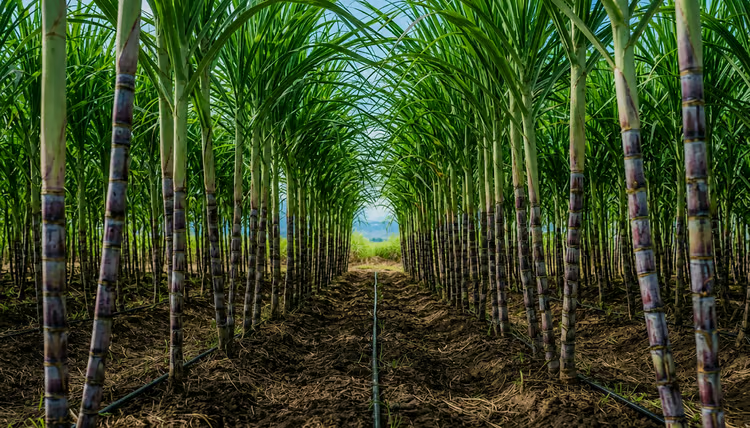
In sugarcane cultivation, drip lines are generally installed along the crop rows. Emitters release controlled amounts of water at specific intervals. Instead of flooding the entire field, the system focuses irrigation around the areas where the sugarcane root system can access moisture.
The basic principle is simple:
Water source → Pump → Filtration unit → Mainline → Sub-main → Drip laterals → Emitters → Sugarcane root zone
This approach allows farmers to control the amount and frequency of irrigation according to crop requirements, soil conditions, weather and crop growth stage.
Why Is Drip Irrigation Important for Sugarcane?
Sugarcane has a relatively long growing period and requires consistent moisture for healthy vegetative growth and stalk development. Both insufficient irrigation and excessive irrigation can affect crop performance.
Flood irrigation can distribute water unevenly across a field. Some areas may receive excessive water while other areas may receive less than required. Water may also be lost through surface runoff, evaporation and deep drainage.
Drip irrigation addresses these challenges by applying water close to the crop root zone.
Important advantages include:
- Better control over irrigation
- More uniform water distribution
- Reduced surface runoff
- Reduced unnecessary wetting of the field
- Improved fertilizer application through fertigation
- Better moisture management
- Reduced weed growth between rows when compared with full-field irrigation
- Easier irrigation scheduling
- Potential improvement in water-use efficiency
- Better suitability for automated irrigation systems
The actual results depend on soil type, climate, system design, crop variety, planting method, irrigation management and maintenance.
How Does Drip Irrigation Work in Sugarcane Fields?
A sugarcane drip irrigation system consists of several components working together.
Water Source
The water may come from a farm pond, borewell, open well, canal storage system or another suitable irrigation source.
Before installing the system, farmers should evaluate water availability and water quality. Water containing excessive suspended particles, salts or other contaminants may require appropriate treatment.
Pumping Unit
A pump supplies water from the source to the irrigation network.
The pump should be selected according to:
- Required discharge
- Total field area
- Pipe length
- Elevation difference
- Operating pressure
- Number of irrigation zones
Correct pump sizing helps maintain the required pressure throughout the system.
Filtration Unit
Filtration is one of the most important parts of a drip irrigation system.
Drip emitters have small water passages that can become blocked by:
- Sand
- Silt
- Algae
- Organic matter
- Other suspended particles
Depending on the water source, farmers may use screen filters, disc filters, sand media filters or combinations of filtration equipment.
Mainline and Sub-main
The mainline transports filtered water from the source toward the field. Sub-main pipes distribute water to different sections or irrigation zones.
Proper pipe sizing helps maintain suitable pressure and reduces unnecessary pressure losses.
Drip Laterals
Drip laterals are smaller pipes installed along or near sugarcane rows.
These laterals contain emitters that release water at controlled rates.
Emitters
Emitters regulate water delivery to the soil.
Emitter selection depends on factors such as:
- Soil type
- Crop spacing
- Lateral spacing
- Required discharge
- Field slope
- Irrigation duration
A properly designed system should provide relatively uniform water distribution across the field.
Benefits of Drip Irrigation in Sugarcane Cultivation
1. Efficient Water Application
One of the major reasons farmers choose drip irrigation is better control over water application.
Instead of applying a large volume of water across the entire field, drip irrigation supplies water gradually near the crop root zone.
This can help reduce avoidable water losses when compared with poorly managed surface irrigation.
2. Better Root-Zone Moisture Management
Sugarcane requires adequate moisture for active growth. Maintaining suitable moisture near the root zone helps create a more favorable environment for root activity.
Drip irrigation allows farmers to apply smaller amounts of water at more frequent intervals rather than relying only on occasional heavy irrigation.
3. Improved Fertilizer Application Through Fertigation
Drip irrigation can be combined with fertigation.
Fertigation means applying soluble fertilizers through the irrigation system.
Instead of applying all fertilizer at once, nutrients can be delivered in smaller quantities according to the crop’s requirements and recommended fertilizer program.
Potential advantages include:
- More controlled nutrient application
- Better nutrient distribution
- Reduced manual fertilizer application
- Ability to synchronize irrigation and nutrient delivery
Farmers should use only fertilizers and concentrations that are compatible with their irrigation equipment and follow agronomic recommendations.
4. Reduced Weed Growth in Some Areas
Since drip irrigation primarily wets the soil near the crop root zone, areas between crop rows may receive less moisture than under flood irrigation.
This can reduce favorable conditions for some weeds.
However, drip irrigation does not eliminate weeds completely. Weed management is still necessary.
5. Easier Irrigation Scheduling
Drip irrigation makes it easier to divide a field into irrigation zones and schedule irrigation according to crop requirements.
Farmers can adjust:
- Irrigation frequency
- Irrigation duration
- Irrigation zones
- Fertigation schedules
This provides greater control over field water management.
6. Potential Improvement in Sugarcane Productivity
When water and nutrients are managed appropriately, drip irrigation can support uniform crop development and healthy stalk growth.
However, drip irrigation alone does not guarantee higher yield. Variety selection, soil fertility, planting material, pest management, weed control, weather and overall crop management also have major effects.
7. Reduced Labor for Irrigation
Once the system is properly installed, farmers may spend less time manually moving water through different parts of the field.
Automation can further reduce routine irrigation labor.
8. Better Suitability for Fertilizer and Water Management
Combining drip irrigation with fertigation creates an integrated system for managing water and nutrients.
This can be particularly useful for commercial sugarcane production where precise crop management is important.
Drip Irrigation Layout for Sugarcane
A typical sugarcane drip system may follow this arrangement:
Water Source
↓
Pump
↓
Filtration Unit
↓
Fertilizer/Fertigation Unit
↓
Mainline
↓
Sub-main
↓
Control Valves
↓
Drip Laterals
↓
Emitters
↓
Sugarcane Root Zone
The exact layout should be designed according to field size, topography, water source, soil characteristics and crop spacing.
How to Install Drip Irrigation in Sugarcane
Step 1: Study the Field
Before installation, examine:
- Field size
- Soil type
- Slope
- Water source
- Existing irrigation infrastructure
- Sugarcane row spacing
- Water quality
Field conditions determine the appropriate system configuration.
Step 2: Test the Water
Water quality can affect drip system performance.
Testing may help identify:
- Suspended solids
- pH
- Salinity
- Iron
- Other minerals
- Biological contaminants
The filtration and treatment requirements should be selected according to the water-quality analysis.
Step 3: Design Irrigation Zones
Large fields can be divided into smaller irrigation blocks.
Dividing the field into zones can help maintain suitable operating pressure and allow farmers to irrigate different sections systematically.
Step 4: Install the Filtration System
Install appropriate filtration equipment between the water source and the irrigation network.
Filtration should be sized according to the water source and system flow requirements.
Step 5: Install Mainline and Sub-main Pipes
Mainlines carry water from the filtration system to the field.
Sub-main pipes distribute water to individual sections.
Step 6: Install Drip Laterals
Place drip laterals according to the sugarcane planting pattern and recommended system design.
The laterals should be installed carefully to avoid:
- Sharp bends
- Mechanical damage
- Leakage
- Poor connections
Step 7: Flush the System
Before normal operation, flush the pipes to remove debris and installation material.
Flushing is also an important part of routine drip system maintenance.
Step 8: Check Pressure and Flow
Check different points in the field to ensure water is reaching the laterals properly.
If some areas receive significantly more or less water, the system may require adjustment.
Irrigation Scheduling for Sugarcane
There is no single irrigation schedule that is suitable for every sugarcane field.
The required irrigation frequency depends on:
- Soil type
- Temperature
- Rainfall
- Humidity
- Crop age
- Evapotranspiration
- Sugarcane variety
- Field conditions
- Root-zone moisture
- Drip system discharge
Sandy soils generally have lower water-holding capacity and may require more frequent irrigation than heavier soils.
Clay soils can retain more water but may require careful management to avoid prolonged waterlogging.
Farmers should avoid blindly following a fixed daily irrigation duration. Instead, irrigation should be adjusted based on crop and environmental conditions.
Water Requirement of Sugarcane Under Drip Irrigation
Sugarcane water requirement changes throughout its growth cycle.
The major stages include:
Germination and Establishment
During establishment, sufficient moisture is important for good germination and early root development.
The soil should not be allowed to become excessively dry around the planting zone.
Tillering Stage
This stage is important for the development of productive shoots.
Consistent moisture availability can support healthy tillering.
Grand Growth Stage
Sugarcane develops significant vegetative growth during the grand growth phase.
Water demand can become high during this period, especially under hot and dry weather conditions.
Maturity Stage
As the crop approaches maturity, irrigation management becomes increasingly important.
Excessive irrigation close to harvest may not always be desirable. Irrigation should be managed according to crop maturity, soil moisture and local agronomic recommendations.
Fertigation in Sugarcane Through Drip Irrigation
One of the major advantages of drip irrigation is the ability to combine irrigation with fertilizer application.
A fertigation system can deliver suitable soluble fertilizers through the irrigation network.
A general fertigation process includes:
- Start irrigation with clean water.
- Introduce the recommended fertilizer solution.
- Monitor the injection process.
- Complete fertilizer application.
- Flush the system with clean water.
Flushing after fertigation helps reduce fertilizer residue inside the pipes and emitters.
The fertilizer type, concentration and application frequency should be based on soil testing and crop recommendations.
Drip Irrigation and Sugarcane Yield
Farmers often ask whether drip irrigation increases sugarcane yield.
The answer depends on field conditions and management.
Drip irrigation can improve the efficiency of water and nutrient application, which may support healthier and more uniform crop growth.
However, yield depends on many factors:
- Quality of planting material
- Sugarcane variety
- Soil fertility
- Water availability
- Irrigation management
- Fertilizer management
- Weed control
- Pest and disease management
- Weather
- Harvest timing
Therefore, drip irrigation should be considered one part of an overall crop-management strategy.
Drip Irrigation for Sugarcane in Different Soil Types
Sandy Soil
Sandy soil drains water relatively quickly.
Drip irrigation can help by supplying water in smaller and more frequent applications.
The irrigation schedule should be carefully monitored to prevent moisture stress.
Loamy Soil
Loamy soils generally provide a favorable balance between drainage and water retention.
Drip irrigation can be managed according to crop demand and weather conditions.
Clay Soil
Clay soils can hold more water but may drain slowly.
Excessive irrigation can create poor aeration and waterlogging.
Shorter irrigation events with careful monitoring may be appropriate depending on field conditions.
How to Maintain a Sugarcane Drip Irrigation System
Regular maintenance is essential for reliable performance.
Clean Filters Regularly
Filters should be inspected and cleaned according to the water quality and manufacturer’s recommendations.
A clogged filter can reduce system performance.
Flush Laterals
Drip laterals should be flushed periodically to remove accumulated particles and deposits.
Check Emitters
Inspect emitters for:
- Blockage
- Damage
- Uneven discharge
- Leakage
Blocked emitters can create dry areas and uneven crop growth.
Inspect Pipes and Connections
Look for:
- Cracks
- Leakage
- Loose connectors
- Damaged pipes
- Animal or machinery damage
Monitor Pressure
Pressure should be checked at appropriate locations within the irrigation network.
Unexpected pressure differences may indicate blockage, leakage or improper system design.
Common Problems in Sugarcane Drip Irrigation
Emitter Clogging
This is one of the most common problems.
Possible causes include:
- Poor filtration
- Sediment
- Algae
- Fertilizer precipitation
- Mineral deposits
Appropriate filtration, flushing and water treatment can help reduce clogging.
Uneven Water Distribution
Uneven distribution can result from:
- Incorrect pressure
- Long laterals
- Blocked emitters
- Poor system design
- Field elevation differences
The system should be checked and adjusted when uneven irrigation is observed.
Excessive Irrigation
More water does not necessarily mean better sugarcane growth.
Excessive irrigation may increase:
- Water consumption
- Nutrient losses
- Waterlogging risk
- Disease-related problems in some conditions
Irrigation should be based on crop and soil requirements.
Insufficient Irrigation
If irrigation is too little or too infrequent, the crop can experience water stress.
Signs may include reduced growth, leaf rolling and poor crop development, although these symptoms can have other causes as well.
How to Improve Water Efficiency in Sugarcane
Farmers can improve water management by combining drip irrigation with good agricultural practices.
Use Soil Moisture Information
Soil moisture monitoring can help farmers determine when irrigation is actually needed.
Adjust Irrigation According to Weather
Hot, dry and windy conditions can increase crop water demand.
Rainfall should also be considered when planning irrigation.
Divide Large Fields Into Zones
Zone-based irrigation can improve operational control and pressure management.
Maintain the Filtration System
Good filtration is essential for maintaining emitter performance.
Use Fertigation Carefully
Applying nutrients through drip irrigation should follow recommended fertilizer programs.
Repair Leaks Quickly
Even small leaks can waste water over time and affect pressure distribution.
Drip Irrigation vs Flood Irrigation for Sugarcane
| Feature | Drip Irrigation | Flood Irrigation |
|---|---|---|
| Water delivery | Near root zone | Across field |
| Irrigation control | High | Generally lower |
| Water distribution | Can be highly uniform when designed correctly | Can vary across field |
| Fertigation | Possible | More difficult to control |
| Automation | Highly suitable | More limited |
| Surface wetting | Limited | Extensive |
| Initial investment | Higher | Usually lower |
| Maintenance | Requires regular maintenance | Different maintenance requirements |
| Water-use management | More precise | Often less precise |
The appropriate irrigation method depends on local conditions, available resources, farm economics and management capability.
Economic Considerations of Drip Irrigation in Sugarcane
Drip irrigation requires an initial investment for equipment and installation.
Typical cost components may include:
- Pumping equipment
- Filters
- Mainline
- Sub-main
- Drip laterals
- Valves
- Fertigation equipment
- Connectors
- Installation
- Automation equipment, if used
The economic benefit depends on:
- Installation cost
- Field size
- Water availability
- Crop yield
- Sugarcane price
- Labor savings
- Fertilizer management
- Government support or subsidy availability
- System lifespan
- Maintenance costs
Farmers should calculate the expected return based on their own field conditions rather than relying on a universal cost-benefit figure.
Is Drip Irrigation Suitable for Sugarcane?
Drip irrigation can be suitable for sugarcane where farmers need greater control over irrigation and nutrient application.
It can be particularly useful when:
- Water availability is limited
- The field requires controlled irrigation
- Fertigation is desired
- Labor for irrigation is a concern
- Water-use efficiency is an important goal
- The farmer wants to introduce irrigation automation
However, proper design and maintenance are essential.
Best Practices for Drip Irrigation in Sugarcane
For effective sugarcane drip irrigation, farmers should follow several basic principles:
- Test irrigation water before designing the system.
- Select suitable filtration equipment.
- Design the system according to field size and topography.
- Use appropriate drip laterals and emitters.
- Monitor soil moisture.
- Adjust irrigation according to weather.
- Flush the system regularly.
- Clean filters according to operating conditions.
- Inspect emitters regularly.
- Use fertigation according to soil and crop recommendations.
- Repair leaks immediately.
- Monitor pressure across irrigation zones.
- Keep maintenance records.
- Avoid excessive irrigation.
- Review the system periodically as the crop and field conditions change.
Role of Automation in Sugarcane Drip Irrigation
Modern drip irrigation systems can be combined with automation.
Automation may include:
- Automatic valves
- Timers
- Soil moisture sensors
- Pressure sensors
- Flow meters
- Fertigation controllers
- Remote monitoring systems
Automation can help farmers manage irrigation more systematically.
For larger farms, sensor-based irrigation can provide information about soil moisture and environmental conditions, allowing irrigation decisions to be based on actual field conditions rather than a fixed schedule.
Drip Irrigation for Sugarcane in India
India has a large sugarcane-growing area, and irrigation management is important because sugarcane requires substantial water over its long growing period.
Different sugarcane-producing regions have different:
- Soil types
- Rainfall patterns
- Temperatures
- Water availability
- Planting seasons
- Sugarcane varieties
- Agricultural practices
Therefore, drip irrigation systems should be customized to regional and farm-level conditions.
In regions where groundwater availability is declining or irrigation water is limited, improving water-use efficiency can become particularly important.
Farmers should also check applicable state and central government micro-irrigation programs before purchasing a system because subsidy rules, eligibility and application procedures can change.
How to Choose a Drip Irrigation System for Sugarcane
When selecting a drip irrigation system, farmers should evaluate more than just the purchase price.
Important considerations include:
System Design
The system should be designed specifically for the field rather than using a generic layout.
Filtration Quality
Good filtration is essential for maintaining emitter performance.
Emitter Performance
The emitter should provide suitable discharge and distribution characteristics for the field.
Pipe Quality
Mainlines, sub-mains and laterals should be suitable for agricultural irrigation conditions.
Technical Support
Installation support and after-sales service can be important for long-term operation.
Availability of Spare Parts
Filters, connectors, valves and other components should be readily available when replacements are needed.
Warranty
Farmers should understand warranty terms before purchasing the system.
Frequently Asked Questions About Drip Irrigation in Sugarcane
What is drip irrigation in sugarcane?
Drip irrigation in sugarcane is a method of supplying controlled amounts of water directly near the crop root zone through drip laterals and emitters. It helps farmers manage irrigation more precisely than many traditional surface-irrigation methods.
Is drip irrigation good for sugarcane?
Drip irrigation can be beneficial for sugarcane because it allows controlled water application near the root zone and can also support fertigation. Results depend on proper system design, irrigation scheduling, crop management and maintenance.
How often should sugarcane be irrigated through drip?
There is no universal irrigation frequency. It depends on soil type, weather, crop growth stage, rainfall, evapotranspiration and system discharge. Farmers should adjust irrigation based on soil moisture and crop requirements.
Can fertilizer be applied through sugarcane drip irrigation?
Yes. Suitable soluble fertilizers can be applied through a properly designed drip system using fertigation. Fertilizer selection and application rates should follow soil-test results and crop recommendations.
Does drip irrigation save water in sugarcane?
Drip irrigation can improve water-use efficiency by applying water directly around the crop root zone and reducing some losses associated with surface irrigation. The actual water savings depend on system design, irrigation scheduling, field conditions and management.
What causes drip emitters to clog in sugarcane fields?
Emitter clogging can result from suspended particles, algae, mineral deposits or fertilizer precipitation. Proper filtration, regular flushing and appropriate water-quality management can help prevent clogging.
How can farmers maintain a sugarcane drip irrigation system?
Farmers should regularly clean filters, flush laterals, inspect emitters, check pressure, identify leaks and maintain valves and connectors. Regular maintenance helps maintain uniform water distribution.
Can drip irrigation increase sugarcane yield?
Properly managed drip irrigation can support suitable moisture and nutrient management and may contribute to improved crop performance. However, yield depends on many factors, including variety, soil fertility, weather, planting material, pest management and overall farm practices.
Is drip irrigation suitable for all sugarcane soils?
Drip irrigation can be used across different soil types, but the system design and irrigation schedule should be adjusted according to soil water-holding capacity, drainage and crop requirements.
What is fertigation in sugarcane?
Fertigation is the application of suitable soluble fertilizers through an irrigation system. In sugarcane, drip fertigation can allow nutrients to be supplied in a controlled manner along with irrigation water.
Final Thoughts
Drip irrigation in sugarcane provides farmers with a practical way to improve control over water and nutrient application. Instead of distributing water broadly across the entire field, the system delivers controlled irrigation close to the crop root zone.
The major advantages can include improved irrigation control, better water-use management, fertigation capability, reduced unnecessary surface wetting and easier automation. However, the success of a drip irrigation system depends heavily on correct design, installation, filtration, irrigation scheduling and regular maintenance.
For sugarcane farmers, the best approach is to consider the complete irrigation system rather than focusing only on drip pipes. Water quality, soil type, crop spacing, field topography, irrigation demand and fertilizer management should all be considered before installation.
With appropriate planning and management, drip irrigation can become an important component of efficient and modern sugarcane cultivation.