Introduction
Potato is one of the most important vegetable crops grown across India and many other agricultural regions. It is cultivated for fresh consumption, food processing, chips, French fries, starch production and several other applications. Because potatoes develop underground tubers, proper water management is extremely important throughout the growing season.
Both insufficient irrigation and excessive irrigation can affect potato production. Water stress can reduce tuber development, while excess water may create poor soil conditions, encourage diseases and reduce tuber quality. This is why farmers are increasingly interested in efficient irrigation methods that deliver water directly to the crop root zone.
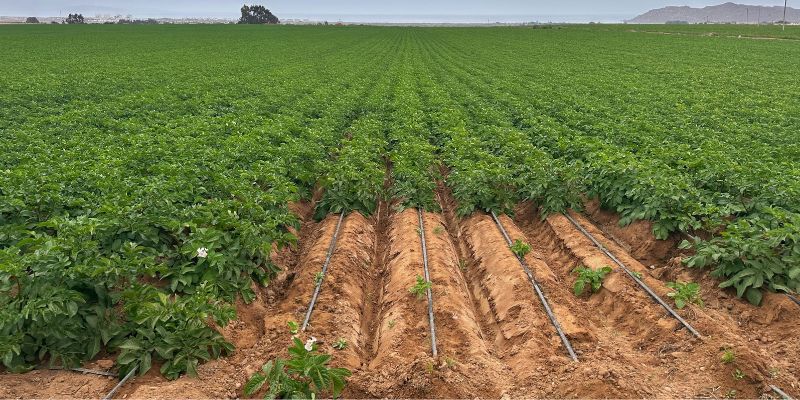
Drip irrigation in potato farming is an efficient method of supplying controlled amounts of water near the plant roots. Instead of distributing large quantities of water across the entire field, a drip system applies water gradually and uniformly through emitters or drippers.
With proper installation and management, drip irrigation can help farmers improve water-use efficiency, maintain suitable soil moisture, support uniform tuber development and apply fertilizers more efficiently through fertigation.
This guide explains how drip irrigation works for potatoes, its major benefits, irrigation scheduling, system components, fertigation, installation considerations, common mistakes and frequently asked questions.
What Is Drip Irrigation for Potato Crops?
Drip irrigation is a micro-irrigation technique that delivers water slowly and directly to the root zone of crops.
For potato cultivation, drip lines can be positioned along the crop rows so that water reaches the soil close to the developing root system. Depending on the field layout and irrigation system, drip lines may be installed on or near the soil surface or placed below the soil.
The basic system generally consists of:
- Water source
- Pumping unit
- Mainline
- Sub-mainline
- Filters
- Pressure regulators
- Fertilizer injection or fertigation equipment
- Drip laterals
- Emitters or drippers
- Valves and connectors
The objective is to maintain suitable moisture around the potato root zone without continuously flooding the field.
Why Water Management Is Important in Potato Farming
Potatoes have relatively shallow roots compared with some deep-rooted crops. Their productivity is strongly influenced by soil moisture conditions.
During the crop cycle, potatoes require adequate moisture for:
- Sprouting and establishment
- Vegetative growth
- Root development
- Tuber initiation
- Tuber bulking
- Maturity
The tuber initiation and bulking stages are particularly important for marketable production.
Water stress during important growth stages can affect the number and size of tubers. On the other hand, excessive irrigation can result in waterlogging, nutrient losses and unfavorable conditions for root and tuber health.
An efficient irrigation system should therefore provide the crop with the right amount of water at the right time.
How Does Drip Irrigation Work in Potato Farming?
The working principle is simple.
Water is pumped from the source and passes through filtration equipment. The filtered water travels through the mainline and sub-mainlines before reaching drip laterals installed along potato rows.
Small emitters release water at controlled rates.
Instead of applying water over the complete soil surface, drip irrigation focuses moisture near the crop root zone.
A typical sequence is:
Water Source → Pump → Filter → Mainline → Sub-mainline → Drip Lateral → Emitters → Potato Root Zone
This controlled application helps reduce unnecessary water movement and allows farmers to manage irrigation according to soil type, crop stage, weather and field conditions.
Major Benefits of Drip Irrigation in Potato Farming
1. Efficient Water Use
One of the biggest advantages of drip irrigation is improved water-use efficiency.
Traditional surface irrigation may distribute water across areas where potato roots do not need the same amount of moisture. Drip irrigation delivers water closer to the root zone.
This can help reduce unnecessary water application and make better use of available irrigation resources.
Water savings will vary depending on soil type, climate, irrigation management, field design and the previous irrigation method. Therefore, farmers should avoid assuming a fixed percentage of savings for every field.
2. Better Soil Moisture Management
Potato plants perform better when soil moisture remains within an appropriate range.
Drip irrigation allows farmers to apply smaller quantities of water more frequently instead of giving large amounts of water at long intervals.
This can help maintain a more stable moisture environment around the root zone.
3. Supports Uniform Tuber Development
Uniform moisture availability can support more consistent tuber development.
Potatoes need adequate water during tuber initiation and bulking. Irregular moisture conditions may contribute to uneven growth and variations in tuber size.
A properly designed drip system can distribute water more uniformly across the crop rows.
4. Fertigation Becomes Easier
Drip irrigation can be combined with fertigation.
Fertigation means applying soluble nutrients through irrigation water.
Instead of applying all nutrients at once, farmers can divide nutrient applications according to crop requirements and growth stages.
This can improve nutrient-use efficiency when the system is properly designed and managed.
5. Reduced Wetting of Foliage
Because drip irrigation applies water near the soil rather than spraying the entire crop canopy, it can reduce unnecessary wetting of potato leaves.
This can be beneficial for crop management, particularly in conditions where prolonged leaf wetness can favor certain foliar diseases.
However, drip irrigation does not eliminate disease risk. Crop rotation, seed quality, field sanitation, weather management and appropriate plant protection practices remain important.
6. Reduced Weed Growth Between Rows
Drip irrigation generally wets a smaller area of soil than flood irrigation.
Because the entire field surface does not receive the same amount of water, weed germination in dry areas may be reduced.
However, weeds can still develop within the wetted zone and between rows depending on soil conditions and field management.
7. Better Fertilizer Management
Drip irrigation allows nutrients to be supplied closer to the active root zone.
This can help farmers manage nutrients more precisely when fertilizer compatibility, concentration and application timing are properly controlled.
8. Reduced Soil Erosion
Compared with high-volume surface irrigation, controlled drip application can reduce soil movement and erosion caused by fast-moving water.
This is particularly useful in fields where excessive surface water movement is a concern.
9. Suitable for Different Field Conditions
Drip systems can be designed for different field sizes and layouts.
With proper hydraulic design, filtration and pressure management, drip irrigation can be adapted to many potato-growing fields.
Important Growth Stages for Potato Irrigation
Potato irrigation should be adjusted according to the crop growth stage.
Stage 1: Planting and Sprouting
After planting, the soil should have enough moisture to support sprouting and early root development.
Excessive irrigation should be avoided because saturated soil can create unfavorable conditions for developing roots and seed pieces.
Stage 2: Vegetative Growth
During vegetative growth, the plant develops leaves, stems and roots.
The crop requires adequate moisture to maintain healthy growth. Irrigation frequency should be adjusted according to soil type, temperature, rainfall and plant development.
Stage 3: Tuber Initiation
Tuber initiation is a critical stage.
The plant begins developing underground tubers, and moisture stress can negatively affect tuber formation.
Maintaining appropriate soil moisture during this period is therefore important.
Stage 4: Tuber Bulking
During tuber bulking, the developing potatoes increase in size.
This is one of the most important stages for irrigation management. Consistent moisture can support tuber expansion and help maintain marketable quality.
Stage 5: Maturity
As the crop approaches maturity, irrigation requirements generally change.
Irrigation may need to be reduced or stopped before harvesting depending on crop maturity, soil conditions, weather and harvesting requirements.
The exact timing should be determined based on local agronomic conditions rather than following one fixed schedule for every farm.
Drip Irrigation Schedule for Potato
There is no single irrigation schedule that works for every potato field.
Irrigation requirements depend on:
- Soil type
- Temperature
- Humidity
- Rainfall
- Crop growth stage
- Plant population
- Evapotranspiration
- Dripper discharge
- Drip-line spacing
- Field slope
- Root-zone moisture
- Variety
- Local climate
Sandy soils generally hold less water and may require more frequent irrigation with smaller applications.
Clay soils hold more water but may require careful irrigation management to avoid excessive moisture.
The best approach is to monitor soil moisture and crop condition and adjust irrigation accordingly.
Farmers can use soil-moisture monitoring tools, weather information and crop evapotranspiration data to improve irrigation scheduling.
How Much Water Does Potato Crop Need?
Potato water requirements vary throughout the crop cycle.
Instead of using one fixed quantity of water per day, irrigation should be calculated according to crop water demand.
A simplified concept is:
Crop Water Requirement = Reference Evapotranspiration × Crop Coefficient
The crop coefficient changes according to the crop growth stage.
For practical farm management, irrigation decisions should consider:
- Current soil moisture
- Recent rainfall
- Temperature
- Crop stage
- Evapotranspiration
- Dripper flow rate
- Irrigated area
This approach is more reliable than applying the same amount of water every day throughout the season.
Drip Line Placement for Potato Crops
Drip-line placement is an important part of system design.
The laterals should be positioned so that water reaches the effective root zone of the potato plants.
The exact spacing depends on:
- Potato row spacing
- Soil texture
- Dripper spacing
- Dripper discharge
- Root-zone characteristics
- System pressure
- Field layout
In lighter soils, water may move differently compared with heavier soils. Therefore, drip-line placement should be designed according to local soil conditions.
Improper placement can lead to dry areas or excessive wetting.
Dripper Selection for Potato Farming
Choosing suitable emitters is important for achieving uniform irrigation.
Important factors include:
- Dripper discharge
- Dripper spacing
- Pressure-compensating characteristics
- Filtration requirements
- Operating pressure
- Soil type
- Lateral length
The system should be hydraulically designed so that plants receive reasonably uniform water application throughout the field.
A professional irrigation-system designer can calculate the required pipe diameter, pressure, flow rate and number of irrigation zones.
Fertigation Through Drip Irrigation
One of the most useful features of drip irrigation is fertigation.
Potatoes require nutrients such as nitrogen, phosphorus and potassium, along with secondary and micronutrients depending on soil conditions and crop requirements.
Instead of applying all fertilizer at once, nutrients can be supplied through irrigation water in suitable doses.
Potential advantages include:
- Better nutrient placement
- Flexible fertilizer application
- Reduced nutrient wastage
- Improved nutrient availability
- Better synchronization between crop demand and nutrient supply
However, fertilizers used in drip systems must be compatible with irrigation water and equipment.
Poor-quality or incompatible fertilizers can cause clogging and system problems.
Fertigation Management for Potato Crops
A general fertigation strategy may divide nutrients across different growth stages.
Early Stage
The focus is on supporting root establishment and healthy vegetative growth.
Tuber Initiation
Nutrient management should support the transition from vegetative growth toward tuber formation.
Tuber Bulking
Potassium and other nutrients may have an important role in supporting crop development and tuber quality, but fertilizer recommendations should be based on soil testing and local agronomic recommendations.
Maturity
Nutrient applications should be adjusted as the crop approaches harvest.
Farmers should avoid excessive fertilizer application simply because fertigation makes frequent application easier.
The goal is balanced nutrition, not maximum fertilizer use.
Drip Irrigation and Potato Yield
Yield depends on many factors, including:
- Variety
- Seed quality
- Planting date
- Soil fertility
- Irrigation
- Fertilizer management
- Disease control
- Pest management
- Temperature
- Crop density
- Harvesting practices
Drip irrigation can contribute to better production by improving water management, but it should not be considered a guarantee of a particular yield.
The greatest benefit is achieved when irrigation, fertigation and crop management are planned together.
Drip Irrigation for Potato Farming in India
India is one of the major potato-producing countries, and potatoes are cultivated across several states with different soil and climatic conditions.
Potato-growing regions may experience different rainfall patterns, temperatures and irrigation availability.
Drip irrigation can be considered where farmers need better control over irrigation water.
The system can be especially useful where:
- Water availability is limited
- Irrigation costs are increasing
- Farmers need precise irrigation
- Fertigation is desired
- Surface irrigation causes uneven water distribution
- The field requires improved water management
However, system selection should always consider the local crop calendar, soil type and water quality.
Drip Irrigation in Potato Farming in Maharashtra
Maharashtra has diverse agricultural conditions and several areas where efficient irrigation practices are important.
For potato growers in Maharashtra, irrigation planning should consider local soil, temperature, rainfall and water availability.
A drip irrigation system can be designed according to the field size and potato row arrangement.
Before installation, farmers should evaluate:
- Water-source capacity
- Water quality
- Soil type
- Field dimensions
- Crop spacing
- Pump capacity
- Required filtration
- Irrigation zones
- Fertigation requirements
Local agricultural experts and irrigation professionals can help determine the appropriate system specifications.
Drip Irrigation in Potato Farming in Gujarat
Gujarat is another important agricultural region where efficient irrigation can help farmers manage available water resources.
Potato cultivation requires careful irrigation management, especially during periods of limited rainfall.
Drip irrigation can provide controlled water delivery and may also support fertigation.
Farmers should select system components based on field conditions rather than simply purchasing a standard system.
Drip Irrigation in Potato Farming in Uttar Pradesh
Uttar Pradesh is an important potato-producing region.
The irrigation strategy for potatoes in the region can vary according to soil, weather, planting time and water availability.
Drip systems can help growers deliver water directly near crop roots while reducing unnecessary wetting of the entire field.
The system should be adjusted according to local crop conditions and irrigation requirements.
Drip Irrigation in Potato Farming in West Bengal
Potato production in West Bengal also requires appropriate irrigation management.
Where water resources and field conditions make drip irrigation practical, farmers can use it to improve control over water application.
Proper filtration and maintenance become especially important when the irrigation water contains suspended particles or other materials that could clog emitters.
Factors to Consider Before Installing a Potato Drip System
Before installing drip irrigation, farmers should evaluate the following:
1. Water Source
Check whether the available water source can provide the required flow and pressure.
2. Water Quality
Water should be tested for:
- Suspended particles
- Salinity
- pH
- Hardness
- Iron
- Other clogging-related factors
3. Soil Type
Soil texture affects water movement and irrigation frequency.
4. Field Size
Large fields may need multiple irrigation zones.
5. Crop Spacing
Drip-line design should match the potato planting pattern.
6. Filtration
Proper filtration is essential for protecting emitters from clogging.
7. Fertigation
If fertilizers will be injected through the system, suitable fertigation equipment should be included in the design.
Maintenance of Drip Irrigation Systems
A drip irrigation system requires regular maintenance.
Important practices include:
- Clean filters regularly
- Check operating pressure
- Inspect laterals for leaks
- Check emitters for clogging
- Flush pipelines periodically
- Inspect valves and connectors
- Check fertilizer injection equipment
- Monitor water distribution
- Repair damaged pipes quickly
Regular maintenance helps maintain irrigation uniformity and extends system life.
Common Problems in Potato Drip Irrigation
Emitter Clogging
Clogging can result from sediment, algae, mineral deposits or unsuitable fertilizers.
Solution: Use appropriate filtration, regular flushing and suitable water-treatment practices.
Uneven Water Distribution
Uneven pressure or poorly designed pipe networks can cause some plants to receive more water than others.
Solution: Check hydraulic design, pressure and irrigation zones.
Over-Irrigation
More water does not necessarily mean better crop growth.
Solution: Monitor soil moisture and adjust irrigation according to crop demand.
Under-Irrigation
Insufficient water can cause plant stress and affect tuber development.
Solution: Monitor crop condition and soil moisture regularly.
Poor Fertigation
Incorrect fertilizer concentration or incompatible products can damage the irrigation system.
Solution: Use compatible fertilizers and follow recommended application practices.
Drip Irrigation vs Traditional Irrigation for Potatoes
| Feature | Drip Irrigation | Traditional Surface Irrigation |
|---|---|---|
| Water delivery | Controlled | Usually less controlled |
| Root-zone application | Direct | Broad field application |
| Fertigation | Easy to integrate | More difficult |
| Water distribution | Can be highly uniform with good design | May vary across field |
| Foliage wetting | Minimal | Can occur depending on method |
| Automation | Possible | Usually more limited |
| Initial investment | Higher | Often lower |
| Maintenance | Requires regular maintenance | Generally simpler |
| Water-use management | Precise | Less precise |
The right irrigation method depends on farm conditions, water availability, investment capacity and management skills.
How to Improve Potato Production with Drip Irrigation
Farmers can improve results by combining irrigation with good crop management.
Use Quality Seed
Healthy, quality planting material provides a strong foundation for crop establishment.
Maintain Appropriate Soil Moisture
Avoid both prolonged dryness and excessive saturation.
Monitor Crop Growth
Irrigation should change as the crop develops.
Use Soil Testing
Soil testing can help determine nutrient requirements.
Practice Balanced Fertigation
Apply nutrients according to crop demand and agronomic recommendations.
Maintain the System
A poorly maintained drip system cannot provide uniform irrigation.
Monitor Weather
Rainfall and temperature should influence irrigation decisions.
Is Drip Irrigation Suitable for Potato Farming?
Yes, drip irrigation can be suitable for potato farming when the system is properly designed, installed and managed.
It is particularly useful for growers who want better control over water application and fertigation.
However, the suitability of drip irrigation depends on:
- Water availability
- Farm size
- Soil conditions
- Crop spacing
- Investment budget
- Water quality
- Local climate
- Farmer management practices
A proper feasibility assessment should be completed before installation.
Cost of Drip Irrigation for Potato Farming
The cost of a potato drip irrigation system depends on several factors.
These include:
- Farm size
- Pipe length
- Dripper type
- Dripper spacing
- Filter system
- Pump requirements
- Fertigation equipment
- Automation
- Installation
- Water-source conditions
- Field layout
Therefore, there is no universal installation price for every farm.
Farmers should request a field-specific quotation after providing farm dimensions, crop spacing, water-source details and irrigation requirements.
How Drip Irrigation Supports Sustainable Potato Farming
Agriculture increasingly requires better management of water, nutrients and energy.
Drip irrigation can support sustainable potato production by allowing farmers to apply water more precisely.
Potential sustainability benefits include:
- Better water management
- Reduced unnecessary irrigation
- More precise fertilizer application
- Reduced surface runoff
- Better control of soil moisture
- Reduced water movement across non-root areas
Sustainability benefits depend heavily on proper design and management.
Future of Drip Irrigation in Potato Farming
Modern irrigation is increasingly moving toward data-driven crop management.
Future potato irrigation systems may combine:
- Soil-moisture sensors
- Weather stations
- Automated valves
- Smart controllers
- Remote monitoring
- Fertigation automation
- Mobile applications
- Crop monitoring technologies
These technologies can help farmers make irrigation decisions based on real-time field conditions rather than fixed schedules.
Smart irrigation can therefore become an important part of precision potato farming.
Frequently Asked Questions About Drip Irrigation in Potato Farming
1. Is drip irrigation good for potatoes?
Yes. Drip irrigation can be an effective method for potatoes because it delivers controlled water near the root zone. It can also be integrated with fertigation and help farmers manage soil moisture more precisely.
2. How often should potatoes be irrigated through drip irrigation?
There is no universal irrigation frequency. It depends on soil type, weather, crop stage, evapotranspiration, rainfall and dripper discharge. Irrigation should be based on actual crop and soil conditions.
3. Can drip irrigation increase potato yield?
Drip irrigation can support better crop growth and tuber development by improving water management. However, yield also depends on seed quality, variety, fertility, disease management, temperature and other agronomic factors.
4. Can fertilizer be applied through potato drip irrigation?
Yes. Fertilizers that are suitable and compatible with drip irrigation can be applied through fertigation equipment. Proper filtration and fertilizer compatibility are important to prevent clogging.
5. What type of drip line is suitable for potatoes?
The appropriate drip line depends on potato row spacing, soil type, dripper spacing, flow rate, field size and hydraulic design. A system should be selected according to the specific field rather than using the same specification everywhere.
6. Does drip irrigation reduce water use in potato farming?
Drip irrigation can improve water-use efficiency by applying water directly to the crop root zone. The actual water savings depend on the existing irrigation method, system design, soil, climate and management.
7. Is drip irrigation suitable for sandy soil?
Yes. Drip irrigation can be used in sandy soil, but irrigation may need to be more frequent because sandy soils generally have lower water-holding capacity. The irrigation schedule should be based on soil moisture and crop demand.
8. Can drip irrigation prevent potato diseases?
Drip irrigation does not prevent all potato diseases. However, because it generally avoids wetting the foliage, it may reduce conditions associated with prolonged leaf wetness for some diseases. Integrated crop protection is still necessary.
9. How important is filtration in potato drip irrigation?
Filtration is extremely important. Suspended particles and other contaminants can clog emitters. The filter type and filtration level should be selected according to the quality of the irrigation water.
10. What is fertigation in potato farming?
Fertigation is the application of dissolved fertilizers through an irrigation system. With drip irrigation, nutrients can be supplied near the active root zone according to crop requirements.
Conclusion
Drip irrigation in potato farming provides farmers with a controlled approach to water management. By delivering water close to the root zone, a properly designed drip system can help maintain suitable soil moisture, support tuber development and improve irrigation efficiency.
The benefits can be further enhanced when drip irrigation is combined with proper fertigation, soil testing, quality seed, balanced nutrition, crop monitoring and regular system maintenance.
There is no single irrigation schedule, drip-line spacing or fertilizer program that is suitable for every potato farm. Soil type, climate, crop stage, water quality, field size and local growing conditions must be considered before designing the system.
For farmers looking to improve water management in potato cultivation, drip irrigation can be an important component of modern and precision-based farming. With appropriate design, installation and management, it can help create a more controlled growing environment while supporting efficient use of valuable water and nutrients.