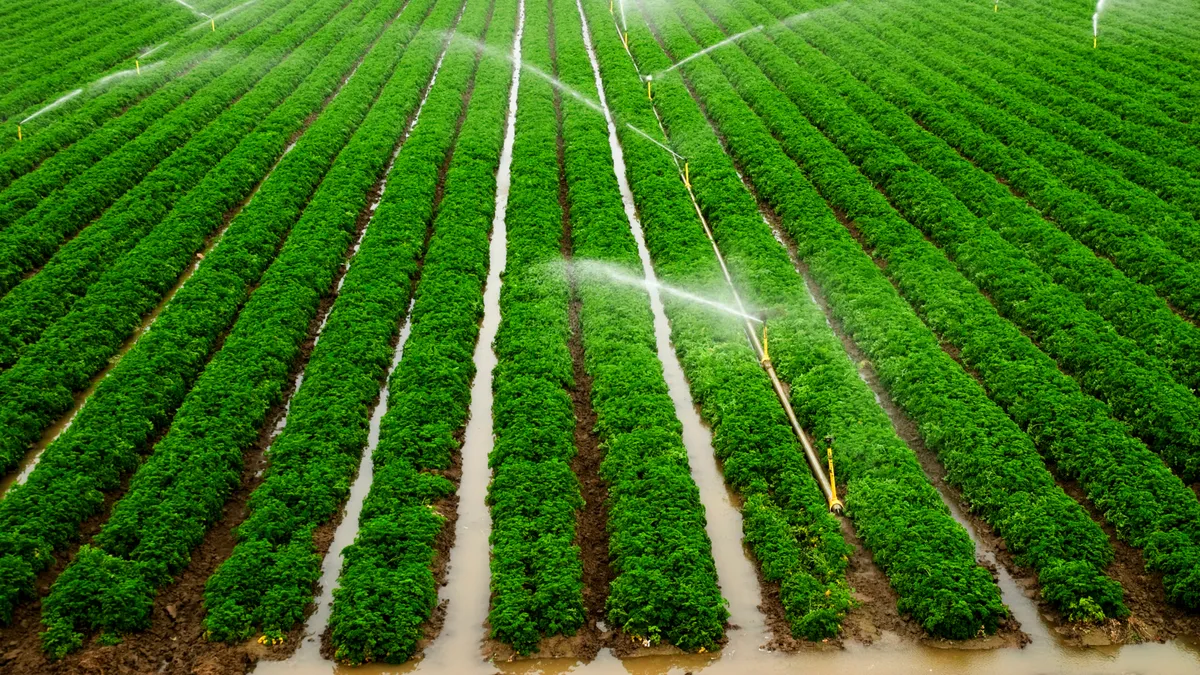
Modern agriculture needs better ways to manage water. Rainfall can be unpredictable, groundwater levels can change, and traditional irrigation methods may distribute more water than the crop actually needs. This is why micro irrigation has become an important solution for farmers, horticulture growers, nurseries, greenhouse operators, and commercial agricultural projects.
A properly designed micro irrigation system delivers water in a controlled way to the crop root zone. Depending on the crop and field conditions, the system can use drippers, micro sprinklers, foggers, or other low-flow emitters. Drip irrigation is one of the most widely used forms because it supplies water close to the plant roots.
For farmers looking for precise water application, a micro drip irrigation system can help create more controlled irrigation. It can also work with filtration and fertigation equipment to deliver water and soluble nutrients through the irrigation network.
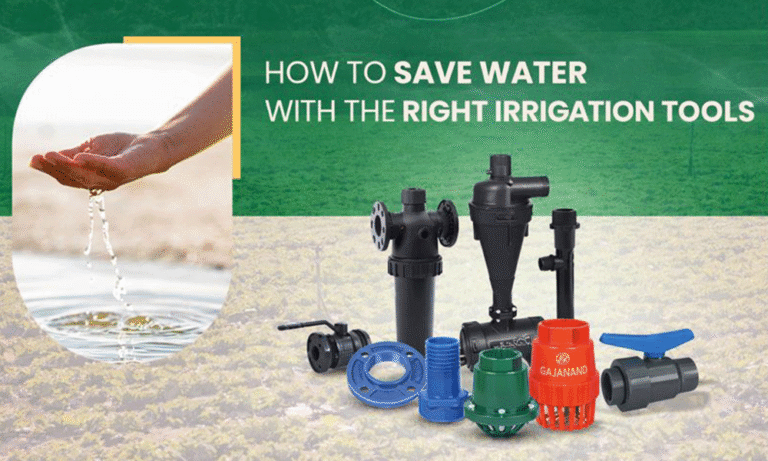
Gajanand Irrigation provides irrigation products and components designed for agricultural water-management applications, including filters, fertigation assemblies, valves, fittings, and other irrigation accessories.
What Is Micro Irrigation?
Micro irrigation is an irrigation approach in which water is applied to crops at a controlled flow rate and close to the plant or root zone. Instead of distributing large quantities of water over the entire field, the system focuses water application where it is needed.
Micro irrigation can include several technologies, such as:
- Drip irrigation
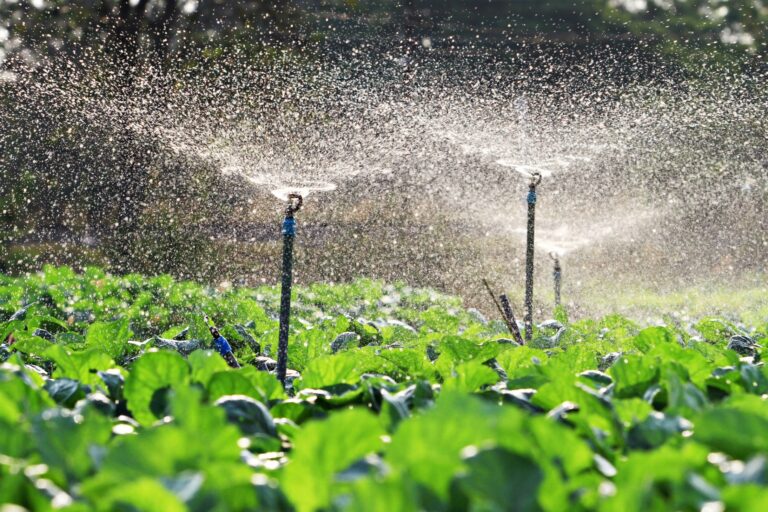
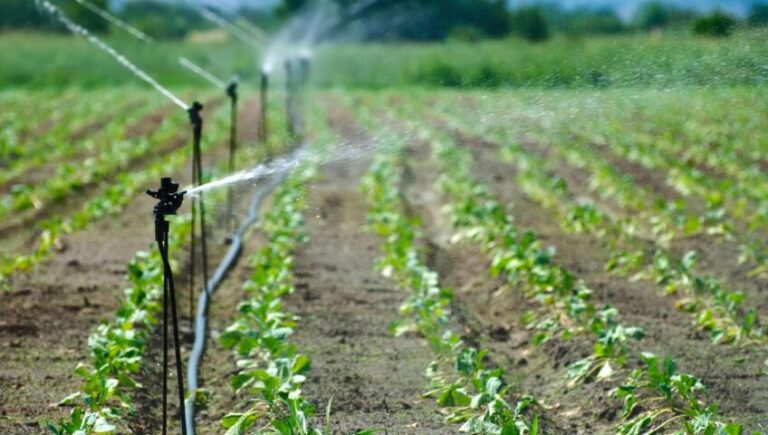
- Micro sprinkler irrigation
- Mini sprinkler irrigation
- Fogging systems
- Micro tubes
- Low-flow emitters
The exact system depends on the crop, soil, field layout, water source, climate, and irrigation requirement.
Tamil Nadu Agricultural University describes micro irrigation as a modern irrigation method using devices such as drippers, sprinklers, foggers, and other emitters to apply water on or below the soil surface.
The basic principle is simple:
Water source → filtration → pressure control → mainline → sub-main → lateral → emitter → crop root zone
This controlled approach can reduce unnecessary water application and help maintain more consistent soil moisture.
What Is a Micro Irrigation System?
A micro irrigation system is a complete network of equipment used to deliver water efficiently to crops.
It is not just a pipe or a dripper. A properly designed system contains multiple components that work together.
A typical system may include:
- Water source
- Pumping equipment
- Hydrocyclone or pre-filter
- Disc or screen filter
- Mainline
- Sub-mainline
- Control valves
- Pressure-regulation equipment
- Lateral pipes
- Drippers or micro sprinklers
- Flush valves
- Air-release valves
- Fertigation equipment
- Pipe fittings and connectors
The exact configuration depends on the size and requirements of the farm.
For example, a borewell supplying water with sand may require appropriate pre-filtration before water reaches the finer filtration stage. Gajanand Irrigation’s Hydrocyclone Filter is designed to separate heavy particles such as sand and sediment before water enters the rest of the irrigation network.
How Does a Micro Irrigation System Work?
The operation of a micro irrigation system follows a controlled sequence.
1. Water Collection
Water may come from a borewell, open well, reservoir, farm pond, canal, storage tank, or another suitable source.
2. Pumping
A pump may be used to provide the required pressure and flow. The pump selection should match the irrigation area and system design.
3. Filtration
Water passes through filtration equipment to remove particles that could block emitters.
This is particularly important for drip systems because emitters have small water passages.
4. Pressure Management
Pressure must remain within the required operating range of the irrigation components.
Excessive pressure can damage components, while insufficient pressure can result in poor water distribution.
5. Water Distribution
Filtered water travels through the mainline and sub-mainline before entering lateral pipes.
6. Controlled Application
Emitters or micro sprinklers distribute water around the crop.
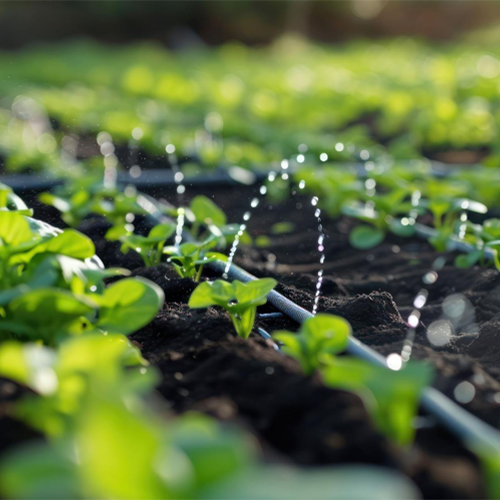
In a micro drip irrigation system, water is released slowly near the plant root zone.
7. Fertigation
Where suitable equipment and agronomic practices are used, soluble fertilizers can be introduced through the irrigation water.
This method is known as fertigation.
What Is a Micro Drip Irrigation System?
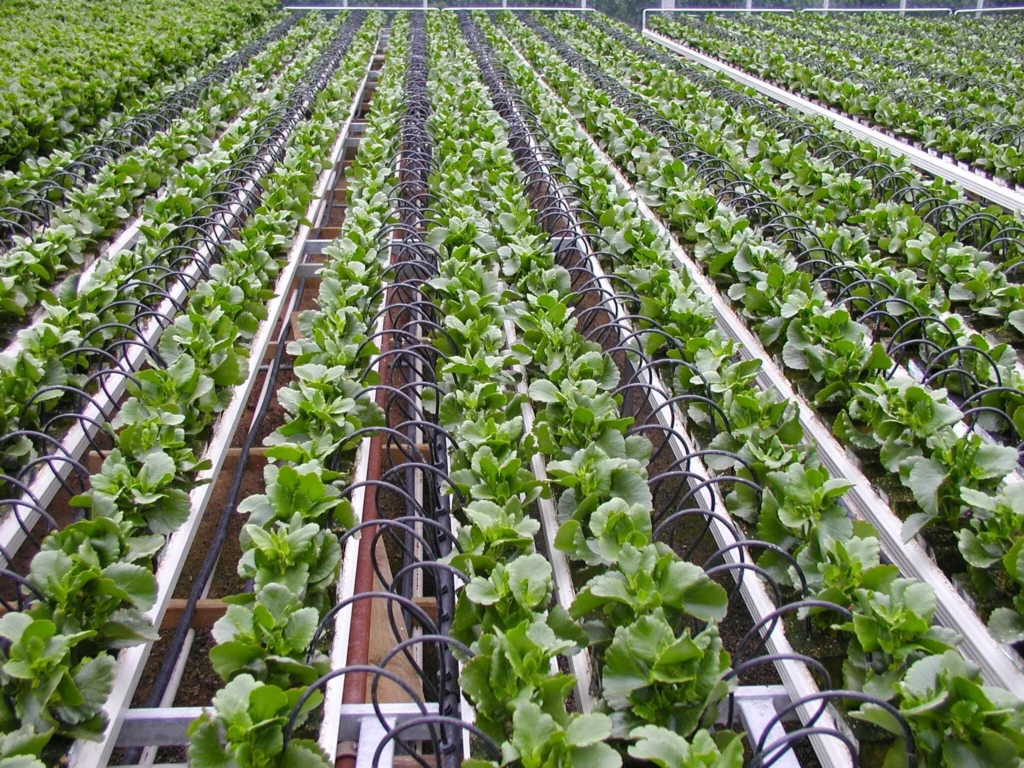
A micro drip irrigation system is a type of micro irrigation system that applies water through drip emitters positioned along irrigation laterals.
The water comes out slowly through small outlets. The objective is to maintain moisture around the crop’s active root zone instead of unnecessarily wetting the entire field.
Micro drip irrigation can be useful for crops with defined plant spacing.
Examples include:
- Vegetables
- Fruit crops
- Orchards
- Vineyards
- Cotton
- Sugarcane
- Banana
- Tomato
- Chilli
- Papaya
- Pomegranate
- Nursery plants
- Greenhouse crops
The correct emitter spacing and flow rate should be selected according to crop spacing, soil type, plant age, climate, and irrigation requirements.


5
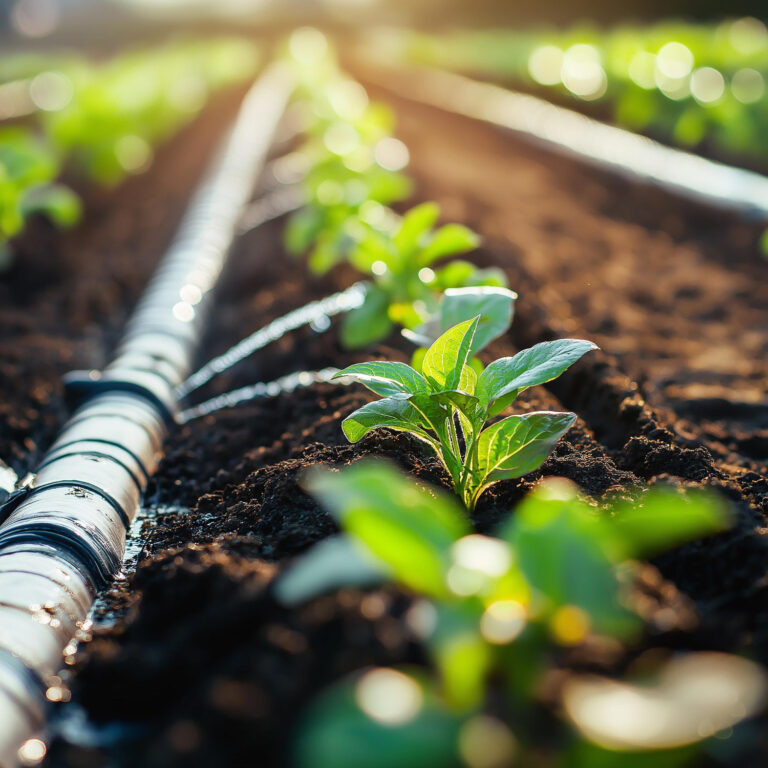
Suggested image caption: A micro drip irrigation system applying water close to the plant root zone.
Main Components of a Micro Drip Irrigation System
Water Source
The first component is the water source.
The source may be a:
- Borewell
- Open well
- Farm pond
- Canal
- Reservoir
- Water storage tank
Water quality should be considered before selecting filtration equipment.
Pump
A pump may be required to move water from the source to the field.
Pump capacity should be selected according to the required flow, pressure, elevation, pipeline length, and irrigation zones.
Hydrocyclone Filter
When irrigation water contains sand or other heavy particles, a hydrocyclone can be used as a pre-filtration stage.
It separates heavier particles through centrifugal action before water moves to downstream filtration equipment.
Read more about Hydrocyclone Filters for Drip Irrigation through Gajanand Irrigation’s dedicated resource. Hydrocyclone Filters for Drip Irrigation
Disc Filter
A disc filter is another important filtration component.
Gajanand Irrigation’s disc filters are designed for applications including drip irrigation, sprinkler and micro sprinkler irrigation, borewell and open-well irrigation, greenhouse irrigation, and high-density crop cultivation.
Good filtration helps reduce the risk of emitter clogging and supports consistent water flow.
See the available Disc Filters for Irrigation. Disc Filters for Irrigation
Mainline and Sub-Mainline
The mainline carries water from the filtration and control area toward the field.
Sub-mainlines distribute water to different irrigation sections.
Good hydraulic design helps maintain appropriate pressure and flow across the system.
Lateral Pipes
Laterals are smaller pipes that carry water closer to the plants.
Drippers or emitters are installed along the laterals according to crop spacing.
Drippers and Emitters
Emitters control the amount of water released near the plant.
Different crops require different emitter arrangements.
The selection should consider:
- Crop spacing
- Soil type
- Water requirement
- Plant age
- Field slope
- Operating pressure
- Irrigation frequency
Valves
Valves help control water movement.
A farmer can divide a field into different irrigation zones and operate them according to crop requirements.
Fertigation Assembly
Fertigation allows suitable soluble fertilizers to be introduced through irrigation water.
This can improve nutrient application efficiency when correctly designed and managed.
Gajanand Irrigation includes fertigation assembly among its irrigation product offerings.
Poly Fittings
Fittings connect different sections of the irrigation network.
Gajanand Irrigation’s poly fittings are designed for drip and sprinkler irrigation applications and are described as leak-resistant, weather-resistant, chemical-resistant, and easy to assemble.
Explore Poly Fittings for Irrigation Systems. Poly Fittings for Irrigation Systems
Benefits of Micro Irrigation
1. Better Water Management
The primary advantage of micro irrigation is controlled water application.
Water is delivered according to the design and irrigation schedule rather than flooding the complete field.
This makes it particularly useful in areas where water availability is limited.
2. Reduced Water Wastage
Traditional irrigation can involve runoff, evaporation, and deep percolation.
Micro irrigation can reduce unnecessary water application by targeting the crop’s root zone.
Government information on micro irrigation has reported substantially higher water-use efficiency for micro irrigation compared with conventional irrigation methods.
Actual savings depend on crop, soil, climate, system design, management, and the irrigation method being replaced.
3. Uniform Water Distribution
A properly designed system can provide more consistent water delivery across the crop area.
Uniform irrigation is important because plants receiving significantly different amounts of water may develop unevenly.
4. Improved Fertilizer Management
A micro irrigation system can be integrated with fertigation.
This allows suitable soluble nutrients to move through the irrigation network.
Correct fertilizer concentration, compatibility, filtration, and application scheduling are essential.
5. Reduced Weed Growth
Micro drip irrigation wets a smaller area around the crop compared with methods that wet the entire field.
Less unnecessary wetting can reduce the conditions that support weed growth between crop rows.
6. Lower Labour Requirements
Once installed correctly, a micro irrigation system can reduce the need for manual watering.
Farmers can operate different zones using valves and suitable controls.
7. Suitable for Different Field Conditions
Micro irrigation can be adapted to many farm layouts.
It can be used in:
- Orchards
- Vegetable fields
- Greenhouses
- Nurseries
- Row crops
- Plantations
- Horticultural farms
- Small farms
- Commercial farms
8. Supports Sustainable Agriculture
Efficient irrigation is an important part of sustainable agricultural water management.
The Indian government’s Per Drop More Crop programme continues to promote micro irrigation for improved water-use efficiency and agricultural productivity. A 2026 PIB backgrounder reported more than 115 lakh hectares under micro irrigation as of July 2026.
Micro Irrigation vs Traditional Irrigation
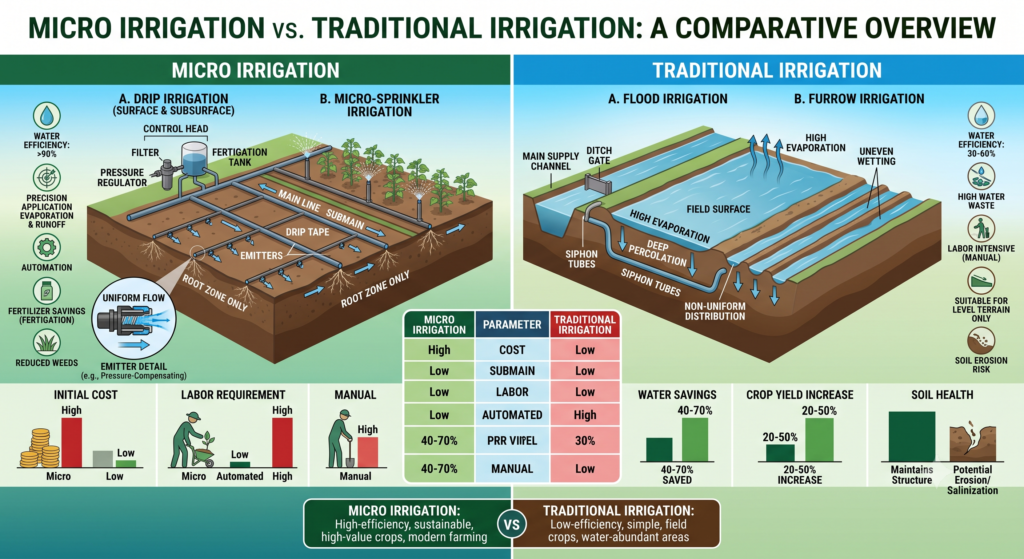
The main difference is how water is delivered.
| Feature | Traditional Surface Irrigation | Micro Irrigation |
|---|---|---|
| Water delivery | Broad field application | Controlled application |
| Root-zone targeting | Limited | High |
| Flow control | Lower | Higher |
| Water management | Less precise | More precise |
| Fertigation | More difficult | Easier to integrate |
| Automation | Limited | Easier to automate |
| Suitable crops | Many field crops | Crops with defined irrigation needs |
| Filtration requirement | Usually lower | Important for emitter-based systems |
Micro irrigation does not automatically guarantee better results. Good design, filtration, pressure management, irrigation scheduling, maintenance, and proper agricultural practices are all important.
Micro Irrigation for Different Crops
Different crops have different water requirements.
Vegetables
Tomato, chilli, cucumber, brinjal, capsicum, onion, and other vegetables can benefit from targeted irrigation.
Micro drip systems can place water close to individual plants or crop rows.
Fruit Crops
Fruit crops such as mango, pomegranate, papaya, and banana often have defined plant spacing.
This makes them suitable for carefully designed drip irrigation layouts.
Sugarcane
Sugarcane requires regular water availability during important growth stages.
A properly designed drip system can help manage water delivery along crop rows.
Cotton
Cotton can be cultivated using efficient irrigation methods where field conditions and system design are suitable.
Greenhouse Crops
Greenhouses require controlled irrigation because plants are grown in a managed environment.
Micro drip systems can provide precise water application to individual plants.
Nursery Plants
Nurseries contain plants of different sizes and spacing.
Micro irrigation can be configured to provide water according to plant requirements.
Importance of Filtration in Micro Irrigation
Filtration is one of the most important parts of an emitter-based irrigation system.
Water may contain:
- Sand
- Silt
- Algae
- Organic matter
- Mud
- Suspended particles
If these materials enter small emitter passages, clogging can occur.
Clogged emitters can create uneven irrigation.
For this reason, filtration should be selected according to the water source and system requirements.
Gajanand Irrigation provides filtration solutions including disc filters and other irrigation filtration products. Its disc-filter range is designed to remove impurities and support drip and sprinkler irrigation applications.

5
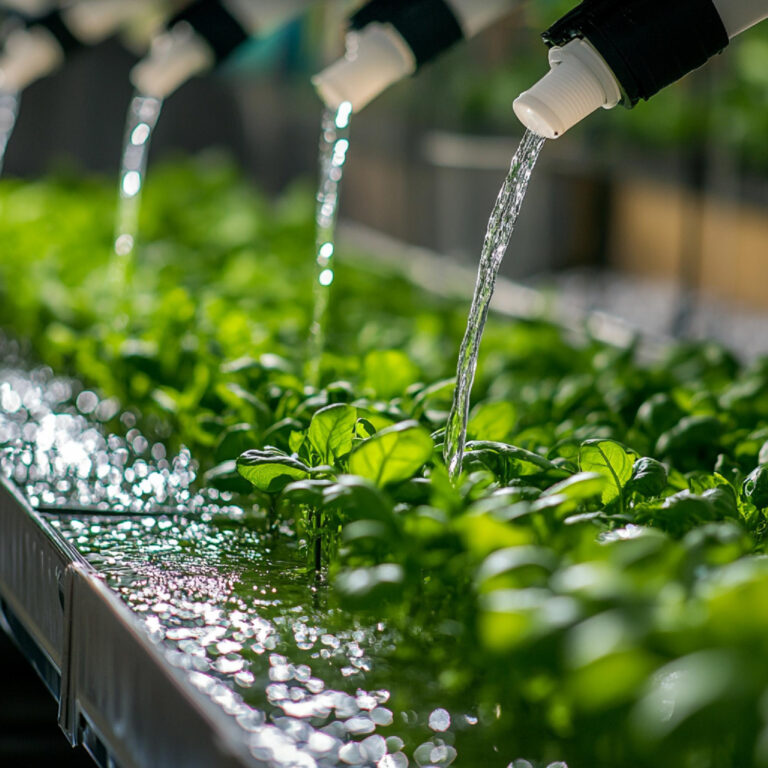
Suggested image caption: Filtration equipment helps protect micro irrigation systems from suspended particles.
You can also read Gajanand Irrigation’s guide comparing Disc Filter vs Screen Filter. Disc Filter vs Screen Filter for Irrigation
How to Choose the Right Micro Irrigation System
Choosing a micro irrigation system should not be based only on price.
Consider these factors first.
1. Crop Type
Identify the crop and its plant spacing.
A vegetable crop planted in rows may need a different layout from an orchard.
2. Soil Type
Sandy, loamy, and clay soils have different water movement characteristics.
The irrigation frequency and application rate should be adjusted accordingly.
3. Water Source
Test the water source before finalizing filtration.
Borewell water may have sand or mineral content, while surface water can contain organic particles and algae.
4. Field Size
The total field area determines the mainline, sub-mainline, lateral, filtration, pump, and zoning requirements.
5. Field Slope
Slope can influence pressure and water distribution.
Proper hydraulic planning becomes particularly important on uneven land.
6. Water Availability
The available water quantity and pumping schedule influence the size and operation of the system.
7. Filtration Requirements
Do not select filters only by appearance or price.
Consider:
- Water quality
- Flow rate
- Particle size
- Required filtration level
- Cleaning method
- System pressure
8. Future Expansion
If the farm may expand later, the system can be planned with future requirements in mind.
Installation Process of a Micro Irrigation System
A professional installation generally follows several stages.
Step 1: Field Survey
Study the field size, crop spacing, elevation, soil, water source, and available infrastructure.
Step 2: Water Testing
Check the water quality to identify filtration requirements.
Step 3: Hydraulic Design
Calculate the required flow and pressure.
Step 4: Filtration Setup
Install appropriate filtration equipment.
Step 5: Mainline Installation
Connect the water source and filtration unit to the mainline.
Step 6: Sub-Main Installation
Divide the field into suitable irrigation zones.
Step 7: Lateral Installation
Lay lateral pipes along crop rows.
Step 8: Emitter Installation
Install appropriate drippers or emitters based on crop spacing.
Step 9: Pressure Testing
Operate the system and check pressure and flow.
Step 10: Flushing
Flush pipelines before normal operation.
Step 11: Final Inspection
Check leaks, blocked emitters, pressure differences, and valve operation.
Maintenance Tips for Micro Drip Irrigation System
A micro drip irrigation system needs regular maintenance.
Clean Filters Regularly
Inspect and clean filters according to water quality and operating conditions.
Flush Laterals
Periodically flush lateral pipes to remove accumulated particles.
Check Emitters
Look for blocked or damaged emitters.
Inspect Connections
Check fittings and joints for leakage.
Gajanand Irrigation’s poly fittings are designed for reliable connections in irrigation networks.
Monitor Pressure
Pressure should be checked at suitable points in the system.
Unexpected pressure changes can indicate leaks, blockages, or hydraulic problems.
Check Valves
Make sure control and flushing valves operate correctly.
Protect Pipes
Prevent damage from machinery, animals, direct physical impact, and improper field operations.
Common Micro Irrigation Problems and Solutions
Problem: Uneven Water Distribution
Possible causes:
- Incorrect pressure
- Blocked emitters
- Incorrect pipe sizing
- Long lateral runs
- Field elevation differences
Solution: Check pressure, clean filters, flush laterals, and inspect the hydraulic design.
Problem: Frequent Emitter Clogging
Possible causes:
- Poor filtration
- Sand
- Organic matter
- Algae
- Mineral deposits
Solution: Review water quality and filtration requirements.
Problem: Low Water Flow
Possible causes:
- Blocked filter
- Pipeline leakage
- Pump problem
- Valve restriction
- Blocked laterals
Solution: Inspect the complete water path from the source to the emitter.
Problem: Water Leakage
Possible causes:
- Damaged pipe
- Loose fitting
- Incorrect connection
- Mechanical damage
Solution: Inspect fittings, laterals, valves, and mainline connections.
Micro Irrigation and Fertigation
One important advantage of a properly designed micro irrigation system is the ability to integrate fertigation.
Fertigation means applying suitable soluble fertilizers through irrigation water.
Instead of distributing fertilizer separately over a large area, nutrients can be carried with irrigation water toward the crop root zone.
However, fertigation should be managed carefully.
Important considerations include:
- Fertilizer solubility
- Water quality
- Compatibility
- Filtration
- Correct concentration
- Irrigation timing
- Crop nutrient requirements
- Proper flushing after application
A suitable fertigation assembly can make nutrient application more controlled.
Gajanand Irrigation lists Fertigation Assembly among its irrigation products.
Micro Irrigation for Water-Smart Farming in India
Water management is becoming increasingly important for Indian agriculture.
Farmers across Gujarat, Maharashtra, Rajasthan, Karnataka, Tamil Nadu, Andhra Pradesh, Telangana, Madhya Pradesh, Punjab, Haryana, and other agricultural regions may face different combinations of rainfall variability, groundwater pressure, soil conditions, and crop requirements.
A micro irrigation system can help farmers move from broad irrigation toward more controlled water application.
The exact result depends on system design and farm management.
India’s Per Drop More Crop programme promotes micro irrigation as part of water-efficient agricultural development.
For farmers in Gujarat and other regions, local field conditions should be considered when selecting irrigation components, filtration, pipe layouts, and irrigation schedules.
Why Gajanand Irrigation for Micro Irrigation Components?
Gajanand Irrigation is an Ahmedabad-based irrigation company with a product range covering important irrigation components.
Its catalog includes products such as:
- Screen filters
- Disc filters
- Fertigation assemblies
- Mini sprinklers
- Irrigation accessories
The company’s filtration products are designed for applications including drip irrigation, sprinkler irrigation, micro sprinkler irrigation, greenhouse irrigation, and other agricultural water-management applications.
For farmers, irrigation dealers, agricultural projects, and other buyers, selecting the correct component should always be based on the complete system requirement rather than one individual product.
View the complete Gajanand Irrigation product catalog. Gajanand Irrigation Catalog
For project-specific requirements, you can contact the Gajanand Irrigation team. Contact Gajanand Irrigation
Frequently Asked Questions About Micro Irrigation
What is micro irrigation?
Micro irrigation is a water-efficient irrigation method that applies water at controlled flow rates close to the crop or root zone. It includes systems such as drip irrigation, micro sprinklers, foggers, and other low-flow emitters.
What is a micro irrigation system?
A micro irrigation system is a complete network consisting of components such as a water source, pump, filters, pipelines, valves, laterals, and emitters. The system is designed to deliver controlled amounts of water to crops.
What is a micro drip irrigation system?
A micro drip irrigation system is a type of micro irrigation system that delivers water slowly through drip emitters installed along lateral pipes. It is commonly used for vegetables, fruit crops, orchards, nurseries, greenhouses, and row crops.
Does micro irrigation save water?
Micro irrigation can improve water-use efficiency because water is applied in a controlled way close to the crop root zone. The actual amount of water saved depends on the previous irrigation method, crop, soil, climate, system design, and management. Government sources report higher water-use efficiency for micro irrigation compared with conventional irrigation methods.
Why is filtration important in a micro drip irrigation system?
Filtration helps remove particles that can clog small emitter passages. The correct filter depends on the water source, flow rate, particle characteristics, and irrigation design.
Can micro irrigation be used for fertigation?
Yes. A properly designed system can be integrated with suitable fertigation equipment to apply compatible soluble nutrients through irrigation water. Fertigation should follow appropriate crop and fertilizer-management practices.
Conclusion
Micro irrigation is an important approach to modern agricultural water management. Instead of applying large amounts of water across the entire field, it focuses on controlled and targeted water delivery.
A complete micro irrigation system may include a pump, hydrocyclone or pre-filtration equipment, disc or screen filters, mainlines, sub-mainlines, valves, laterals, emitters, fittings, and fertigation equipment.
For crops that benefit from precise root-zone watering, a micro drip irrigation system can provide controlled water application through drip emitters. With proper design, filtration, pressure management, installation, and maintenance, the system can support efficient irrigation and better resource management.
The most important point is that there is no single system design for every farm. Crop type, soil, water source, field size, climate, topography, and irrigation requirements should all be considered before installation.
Gajanand Irrigation offers a range of irrigation components, including filtration products, fertigation assemblies, mini sprinklers, and irrigation accessories.
For farmers and agricultural projects planning an efficient irrigation network, selecting the right components and designing the system according to actual field conditions is the foundation of reliable irrigation.