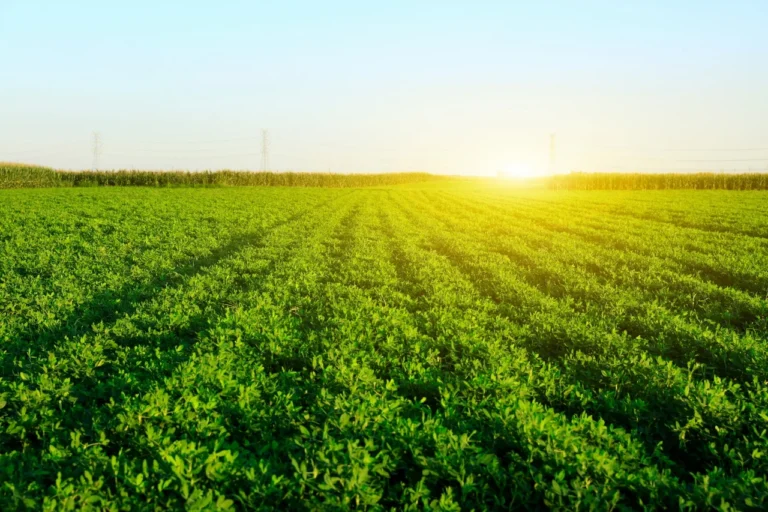
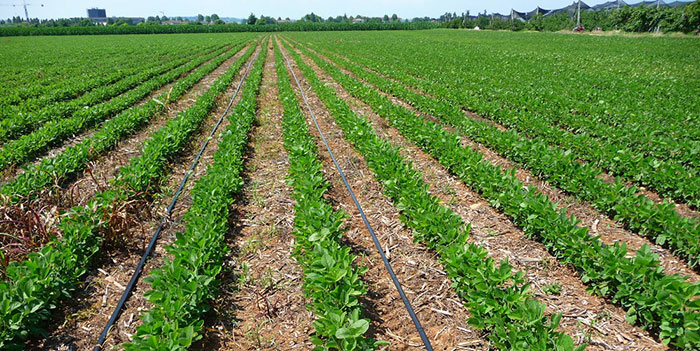
Soybean is an important oilseed and protein crop cultivated across many agricultural regions. Its productivity depends on several factors, including seed quality, soil condition, nutrient management, weather, pest control, and especially water management.
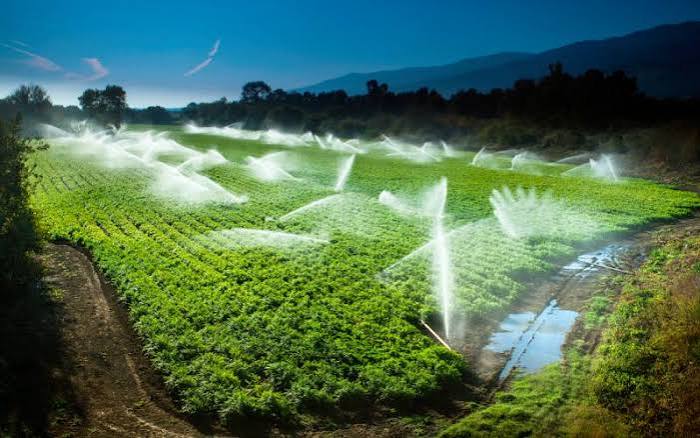
Although soybean can tolerate short periods of water stress, insufficient moisture during flowering, pod formation, and seed filling can affect pod development and final grain yield. Research and modern irrigation practices show that supplying water more precisely can help maintain suitable soil moisture and reduce unnecessary water losses.
Drip irrigation in soybean is a precision irrigation approach in which water is delivered gradually near the crop root zone through drip lines and emitters. Instead of applying a large quantity of water across the entire field at once, the system allows farmers to control irrigation according to soil, crop, weather, and growth-stage requirements.
For farmers looking for efficient soybean irrigation, drip irrigation can be considered where the field, water source, crop layout, economics, and system design are suitable.
Gajanand Irrigation provides irrigation products including drip-related components, filtration systems, pipes, fittings, valves, fertigation assemblies, and other irrigation accessories that can be used when designing an efficient agricultural irrigation system.
What Is Drip Irrigation in Soybean?
Drip irrigation is a method of delivering water directly and gradually to the soil around the crop root zone.
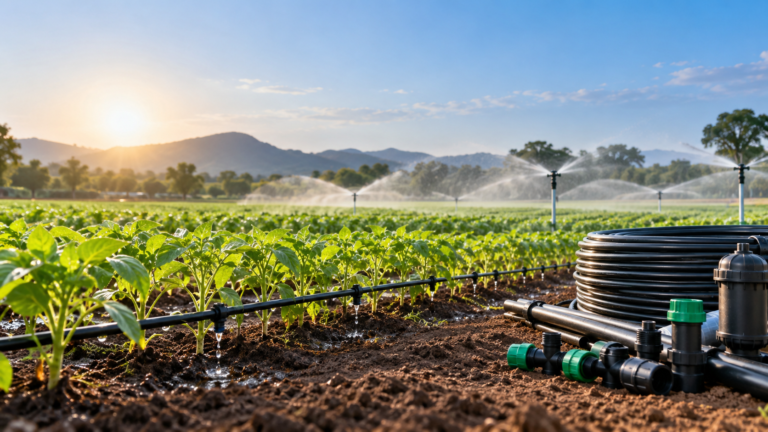
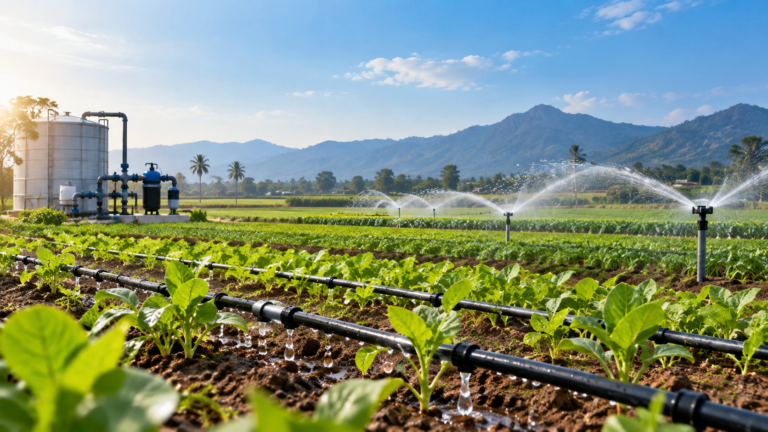
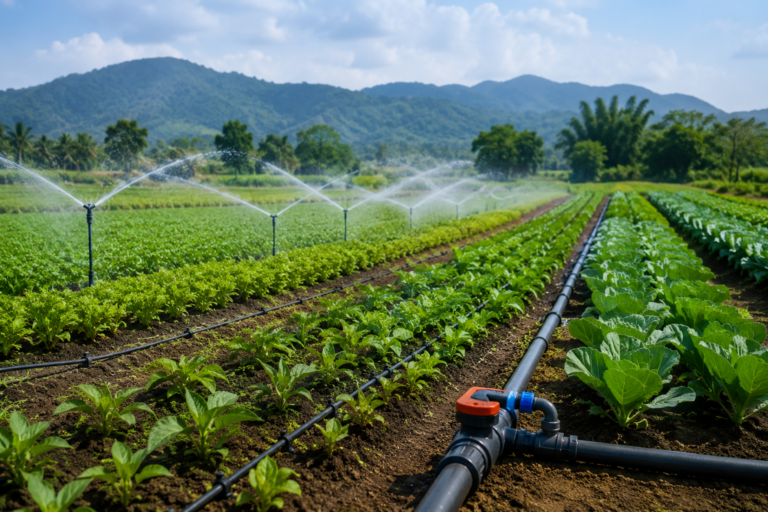
A typical drip irrigation system includes components such as:
- Water source
- Pumping system
- Mainline
- Sub-mainline
- Filters
- Valves
- Drip lines
- Emitters or drippers
- Connectors and fittings
- Fertigation equipment, where required
The water passes through the filtration and distribution system before reaching the drip lines. Emitters then release water at controlled rates.
This approach makes it possible to manage irrigation more precisely than simply flooding the entire field.
For soybean cultivation, the main objective is not to keep the soil continuously wet. Instead, the goal is to maintain suitable moisture in the root zone while avoiding unnecessary water application.
Why Is Irrigation Important for Soybean Cultivation?
Soybean requires adequate moisture throughout its growth cycle, but water demand and sensitivity can change from one stage to another.
Important stages include:
- Germination and establishment
- Vegetative growth
- Flowering
- Pod formation
- Seed filling
- Maturity
Water stress during flowering and pod development can be particularly important because inadequate moisture can reduce pod formation and affect seed development. SAB’s soybean irrigation guidance identifies flowering/fruit setting and pod filling as key periods when water availability is important.
This means irrigation management should focus not only on how much water is applied, but also on when the water is applied.
How Does Drip Irrigation Work in Soybean Fields?
The basic working process is straightforward.
1. Water enters the irrigation system
Water is taken from the available farm water source and supplied to the irrigation network.
2. Filtration removes unwanted particles
Filtration is important because suspended particles can enter irrigation lines and create emitter blockages.
Gajanand Irrigation offers products such as screen filters, disc filters, and hydrocyclone filters for agricultural irrigation applications.
Choosing the filtration arrangement should depend on the water source and the type of impurities present.
3. Water moves through the mainline and sub-mainlines
After filtration, water travels through the main distribution network toward different field sections.
4. Drip lines distribute water
Drip lines are positioned according to the crop layout and irrigation design.
5. Emitters release water near the root zone
The emitters release water gradually. This helps maintain moisture close to the active root zone rather than flooding the entire field.
6. Irrigation is adjusted according to field conditions
Farmers can adjust irrigation duration and frequency according to rainfall, soil moisture, crop growth stage, temperature, and other field conditions.
Major Benefits of Drip Irrigation in Soybean
1. Better Water Management
One of the primary advantages of drip irrigation is controlled water application.
Instead of applying water over the entire soil surface, water is delivered more precisely around the crop root zone.
This can help farmers manage limited water resources more effectively.
Gajanand Irrigation also describes drip irrigation as a method that can deliver water directly to the root zone while helping reduce evaporation, weed growth, and water wastage.
2. Helps Maintain Root-Zone Moisture
Soybean plants require suitable soil moisture for healthy growth.
Large fluctuations between very dry and excessively wet conditions can make water management difficult.
A properly designed drip system can provide smaller and more controlled applications, helping maintain a more stable moisture environment.
3. Supports Critical Growth Stages
Flowering, pod formation, and seed filling are important stages for soybean production.
SAB notes that water stress during flowering/fruit setting and pod filling can contribute to reduced pod formation, smaller seed size, and premature leaf drop.
With drip irrigation, farmers can focus irrigation on periods when maintaining adequate moisture is particularly important.
4. Reduces Water Loss
Traditional surface irrigation can result in water losses through runoff, evaporation, and uneven distribution.
Drip irrigation applies water gradually and close to the crop root zone.
The exact water saving will depend on soil type, system design, weather, irrigation scheduling, and the comparison method. Therefore, farmers should not assume one fixed percentage of water saving for every soybean farm.
5. Reduces Unnecessary Wetting
Drip irrigation does not normally wet the entire field surface in the same way as flood irrigation.
This can reduce unnecessary wetting between crop rows and may help control weed pressure.
However, weed management still requires proper field monitoring and should not rely on irrigation method alone.
6. Can Support Fertigation
Drip irrigation can also be integrated with fertigation when the irrigation system and fertilizer program are designed appropriately.
A fertigation system allows soluble nutrients to be delivered through irrigation water.
Gajanand Irrigation lists fertigation assemblies among its irrigation products.
Fertilizer compatibility, concentration, filtration, water quality, and crop requirements should always be considered before implementing fertigation.
7. Better Control on Uneven Fields
Fields are not always perfectly level.
Variations in terrain can cause uneven water distribution with some conventional irrigation methods.
A properly designed pressurized irrigation system can provide better control, although pressure management and hydraulic design remain important.
Drip Irrigation and Soybean Yield
One of the main reasons farmers consider drip irrigation is its potential effect on crop productivity.
Research and technical sources have reported positive effects from properly managed drip irrigation in soybean. For example, SAB reports that drip irrigation can help maintain a suitable soil moisture profile and notes productivity increases of up to 30% in some cases compared with traditional irrigation.
However, yield improvement is not guaranteed at a fixed percentage.
Actual soybean yield depends on:
- Variety
- Seed quality
- Soil fertility
- Weather
- Rainfall
- Irrigation scheduling
- Plant population
- Pest and disease management
- Weed control
- Fertilizer management
- Water quality
- Drip system design
- Field conditions
Therefore, drip irrigation should be viewed as one part of an integrated soybean production strategy.
What Recent Research Says About Drip Irrigation in Soybean
Recent research has also examined how drip irrigation affects soybean physiological performance under specific stress conditions.
A 2025 study published in Agricultural Water Management investigated drip irrigation under combined heavy-metal stress involving cadmium, lead, and chromium. The researchers reported improvements in soybean photosynthetic characteristics, light-use processes, growth, and yield under the conditions studied.
This is an important scientific finding, but the experiment involved a specific heavy-metal-stress environment. It should not be interpreted as evidence that the same yield response will occur on every soybean farm.
The broader lesson is that irrigation management can influence the plant’s water environment and physiological performance, particularly when crops face additional stresses.
Soybean Water Requirements and Irrigation Scheduling
There is no single irrigation schedule that is correct for every soybean field.
Water requirements vary according to:
- Soil texture
- Weather
- Rainfall
- Temperature
- Humidity
- Wind
- Crop variety
- Plant population
- Growth stage
- Root-zone moisture
- Field drainage
- Evapotranspiration
Some general references report seasonal soybean water requirements in the range of approximately 500–600 mm under particular production conditions, but actual irrigation requirements must account for effective rainfall and local conditions.
A farmer should therefore avoid following a fixed irrigation quantity without considering rainfall and soil moisture.
A Practical Approach
A simple irrigation decision process can be:
Check rainfall → Check soil moisture → Check crop stage → Check weather → Determine irrigation requirement → Run the system → Monitor the field
This approach is more useful than following a calendar-only irrigation schedule.
Drip Irrigation During Different Soybean Growth Stages
Germination and Early Establishment
During germination, adequate moisture is important for uniform emergence.
However, excessive irrigation can create problems such as poor aeration and unfavorable soil conditions.
The objective should be to maintain appropriate moisture without prolonged waterlogging.
Vegetative Growth
During vegetative development, soybean plants build leaves, stems, and root systems.
Irrigation should respond to actual soil moisture and weather conditions.
If rainfall has already supplied sufficient moisture, additional irrigation may not be necessary.
Flowering
Flowering is a critical stage for water management.
Moisture stress during this period can affect reproductive development.
This is a stage where irrigation monitoring becomes particularly important.
Pod Formation
Pod formation is another important period.
Maintaining suitable moisture can support pod development and reduce stress caused by insufficient water availability.
Seed Filling
During seed filling, the crop continues to require adequate moisture.
Water stress during this period can affect seed development and final seed size.
Maturity
As the crop approaches maturity, irrigation requirements generally change.
Excessive irrigation close to harvest can be unnecessary and may create field-management problems.
Irrigation should therefore be adjusted according to crop maturity, soil moisture, rainfall, and local agronomic recommendations.
How to Design a Drip Irrigation System for Soybean
A soybean drip irrigation system should be designed according to actual field conditions.
Step 1: Understand the Field
Before installation, evaluate:
- Field size
- Field shape
- Slope
- Soil type
- Crop spacing
- Water source
- Available pressure
- Water quality
Step 2: Test the Water
Water quality can directly affect irrigation equipment.
Check for:
- Suspended particles
- Sand
- Salinity
- Chemical contaminants
- Biological material
The filtration system should then be selected according to the water source.
Step 3: Select Appropriate Filtration
Filtration protects drip irrigation components from particles that may cause clogging.
Gajanand Irrigation provides different filtration products, including screen filters, disc filters, and hydrocyclone filters.
The correct filter combination depends on the source and quality of irrigation water.
Step 4: Plan Mainlines and Sub-Mainlines
The distribution network should be designed to provide appropriate pressure and flow across the field.
Poor hydraulic design can cause one part of the field to receive more water than another.
Step 5: Select Drip Lines and Emitters
Drip-line selection should consider:
- Crop spacing
- Soil type
- Emitter discharge
- Emitter spacing
- Operating pressure
- Field length
- Water quality
These parameters should be selected through proper irrigation-system design rather than simply choosing a product based on price.
Step 6: Install Valves and Fittings
Valves and fittings make it possible to divide the field into manageable irrigation zones.
Gajanand Irrigation provides irrigation fittings and valves as part of its agricultural irrigation product range.
Step 7: Consider Fertigation
Where appropriate, a fertigation assembly can be incorporated into the system.
This can help coordinate water and nutrient application, provided the fertilizer and irrigation water are compatible with the system.
Importance of Filtration in Soybean Drip Irrigation
Filtration is one of the most important parts of a drip irrigation system.
Small particles can enter drip lines and eventually block emitters.
Clogging can result in:
- Reduced water discharge
- Uneven irrigation
- Crop stress
- Increased maintenance
- Reduced system efficiency
For this reason, farmers should inspect filters regularly and follow appropriate cleaning procedures.
Gajanand Irrigation’s product range includes different filtration solutions designed for agricultural irrigation applications.
For more information about irrigation filtration, farmers can also read the Gajanand guide on Disc Filter vs Screen Filter.
Maintenance Tips for Soybean Drip Irrigation
A drip system needs regular maintenance.
Clean Filters Regularly
Dirty filters can restrict flow and increase pressure problems.
Cleaning frequency should depend on water quality and system operation.
Inspect Drip Lines
Look for:
- Leaks
- Physical damage
- Disconnected lines
- Uneven flow
- Blocked emitters
Flush the Lines
Periodic flushing can help remove accumulated particles from the irrigation network.
Check Pressure
Pressure should be monitored at appropriate points in the system.
Incorrect pressure can affect emitter performance.
Inspect Fittings
Loose or damaged fittings can cause leakage and uneven water distribution.
Check the System Before Critical Growth Stages
Before flowering and pod development, inspect the irrigation system carefully.
These stages are particularly important for water management, so a system failure during this period can create unnecessary crop stress.
Common Mistakes in Soybean Drip Irrigation
Mistake 1: Irrigating Without Checking Soil Moisture
Running the system simply because it is a particular day of the week can lead to over-irrigation.
Mistake 2: Ignoring Rainfall
Rainfall should be included when calculating irrigation needs.
Mistake 3: Poor Filtration
Insufficient filtration can increase emitter clogging.
Mistake 4: Applying Too Much Water
More water does not automatically mean better soybean growth.
Excess moisture can reduce soil aeration and create unfavorable root conditions.
Mistake 5: Ignoring Pressure
Pressure variation can create uneven irrigation.
Mistake 6: Neglecting Maintenance
Even a high-quality irrigation system can perform poorly if filters, lines, valves, and fittings are not maintained.
Mistake 7: Using the Same Schedule Throughout the Season
Soybean water demand changes with growth stage and weather.
The irrigation schedule should therefore be adjusted accordingly.
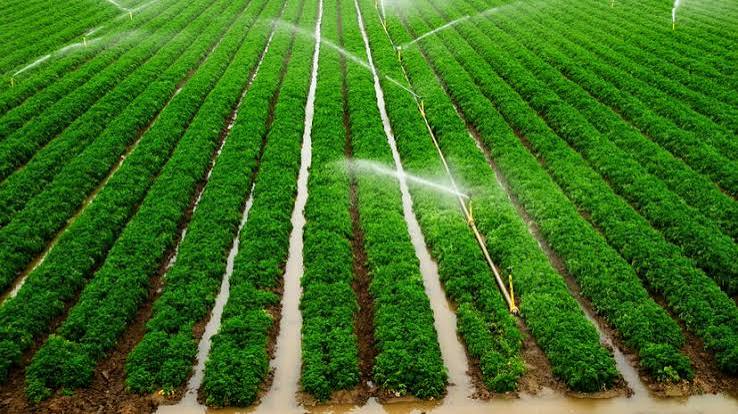
Drip Irrigation vs Flood Irrigation for Soybean
Both systems can be used in agriculture, but their management approach is different.
| Factor | Drip Irrigation | Flood/Surface Irrigation |
|---|---|---|
| Water delivery | Controlled near root zone | Water distributed across field |
| Irrigation control | High | Comparatively lower |
| Water loss | Can be reduced with proper design | Can be higher |
| Fertigation | Can be integrated | More difficult to control precisely |
| Field leveling | Less dependent on perfect leveling | More important |
| Maintenance | Requires regular system maintenance | Different maintenance requirements |
| Initial investment | Higher | Generally lower |
| Scheduling | Precise | Often less precise |
| Automation potential | High | Lower depending on system |
The best method depends on farm conditions, water availability, investment capacity, soil, terrain, and management skills.
Why Choose Gajanand Irrigation for Agricultural Irrigation Components?
Gajanand Irrigation is an Ahmedabad-based irrigation manufacturer that has been operating since 1993. The company states that it supplies irrigation products to domestic and international markets and provides products including filters, pipes, fittings, valves, fertigation assemblies, and other irrigation accessories.
Its product range includes:
- Screen Filters
- Disc Filters
- Hydrocyclone Filters
- Poly Fittings
- Venturi
- Air Release Valves
- Push Fittings
- Ball Valves
- Mini Sprinklers
- Irrigation Fittings
- Fertigation Assemblies
- Foot Valves
- Other irrigation accessories
Farmers, irrigation contractors, dealers, and agricultural businesses can explore the complete product range through the Gajanand Irrigation Catalog.
For customized requirements or product-related assistance, visit the Gajanand Irrigation Contact Us page.
How to Improve Soybean Water Use Efficiency
Water-use efficiency is not achieved simply by installing drip irrigation.
The complete irrigation strategy matters.
Farmers should focus on:
1. Apply Water According to Crop Need
Use crop stage, soil moisture, rainfall, and weather to guide irrigation.
2. Avoid Unnecessary Irrigation
If sufficient rainfall has occurred, irrigation may not be required immediately.
3. Maintain the Root Zone
The objective is to provide appropriate moisture around the active root zone without creating prolonged saturation.
4. Maintain Filters
Clean filtration helps maintain consistent emitter performance.
5. Monitor System Performance
Check pressure, flow, leaks, and blocked emitters.
6. Use Fertigation Carefully
When fertigation is used, nutrient concentration and compatibility should be managed carefully.
7. Keep Records
Farmers can record:
- Irrigation dates
- Irrigation duration
- Rainfall
- Fertilizer applications
- Crop growth stage
- Soil moisture observations
- Yield
These records can help improve irrigation decisions in future seasons.
Is Drip Irrigation Suitable for Soybean?
Yes, drip irrigation can be suitable for soybean cultivation when the system is properly designed and managed.
It can provide:
- Controlled water application
- Better root-zone moisture management
- Potential water savings
- Support during critical growth stages
- Compatibility with fertigation
- Better irrigation control
- Reduced unnecessary wetting
However, suitability depends on farm size, crop layout, soil, water availability, water quality, terrain, irrigation economics, and management capacity.
A professional system assessment should be completed before installation.
Frequently Asked Questions About Drip Irrigation in Soybean
1. Is drip irrigation good for soybean?
Drip irrigation can be an effective option for soybean when properly designed and managed. It delivers water gradually near the root zone and allows farmers to control irrigation according to crop and field requirements.
2. When should soybean be irrigated?
The most important periods for careful irrigation management include flowering, pod formation, and seed filling. Water availability during these reproductive stages can influence pod and seed development.
3. How much water does soybean need?
Soybean water requirements vary with climate, soil, variety, growth stage, rainfall, and evapotranspiration. Some references use approximately 500–600 mm as a seasonal water requirement under particular conditions, but irrigation requirements should be calculated after accounting for effective rainfall and local field conditions.
4. Can drip irrigation increase soybean yield?
Drip irrigation can improve crop water management and has been associated with yield improvements in some soybean studies and field applications. SAB reports increases of up to 30% in some situations compared with traditional irrigation, but results vary according to local conditions and management.
5. Can fertilizer be applied through soybean drip irrigation?
Yes, fertigation can be integrated with drip irrigation when appropriate soluble fertilizers, equipment, filtration, and application practices are used. Gajanand Irrigation offers fertigation assemblies among its irrigation products.
6. Why is filtration important in drip irrigation?
Filtration helps remove particles from irrigation water before they reach drip lines and emitters. Proper filtration can reduce the risk of clogging and support consistent water distribution.
7. What products are needed for a soybean drip irrigation system?
A typical system may require a water source, pump, filtration system, mainline, sub-mainlines, valves, drip lines, emitters, fittings, and potentially fertigation equipment. The exact components depend on the farm design.
8. Can drip irrigation be used in different soil types?
Yes, but the system design and irrigation schedule should be adapted to soil characteristics. Sandy, loamy, and heavier soils have different water-holding and infiltration properties.
9. How often should soybean be irrigated through drip irrigation?
There is no universal number of irrigation events. Frequency should be based on soil moisture, weather, rainfall, crop stage, evapotranspiration, and the discharge of the irrigation system.
10. How can farmers choose the right irrigation products?
Farmers should consider their water source, field size, soil, crop spacing, pressure, water quality, and irrigation requirements. The filtration, pipe, fitting, valve, and drip components should work together as a properly designed system.
Conclusion
Drip irrigation in soybean provides farmers with a controlled approach to water management. By delivering water gradually near the root zone, a properly designed system can help maintain suitable soil moisture while reducing unnecessary water application.
The importance of irrigation becomes particularly clear during flowering, pod development, and seed filling. Research and technical guidance indicate that maintaining adequate moisture during these stages can support soybean growth and yield formation.
However, successful soybean irrigation requires more than installing drip lines. Farmers should select suitable filtration, pipes, fittings, valves, and emitters; monitor soil moisture and rainfall; maintain appropriate pressure; clean filters; flush lines; and adjust irrigation according to crop growth.
Gajanand Irrigation offers a broad range of agricultural irrigation components, including filtration systems, pipes, fittings, valves, fertigation assemblies, and other irrigation accessories.
For farmers and irrigation professionals planning a soybean irrigation project, the right approach is to combine efficient irrigation technology, proper system design, regular maintenance, and crop-based irrigation scheduling.
Explore the Gajanand Irrigation product catalog to learn more about irrigation components, or contact Gajanand Irrigation for product and system-related requirements.