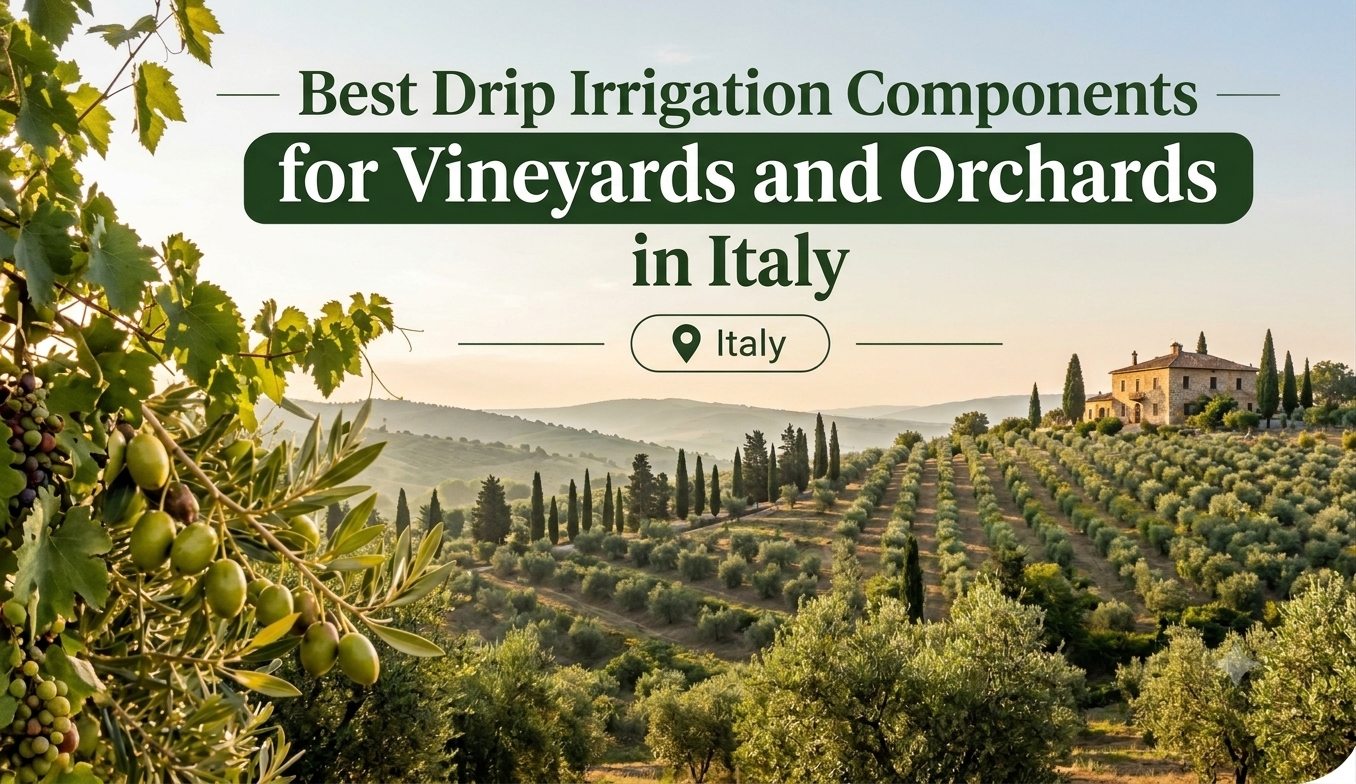
Agriculture plays an important role in Italy’s economy, food production, and agricultural exports. The country is known for its vineyards, olive plantations, citrus orchards, apple farms, vegetable cultivation, and other agricultural activities. From the fertile agricultural areas of northern Italy to the warmer regions of Sicily, Calabria, and Puglia, farmers depend on effective irrigation practices to maintain crop growth and productivity.
However, changing weather conditions, irregular rainfall, rising temperatures, and increasing pressure on freshwater resources have made water management an important part of modern agriculture. Farmers need irrigation systems that deliver water efficiently while reducing unnecessary water consumption.
This is where drip irrigation becomes an effective solution.
Drip irrigation is a modern agricultural irrigation method that delivers water directly to plant roots through a network of pipes, emitters, filters, and control valves. Unlike traditional irrigation methods, it supplies water in controlled quantities near the root zone.
The performance of a drip irrigation system depends on the quality and compatibility of its individual components. Important equipment includes drip irrigation filters, emitters, polyethylene pipes, connectors, pressure regulators, control valves, and fertigation systems.
Choosing the right drip irrigation components in Italy can help farmers develop reliable irrigation networks for vineyards, orchards, vegetable farms, olive plantations, and other agricultural applications.
In this comprehensive guide, we will explain the different components of drip irrigation systems, their functions, benefits, applications, and important factors to consider when selecting agricultural irrigation equipment in Italy.
1. Why Is Drip Irrigation Important for Agriculture in Italy?
Italy has diverse agricultural regions with different climates, soil types, and water requirements. Northern Italy is known for grains, dairy farming, and vineyards, while southern regions are important for fruit production, vegetables, olive oil, and wine. European Commission
Water management is becoming increasingly important for Italian farmers. According to Italy’s National Institute of Statistics (ISTAT), more than 91% of agricultural holdings reported irrigation-related difficulties in 2024. The problem was particularly significant in southern Italy and the islands. Istat
Drip irrigation offers a practical way to manage water distribution according to crop requirements.
Major Benefits of Drip Irrigation
1. Efficient Water Distribution
Drip irrigation delivers water directly to the root zone through specially designed emitters. This helps farmers control how much water reaches individual plants.
2. Reduced Water Wastage
Unlike some traditional irrigation methods, drip irrigation applies water close to plant roots. As a result, it can reduce unnecessary surface runoff and evaporation.
3. Better Crop Management
Different crops require different amounts of water. Drip irrigation allows farmers to adjust water application according to crop type, soil moisture, and seasonal conditions.
4. Supports Fertilizer Application
Fertigation equipment allows farmers to apply suitable water-soluble fertilizers through the irrigation system. This makes nutrient application more controlled.
5. Suitable for Different Agricultural Areas
Drip irrigation can be designed for flat fields, vineyards, orchards, vegetable farms, and agricultural land with varying elevations.
6. Easier Irrigation Scheduling
With automatic valves and irrigation controllers, farmers can manage different agricultural sections according to their individual water requirements.
For these reasons, drip irrigation is an important technology for modern agricultural water management in Italy.
2. What Are the Main Components of a Drip Irrigation System?
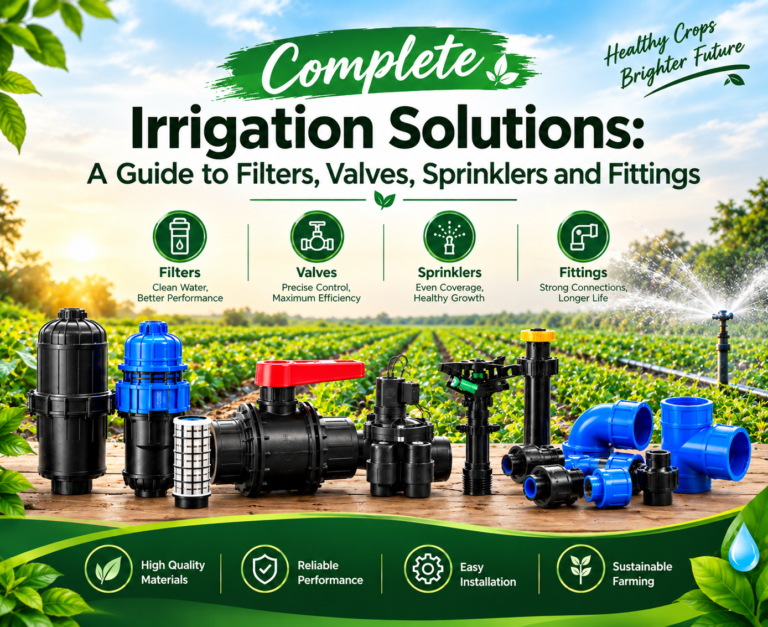
A drip irrigation system consists of several components that work together to transport, filter, regulate, and distribute water.
Each component has a specific function. Therefore, selecting compatible equipment is important for maintaining proper system performance.
The main drip irrigation components include:
- Water pumps.
- Filtration systems.
- Drip emitters and drippers.
- Mainline and sub-main pipes.
- Lateral drip pipes.
- Irrigation control valves.
- Pressure regulators.
- Pressure gauges.
- Fertigation equipment.
- Connectors and fittings.
- Air release valves.
- Flushing valves.
- Flow meters.
- Automatic irrigation controllers.
According to the Food and Agriculture Organization (FAO), a typical drip irrigation system includes a pump unit, control head, main and sub-main lines, lateral pipes, and emitters. FAOHome
Let’s understand how each component works.
3. Water Pumps for Drip Irrigation Systems
A water pump is an important component because it supplies water to the irrigation network at the required flow rate and pressure.
The pump transfers water from a source, such as a well, reservoir, storage tank, or irrigation channel, to the filtration and distribution system.
Types of Water Pumps
Centrifugal Pumps: These pumps are commonly used in agricultural applications where a suitable flow rate is required.
Submersible Pumps: These pumps operate underwater and are often used to draw water from wells and boreholes.
Booster Pumps: Booster pumps help increase water pressure when the existing supply cannot provide the required operating conditions.
How to Select the Right Irrigation Pump?
Farmers should consider:
- Total agricultural area.
- Required water flow.
- Operating pressure.
- Number of irrigation zones.
- Pipeline length.
- Water source.
- Elevation differences.
A properly selected water pump helps maintain the required operating conditions throughout the irrigation system.
4. Drip Irrigation Filters
Filtration is one of the most important stages of a drip irrigation system.
Water from wells, reservoirs, rivers, and irrigation channels may contain sand, silt, algae, organic matter, and other suspended particles.
These impurities can block small emitter openings and reduce water distribution.
Drip irrigation filters remove unwanted particles before water enters the distribution network.
A. Screen Filters
Screen filters use a mesh screen to capture suspended particles.
They are suitable for many agricultural applications where water contains relatively low levels of organic matter.
Benefits:
- Help prevent emitter blockage.
- Easy to install.
- Simple maintenance.
- Available in different filtration capacities.
B. Disc Filters
Disc filters contain multiple grooved discs that trap particles as water passes through them.
They are commonly used in agricultural drip irrigation systems.
Benefits:
- Effective filtration.
- Suitable for different irrigation applications.
- Available in manual and automatic configurations.
- Useful for larger irrigation networks.
C. Sand Media Filters
Sand media filters are useful when irrigation water contains algae, organic materials, or other suspended impurities.
They are commonly considered for systems that use surface water.
Benefits:
- Suitable for agricultural water filtration.
- Helps remove organic impurities.
- Can be integrated into larger filtration stations.
- Supports irrigation system maintenance.
Which Drip Irrigation Filter Is Best for Italian Farms?
The best filter depends on water quality, irrigation source, and emitter requirements.
For example, groundwater with sand particles may require a different filtration arrangement from reservoir water containing algae and organic matter.
Therefore, farmers should test their water quality before selecting a filtration system.
5. Drip Irrigation Emitters and Drippers
Drip emitters, also known as drippers, deliver controlled quantities of water directly to plant roots.
They are installed along lateral irrigation pipes and release water through small outlets.
The emitter flow rate determines how much water is delivered during a specific irrigation period.
Types of Drip Irrigation Emitters
A. Online Drippers
Online drippers are installed directly into polyethylene pipes. Farmers can position them according to the spacing and requirements of individual plants.
They are suitable for:
- Fruit orchards.
- Olive plantations.
- Citrus farms.
- Vineyards.
- Vegetable cultivation.
B. Inline Drippers
Inline drippers are integrated into drip pipes during manufacturing.
They provide regularly spaced water outlets and are useful for agricultural fields with consistent plant spacing.
C. Pressure-Compensating Drippers
Pressure-compensating drippers are designed to maintain relatively consistent water discharge within their specified operating pressure range.
They are especially useful in agricultural fields with uneven terrain or long irrigation lines.
How to Choose the Right Dripper?
Consider these factors before selecting an emitter:
- Crop type.
- Soil characteristics.
- Required water flow.
- Plant spacing.
- Irrigation pressure.
- Emitter spacing.
- Total irrigation line length.
For example, grapevines and fruit trees have different root structures and water requirements. Therefore, their emitter arrangements should also be different.
Selecting the correct dripper helps improve water distribution and supports effective irrigation management.
6. Agricultural Irrigation Pipes and Tubing
Irrigation pipes form the distribution network of a drip irrigation system.
They transport water from the pump and filtration unit to different agricultural sections.
Polyethylene (PE) and PVC pipes are commonly used in agricultural irrigation applications, depending on system design and installation requirements.
A. Mainline Pipes
Mainline pipes carry water from the pumping station to different sections of the agricultural property.
They generally have a larger diameter because they supply multiple irrigation zones.
B. Sub-Main Pipes
Sub-main pipes distribute water from the mainline to individual irrigation sections.
They help divide large farms into smaller, manageable irrigation blocks.
C. Lateral Drip Pipes
Lateral pipes are smaller distribution lines installed along crop rows.
They carry water directly to the emitters positioned near individual plants.
Important Features of Agricultural Irrigation Pipes
When selecting irrigation pipes in Italy, consider:
- Suitable pressure rating.
- Pipe diameter.
- Material quality.
- UV resistance.
- Wall thickness.
- Flexibility.
- Durability.
- Compatibility with connectors and fittings.
High-quality irrigation pipes help reduce leakage risks and support reliable water distribution.
7. Irrigation Control Valves
Control valves regulate the movement of water throughout the irrigation network.
They allow farmers to start, stop, and manage water supply to different agricultural sections.
Common Types of Irrigation Valves
Manual Valves: These valves are operated by hand to control water movement.
Ball Valves: Ball valves are commonly used to open and close water pipelines.
Solenoid Valves: These electrically operated valves can be connected to automatic irrigation controllers.
Hydraulic Control Valves: These valves are used in larger agricultural irrigation networks to regulate water flow and pressure.
Why Are Irrigation Control Valves Important?
Imagine a farm with several agricultural sections. Each section may have different soil conditions and irrigation requirements.
Instead of irrigating the entire property simultaneously, farmers can divide it into separate irrigation zones.
Control valves allow each zone to operate independently.
This makes irrigation scheduling easier and supports better water management.
8. Pressure Regulators and Pressure Gauges
Water pressure directly affects the performance of a drip irrigation system.
High pressure may damage pipes, fittings, and emitters. Low pressure may prevent emitters from delivering their intended flow rate.
Pressure regulators and pressure gauges help maintain and monitor suitable operating conditions.
Pressure Regulators
Pressure regulators reduce incoming water pressure to the operating range required by the irrigation equipment.
Main benefits:
- Help protect irrigation components.
- Support consistent emitter performance.
- Manage pressure variations.
- Improve system reliability.
Pressure Gauges
Pressure gauges measure water pressure at different points in the irrigation network.
They help identify possible problems such as:
- Blocked filters.
- Pipeline leakage.
- Unusual pressure changes.
- Flow restrictions.
- Pressure differences between irrigation zones.
Regular pressure monitoring is important for large agricultural properties with long irrigation pipelines.
9. Fertigation Systems for Modern Agriculture
Fertigation is the process of applying suitable water-soluble fertilizers through irrigation water.
It combines irrigation and nutrient application in one operation.
This technique is useful for vineyards, orchards, vegetable farms, and other agricultural applications where controlled nutrient delivery is required.
Main Fertigation Components
Venturi Injectors: These devices use a pressure difference to draw fertilizer solution into the irrigation pipeline.
Fertilizer Dosing Pumps: These pumps inject controlled quantities of fertilizer into irrigation water.
Fertilizer Tanks: These tanks are used to prepare and store fertilizer solutions.
Injection Valves: These components help control fertilizer injection into the irrigation network.
Benefits of Fertigation
- Supports controlled fertilizer application.
- Delivers nutrients through irrigation water.
- Reduces separate fertilizer distribution operations.
- Helps manage crop nutrition.
- Can be integrated with automated irrigation systems.
However, fertilizer compatibility and water quality must be checked carefully. Proper filtration and pipeline flushing are also important to prevent deposits and emitter blockage.
10. Connectors, Fittings and Irrigation Accessories
Connectors and fittings join different sections of the irrigation network.
Although these components are small, they are essential for creating secure pipeline connections.
Common drip irrigation accessories include:
- Straight connectors.
- Elbow connectors.
- Tee connectors.
- Reducers.
- Grommets.
- Start connectors.
- End caps.
- Pipe joiners.
- Clamps.
Why Are Quality Irrigation Fittings Important?
Low-quality fittings can cause water leakage and pressure loss.
For agricultural irrigation systems, connectors should match the pipe diameter, material, pressure rating, and installation requirements.
Using compatible fittings helps maintain a reliable distribution network and makes maintenance easier.
11. Air Release Valves and Flushing Valves
Air release valves and flushing valves help maintain the performance of drip irrigation systems.
Air Release Valves
Air can accumulate inside irrigation pipelines during filling and operation.
Air release valves help remove trapped air and support stable pipeline operation.
Their main benefits include:
- Helping manage trapped air.
- Supporting normal water movement.
- Reducing air-related flow interruptions.
- Assisting in pressure management.
Flushing Valves
Sediment and other particles may accumulate inside irrigation pipes over time.
Flushing valves allow farmers to remove these particles by releasing water through the pipeline.
They help:
- Clean irrigation lines.
- Reduce emitter blockage.
- Support regular maintenance.
- Maintain system performance.
These components are particularly useful in large agricultural irrigation networks.
12. Flow Meters and Smart Irrigation Controllers
Modern agriculture increasingly uses digital technologies to improve irrigation management.
Flow meters and automatic controllers help farmers monitor water consumption and manage irrigation schedules.
Flow Meters
Flow meters measure the quantity of water passing through irrigation pipelines.
They help farmers monitor water usage and identify unexpected changes in flow.
For example, a sudden change in flow rate may indicate a leakage problem or blocked emitters.
Automatic Irrigation Controllers
Irrigation controllers manage the operation of automatic valves and different irrigation zones.
Farmers can programme irrigation schedules according to crop requirements.
Soil Moisture Sensors
Soil moisture sensors measure the moisture level in agricultural soil.
They provide useful information about when additional irrigation may be needed.
Weather Monitoring Equipment
Weather monitoring systems collect information about rainfall, temperature, humidity, and other environmental conditions.
Farmers can use this information to adjust irrigation schedules.
Combining these technologies helps create smarter agricultural irrigation systems in Italy.
13. Applications of Drip Irrigation Components in Italy
Italy has diverse agricultural production, so drip irrigation equipment can be used across several types of farming.
The European Commission identifies northern Italy with grain and dairy production, while southern Italy has important fruit, vegetable, olive oil, and wine-producing sectors. European Commission
Here are some important applications.
A. Vineyard Irrigation
Vineyards require irrigation management according to grape variety, soil moisture, vine age, and seasonal conditions.
Drip irrigation components such as filters, pressure-compensating emitters, lateral pipes, and control valves can help deliver water along grapevine rows.
B. Olive Plantation Irrigation
Olive trees are cultivated in several Italian regions, especially Puglia, Calabria, and Sicily.
Drip irrigation helps deliver water near the root zone and allows farmers to adjust irrigation according to tree development and soil conditions.
C. Citrus Orchard Irrigation
Citrus production is important in southern Italy, particularly Sicily and Calabria.
Drip irrigation systems can distribute water through multiple emitters positioned around individual trees.
D. Apple Orchard Irrigation
Apple cultivation requires appropriate water management during different stages of plant growth and fruit development.
Drip irrigation allows farmers to adjust water application according to soil moisture and seasonal demand.
E. Vegetable Farming
Vegetable crops often require regular and carefully managed water application.
Drip irrigation provides controlled water delivery and can be combined with fertigation equipment for suitable nutrient applications.
14. How to Choose the Best Drip Irrigation Components in Italy?
Choosing the right irrigation equipment requires proper planning.
Farmers should understand their agricultural requirements before purchasing individual components.
Follow these important steps.
1. Identify Your Water Source
Determine whether water comes from a well, reservoir, river, irrigation canal, or storage tank.
2. Test Water Quality
Check for sand, sediment, algae, and other impurities. This helps determine the filtration requirements.
3. Understand Soil Conditions
Different soils have different water absorption and moisture-retention characteristics.
4. Identify Crop Requirements
Vineyards, orchards, olive plantations, and vegetable farms require different irrigation arrangements.
5. Calculate Water Flow and Pressure
Determine the required flow rate, operating pressure, pipeline length, and pump capacity.
6. Select Compatible Components
Choose filters, emitters, pipes, valves, and fittings that work together according to system specifications.
7. Consider Durability
Select agricultural irrigation equipment with suitable material quality, pressure ratings, and UV resistance.
8. Plan for Maintenance
Choose equipment that can be inspected, cleaned, and repaired easily.
9. Consider Automation
For larger agricultural properties, automatic controllers and monitoring equipment can make irrigation management more convenient.
A properly planned irrigation system helps farmers avoid unnecessary equipment costs and supports long-term performance.
15. Maintenance Tips for Drip Irrigation Systems
Regular maintenance is essential for keeping agricultural drip irrigation systems in good working condition.
Even high-quality equipment may experience performance problems if it is not inspected and maintained properly.
Follow these maintenance practices:
- Clean filters according to water quality and manufacturer recommendations.
- Inspect emitters for blockage or irregular discharge.
- Flush lateral and main irrigation lines regularly.
- Check connectors and fittings for leakage.
- Monitor pressure using pressure gauges.
- Inspect valves for proper operation.
- Check fertilizer injection equipment.
- Monitor flow rates for unusual changes.
- Inspect pipes for damage.
- Adjust irrigation schedules according to rainfall and soil moisture.
Regular inspection helps identify problems early and reduces unexpected irrigation interruptions.
16. Why Are Quality Drip Irrigation Components Important for Italian Agriculture?
The performance of an agricultural irrigation system depends on the quality of its individual components.
Using unsuitable equipment can create several problems, including water leakage, blocked emitters, pressure variations, and uneven water distribution.
For this reason, farmers should focus on selecting reliable and compatible irrigation components.
Here are some important reasons to invest in quality drip irrigation equipment:
Better Water Management: Properly selected emitters and filters help distribute water according to irrigation requirements.
Reduced Maintenance: Durable pipes, valves, and connectors can reduce maintenance issues when correctly installed and operated.
Consistent Irrigation: Suitable pressure regulators and emitters help maintain more uniform water delivery.
Long-Term Reliability: Quality components help build an irrigation network that can operate reliably under appropriate conditions.
Improved Agricultural Management: Automation and monitoring equipment make it easier to manage different irrigation zones.
For Italian agricultural businesses, selecting suitable irrigation equipment is an important step towards efficient and sustainable farming practices.
17. Future of Drip Irrigation Technology in Italy
The future of agricultural irrigation in Italy is closely connected to precision agriculture, water conservation, and modern farming technologies.
As farmers face changing weather conditions and water management challenges, advanced irrigation solutions are becoming increasingly relevant.
Some important developments include:
Precision Irrigation
Precision irrigation uses soil moisture sensors, weather information, and crop data to determine when and how much water should be applied.
This helps farmers make informed irrigation decisions.
Automated Irrigation Systems
Automatic controllers and electrically operated valves allow farmers to manage different irrigation zones with less manual intervention.
Advanced Filtration Technology
Modern filtration equipment helps protect irrigation emitters from sediment and other impurities.
Smart Fertigation
Automated fertilizer injection systems help farmers manage nutrient application through irrigation networks.
Digital Water Monitoring
Flow meters, pressure sensors, and digital monitoring systems help track water consumption and identify possible system problems.
These technologies can support more efficient irrigation management and help farmers adapt to changing agricultural requirements.
18. Conclusion
Drip irrigation plays an important role in modern agriculture by providing controlled water distribution directly to plant root zones.
With changing weather conditions and increasing attention to water management, Italian farmers need reliable irrigation systems that support different agricultural applications.
From water pumps and filtration systems to drip emitters, agricultural pipes, control valves, pressure regulators, and fertigation equipment, every component contributes to the overall performance of an irrigation network.
Choosing the right drip irrigation components in Italy requires careful consideration of water quality, soil conditions, crop type, land topography, operating pressure, and irrigation requirements.
By selecting compatible equipment and following regular maintenance practices, farmers can improve water distribution, reduce unnecessary water losses, and support long-term agricultural productivity.
Whether managing vineyards in Tuscany, olive plantations in Puglia, citrus orchards in Sicily, or vegetable farms in other agricultural regions, a properly designed drip irrigation system can provide an effective solution for modern farming.
As agricultural technology continues to develop, efficient irrigation equipment, precision monitoring, and automated water management will remain important for the future of Italian agriculture.
Frequently Asked Questions (FAQs)
1. What are the main drip irrigation components used in Italy?
The main components include water pumps, filters, drip emitters, mainline pipes, sub-main pipes, lateral tubing, control valves, pressure regulators, connectors, fertigation equipment, and flushing valves.
2. What is the best drip irrigation system for Italian farms?
The best system depends on crop type, soil conditions, water quality, agricultural area, and water availability. A properly designed system should include suitable filtration, pipes, emitters, pressure regulators, and control valves.
3. Why are filters important in drip irrigation systems?
Filters remove suspended particles, sand, and other impurities from irrigation water. They help prevent emitter blockage and maintain proper water distribution.
4. Which drip emitters are suitable for agricultural irrigation?
Online drippers, inline drippers, and pressure-compensating drippers are commonly used. The selection depends on crop spacing, soil conditions, operating pressure, and water requirements.
5. What is the difference between inline and online drippers?
Inline drippers are integrated into drip pipes during manufacturing. Online drippers are installed directly into the pipe at selected positions. Inline drippers are useful for regular plant spacing, while online drippers provide greater flexibility in placement.
6. What are pressure-compensating drippers?
Pressure-compensating drippers are designed to maintain relatively consistent water discharge across a specified operating pressure range. They are useful in agricultural fields with elevation differences.
7. What type of pipes are used in drip irrigation?
Polyethylene (PE) and PVC pipes are commonly used in agricultural irrigation systems. The selection depends on pipeline requirements, operating pressure, installation conditions, and system design.
8. What is fertigation in drip irrigation?
Fertigation is the process of applying suitable water-soluble fertilizers through irrigation water. It allows farmers to deliver nutrients through the irrigation network.
9. How can farmers prevent drip irrigation blockage?
Farmers can prevent blockage by using suitable filters, cleaning filtration equipment regularly, flushing irrigation lines, monitoring water quality, and inspecting emitters.
10. Is drip irrigation suitable for vineyards in Italy?
Yes. Drip irrigation can be used in vineyards to deliver controlled quantities of water near grapevine roots. The system should be designed according to vine spacing, soil type, climate, and irrigation requirements.
11. Can drip irrigation be used for olive and citrus plantations?
Yes. Drip irrigation is suitable for olive and citrus plantations. Multiple emitters can be positioned around individual trees to distribute water across the root zone.
12. What is the role of automatic irrigation controllers?
Automatic irrigation controllers manage irrigation schedules and operate valves according to programmed settings. They help farmers manage multiple agricultural zones.
13. How often should drip irrigation filters be cleaned?
Filter cleaning frequency depends on water quality, sediment levels, system operation, and manufacturer recommendations. Regular inspection is important to maintain filtration performance.
14. How do I choose a reliable drip irrigation equipment supplier in Italy?
Consider product quality, technical specifications, filtration performance, pressure ratings, material durability, product availability, after-sales support, and compatibility with your irrigation system.