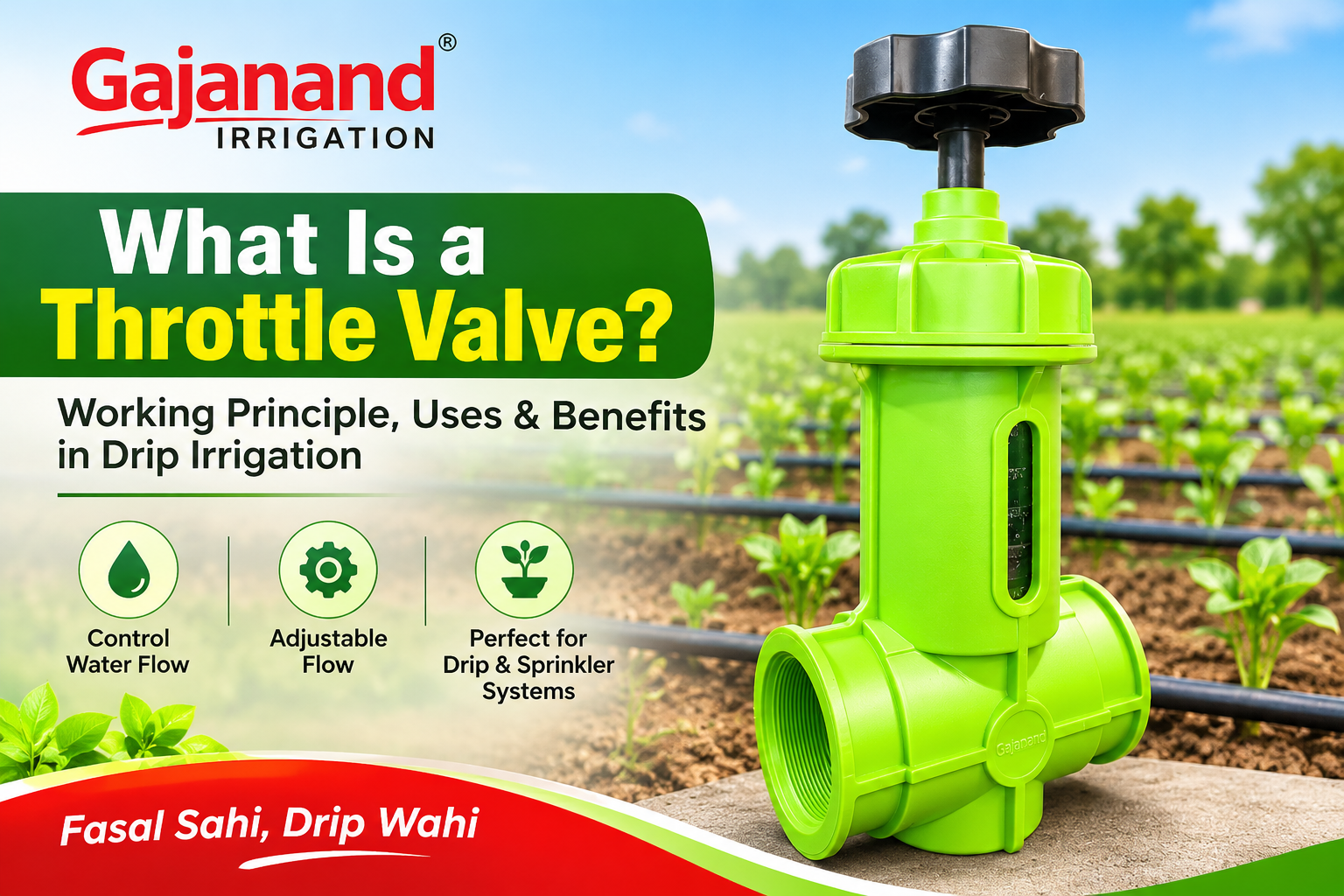
Water management is one of the most important parts of modern agriculture. Farmers need to distribute water properly across different sections of their fields. However, when a farm has multiple irrigation sections, controlling the amount of water supplied to each section can become challenging.
Some sections may receive more water, while others may receive less. This problem can become more noticeable when the field has different slopes, pipeline lengths or irrigation layouts.
A throttle valve is an important irrigation component that helps manage this situation. It allows users to adjust water flow by changing the opening inside the valve. Unlike a valve that is mainly used in fully open or fully closed positions, a throttle valve is designed to operate at partially open positions.
But what is a throttle valve? How does it work? Where should it be installed in a drip irrigation system? And why is it useful for agricultural water management?
In this detailed guide, we will explain the throttle valve meaning, working principle, applications, installation, advantages and important selection factors. We will also explore how the Gajanand Throttle Valve supports better control of water distribution in drip and sprinkler irrigation systems.
What Is a Throttle Valve?
A throttle valve is a flow-control device used to regulate the amount of fluid passing through a pipeline. It works by adjusting the size of the internal opening through which water flows.
When the opening is reduced, less water can pass through the valve under the same operating conditions. When the opening is increased, more water can flow through it.
In agricultural irrigation systems, a throttle valve helps control water distribution between different field sections. It allows farmers or irrigation installers to adjust the flow according to the requirements of each section.
For example, consider a farm divided into three irrigation sections. Each section may have different pipeline lengths or ground conditions. If all sections receive the same uncontrolled water flow, some areas may receive more water than required.
Installing a throttle valve at the beginning of each section allows the installer to adjust the water supply separately.
The valve can be adjusted to a suitable position and left at that setting during normal operation. The handle position can also be marked to make future adjustments easier.
Simple Definition of a Throttle Valve
A throttle valve is a mechanical flow-control component that regulates the amount of water passing through a pipe by increasing or decreasing its internal opening.
In simple words: A throttle valve helps control how much water flows into a particular irrigation section.
What Is the Main Purpose of a Throttle Valve?
The main purpose of a throttle valve is to provide adjustable control over water flow.
Its important functions include:
- Controlling the quantity of water passing through a pipeline.
- Adjusting water flow for individual irrigation sections.
- Helping balance water distribution in multi-section irrigation layouts.
- Supporting better control in drip and sprinkler systems.
- Allowing installers to maintain a selected flow setting.
- Reducing differences in water distribution when sections have different requirements.
A throttle valve is especially useful in agricultural systems where different field sections need separate flow adjustments.
How Does a Throttle Valve Work?
The throttle valve working principle is based on controlling the size of an opening inside the valve.
The handle is used to change the internal opening. This changes the resistance to water flow and influences the amount of water passing through the pipeline.
The working process is straightforward.
1. Water Enters the Valve
Water enters the throttle valve through its inlet connection. It travels from the main irrigation pipeline towards the outlet.
2. The Handle Controls the Opening
The user turns the valve handle to adjust the internal opening.
When the handle position allows a larger opening, more water can pass through. When the opening becomes smaller, the flow is restricted.
3. Water Flow Is Adjusted
The reduced or increased opening changes the flow through the valve.
The amount of adjustment depends on the valve design, operating pressure and pipeline conditions.
4. The Selected Position Is Maintained
Once the required flow has been achieved, the installer can leave the valve at that position.
The handle position can be marked with paint to make it easier to identify the selected setting later.
This is particularly useful in agricultural irrigation systems because the valve does not need to be operated only in fully open or fully closed positions.
Understanding Different Throttle Valve Settings
A throttle valve can be adjusted to different opening positions.
Full opening: The internal passage is opened to allow a greater flow of water.
Partial opening: The opening is reduced to restrict the amount of water passing through the valve.
Low opening: The opening is reduced further, allowing a smaller amount of water to pass through under the same operating conditions.
The actual flow at each position depends on the valve characteristics and the pressure conditions in the system.
For irrigation applications, the installer should determine the appropriate setting according to the requirements of each section.
Why Is a Throttle Valve Important in Drip Irrigation?
Drip irrigation systems use a network of pipelines to deliver water to different areas of a farm. These systems can include main lines, sub-main lines, lateral pipes, filters, valves and drippers.
In a small field, controlling the water supply may be relatively simple. However, larger farms often have multiple irrigation sections.
Each section may have different:
- Pipeline lengths.
- Number of drippers.
- Water requirements.
- Ground slopes.
- Operating conditions.
- Irrigation schedules.
These differences can make water distribution difficult to manage.
A throttle valve provides an additional control point for adjusting the flow supplied to individual sections.
Managing Different Field Sections
Imagine a farmer has divided a field into three sections.
The first section has a shorter pipeline, while the second and third sections have longer pipelines.
The water distribution may not be identical across all sections. The installer can use throttle valves at the beginning of the individual sub-mains to adjust their flow.
This allows each section to be configured according to its requirements.
Supporting Irrigation System Balancing
Balancing an irrigation system means adjusting the system so that each section receives an appropriate water supply.
A throttle valve provides a practical way to make these adjustments.
It is particularly useful when an irrigation layout includes several independent sections that need different flow settings.
However, a throttle valve alone cannot correct every pressure or distribution problem. Proper pipeline design, filtration, pressure management and system testing remain important.
Main Applications of a Throttle Valve
Throttle valves can be used in different irrigation arrangements where adjustable flow control is required.
Let’s understand some important applications.
1. Drip Irrigation Systems
Drip irrigation is one of the major applications of agricultural flow-control components.
In this system, water travels through a network of pipes and reaches crops through drippers.
A throttle valve can be installed at the beginning of each sub-main or irrigation section, after the filter.
It allows the installer to adjust the water entering that particular section.
This is useful when different sections have different pipeline lengths or flow requirements.
Read more about dripper irrigation systems to understand how irrigation pipelines deliver water to crop root zones.
2. Sprinkler Irrigation Systems
Sprinkler irrigation distributes water through sprinkler devices connected to pipelines.
Different sprinkler sections may have different operating requirements. A throttle valve can be used where the system design requires adjustable flow control.
It allows the installer to regulate the amount of water supplied to a particular section.
The final setting should be determined according to the sprinkler specifications and required operating conditions.
3. Agricultural Sub-Main Pipelines
A sub-main pipeline distributes water from the main pipeline to individual irrigation sections.
When a farm contains several sub-mains, controlling their water supply can become important.
A throttle valve installed at the beginning of a sub-main provides an adjustment point for that section.
It can help installers manage different sections without redesigning the complete pipeline layout.
4. Greenhouse Irrigation
Greenhouses often contain separate irrigation zones for different growing areas.
Each zone may have different irrigation requirements depending on the plants, growing arrangement and pipeline design.
A throttle valve can be considered in these systems when adjustable flow control is required.
5. Horticulture and Orchard Irrigation
Orchards and horticultural farms may have long irrigation lines and multiple planting sections.
Differences in pipeline length, terrain and the number of irrigation outlets can affect the flow requirements.
A throttle valve can help installers adjust water distribution between these sections.
What Problems Can a Throttle Valve Help Solve?
Uneven water distribution is a common concern in multi-section irrigation systems.
When different sections receive different amounts of water, farmers may find it difficult to maintain consistent irrigation conditions.
A throttle valve can help address some of these challenges.
Problem 1: First Rows Receive More Water Than Expected
In some irrigation layouts, shorter sections may have different flow characteristics compared with longer sections.
The installer can adjust the throttle valve at the beginning of the relevant section to control its water supply.
This helps establish a more suitable flow setting.
Problem 2: Different Pipeline Lengths
A farm may contain one short irrigation section and another section with a much longer pipeline.
The flow conditions in these sections may differ.
Using a throttle valve at each section allows separate adjustments instead of relying on a single common setting.
Problem 3: Sloping Agricultural Land
Land slope can influence pressure and water distribution throughout an irrigation system.
A section located at a different elevation may experience different operating conditions.
A throttle valve can provide an additional adjustment point. However, proper hydraulic design and pressure management are also necessary.
Problem 4: Difficulty Maintaining Flow Settings
When installers repeatedly adjust valves without recording their positions, it can become difficult to reproduce the previous settings.
The Gajanand Throttle Valve launch guide recommends setting the valve, marking the handle position with paint and leaving it at the selected setting.
This provides a simple visual reference for future operation.
Problem 5: Multiple Irrigation Zones
Large farms may have several independent irrigation zones.
A throttle valve at the beginning of each section gives installers an individual point of adjustment.
This makes it easier to manage the irrigation layout according to its requirements.
Where Should a Throttle Valve Be Installed?
Correct installation is important for the proper operation of a throttle valve.
According to Gajanand Irrigation’s product launch guide, the recommended position is at the beginning of each sub-main or irrigation section, after the filter.
This arrangement provides a convenient point for adjusting the water supplied to each section.
Typical Installation Arrangement
A simplified drip irrigation layout can be understood as follows:
Water Source → Pump → Filter → Main Pipeline → Sub-Main Pipeline → Throttle Valve → Drip Irrigation Lines
In a multi-section farm, each sub-main can have its own throttle valve.
For example:
- Section 1: One throttle valve at the beginning of its sub-main.
- Section 2: One throttle valve at the beginning of its sub-main.
- Section 3: One throttle valve at the beginning of its sub-main.
This arrangement allows the installer to adjust the water supply to each section independently.
Important Installation Considerations
Before installing a throttle valve, consider the following points:
- Identify the correct sub-main or irrigation section.
- Check the pipeline size and connection requirements.
- Install the valve after the filtration arrangement as recommended in the system layout.
- Ensure the valve is fitted in the correct flow direction if the product design specifies one.
- Check all pipe connections for proper fitting.
- Start the irrigation system and inspect the connections.
- Adjust the valve gradually while checking the section’s flow.
- Mark the final handle position for future reference.
For the best results, installation and adjustment should be performed by an experienced irrigation installer.
Throttle Valve vs Regular Ball Valve: What Is the Difference?
Throttle valves and ball valves are both used in fluid-control applications. However, their intended operation can be different.
A regular ball valve is commonly operated in fully open or fully closed positions. It is mainly used to allow or stop flow.
A throttle valve is designed for partial adjustment. It allows the user to select an intermediate opening and maintain that setting.
| Feature | Throttle Valve | Regular Ball Valve |
|---|---|---|
| Main purpose | Adjustable flow control | Opening and closing flow |
| Operation | Partial opening positions | Mainly fully open or closed |
| Flow adjustment | Designed for adjustment | Not primarily designed for precise throttling |
| Common application | Section-wise flow adjustment | Pipeline isolation |
| Setting | Can be maintained at a selected position | Usually operated as open or shut |
Which One Should You Choose?
The selection depends on the purpose of the irrigation system.
If you need to open or close a pipeline, a ball valve may be suitable.
If you need to adjust the amount of water supplied to different irrigation sections, a throttle valve is designed for that purpose.
It is important to select the correct valve according to the application rather than treating all irrigation valves as interchangeable.
You can also explore Gajanand Irrigation’s ball valve solutions to learn more about the company’s irrigation component range.
Important Features to Consider When Selecting a Throttle Valve
Choosing the correct throttle valve is important for reliable irrigation operation.
Not every valve is suitable for every pipeline. The selection should match the irrigation system’s design and operating conditions.
Here are some important factors to consider.
1. Valve Size
The valve size should match the pipeline connection at the beginning of the irrigation section.
An incorrect size can create installation difficulties and affect system performance.
Before purchasing, check the pipe diameter and available valve sizes.
2. Operating Pressure
Every irrigation system operates within a particular pressure range.
The selected throttle valve must be suitable for the pressure conditions of the pipeline.
Check the manufacturer’s declared pressure rating before installation.
Do not assume that all valves can operate at the same pressure.
3. Body Material
The valve body material is another important selection factor.
It should be appropriate for the operating environment, water conditions and intended application.
Check the product specifications to understand the material used in the valve body.
4. Connection Compatibility
The inlet and outlet connections should be compatible with the existing irrigation pipeline.
Correct compatibility helps simplify installation and reduces the possibility of connection-related problems.
5. Handle Operation
The handle should allow convenient adjustment.
Since a throttle valve is designed to operate at different opening positions, installers should be able to adjust and identify the selected position easily.
6. Application Requirements
Consider whether the valve will be used in a drip system, sprinkler system, greenhouse or agricultural sub-main.
The application helps determine the required size, pressure rating and installation arrangement.
7. Manufacturer Support
Choose a manufacturer that can provide product specifications and assistance with selection.
This is particularly important for dealers, distributors, OEM buyers and irrigation contractors who need reliable technical information.
How to Adjust a Throttle Valve Correctly
A throttle valve should be adjusted according to the actual flow requirements of the irrigation section.
Simply turning the handle to an estimated position may not provide the desired result.
Follow a systematic adjustment process.
Step 1: Inspect the irrigation system
Check the filter, pipeline connections and irrigation outlets before making adjustments.
Step 2: Start the water supply
Operate the irrigation system under its intended working conditions.
Step 3: Identify the section requiring adjustment
Observe the flow conditions in each irrigation section.
Step 4: Turn the handle gradually
Make small adjustments instead of changing the opening suddenly.
Step 5: Check the water flow
Observe the effect of each adjustment. Use suitable flow-measuring equipment where accurate measurements are required.
Step 6: Repeat for other sections
Adjust the remaining valves according to their individual requirements.
Step 7: Mark the final position
Once the required setting is established, mark the handle position with paint.
Step 8: Monitor the system
Check the settings during regular irrigation operation, especially after system changes or maintenance.
The goal is to establish a suitable flow setting for each section, not simply to keep every valve at the same opening position.
Maintenance Tips for a Throttle Valve
Regular inspection helps maintain the performance of irrigation components.
Although maintenance requirements depend on the product design and operating conditions, some general practices are useful.
Inspect the Valve Regularly
Check the valve body, handle and pipeline connections for visible damage or leakage.
Check the Handle Position
Make sure the handle remains at the selected setting.
If the position changes, investigate the reason before restoring the original setting.
Inspect Pipeline Connections
Check the inlet and outlet connections for leakage.
Loose or damaged connections should be addressed before continuing normal operation.
Maintain the Filtration System
Filtration is important in drip irrigation because suspended particles can block small water passages.
Clean and maintain the filter according to its manufacturer’s instructions.
Explore irrigation filter solutions to understand the importance of filtration in agricultural water management.
Check Settings at the Beginning of the Season
The Gajanand launch guide identifies checking the valve setting at the beginning of each season as a possible maintenance practice, subject to confirmation of the product-specific care instructions.
This is useful when irrigation layouts or operating conditions have changed.
Always follow the actual product maintenance instructions supplied by the manufacturer.
How Does a Throttle Valve Work with Other Irrigation Components?
A throttle valve is one part of a complete irrigation system.
Its performance depends on the overall pipeline arrangement and the condition of other components.
Understanding how it works alongside other irrigation products can help farmers and installers design better irrigation layouts.
Throttle Valve and Filters
Filters remove unwanted particles from irrigation water before it enters smaller pipelines and drippers.
In the recommended Gajanand arrangement, the throttle valve is installed after the filter at the beginning of the sub-main.
This makes filtration an important part of the complete flow-control arrangement.
Throttle Valve and Header Assemblies
A header assembly brings together important irrigation components in a central arrangement.
Depending on the system design, it may include filters, valves, pressure gauges, fertigation units and other control accessories.
A suitable throttle valve can form part of a wider irrigation flow-control layout.
Read more about Gajanand Irrigation Header Assemblies.
Throttle Valve and Venturi Systems
A Venturi injector is used for introducing fertilizers or other suitable substances into irrigation water through a pressure-difference principle.
It serves a different purpose from a throttle valve.
A throttle valve adjusts water flow, while a Venturi injector supports fertigation or chemical injection applications.
Explore the Gajanand Venturi Fertilizer Injector for more information.
Throttle Valve and Fertigation Assemblies
Fertigation assemblies combine important components used to deliver nutrients through irrigation water.
Depending on the design, these assemblies may include filters, control valves, pressure gauges, Venturi injectors and other accessories.
A throttle valve can be considered as part of a broader irrigation control arrangement when the system design requires section-wise flow adjustment.
Learn more about fertigation assemblies.
Benefits of Using a Throttle Valve in Agricultural Irrigation
A throttle valve offers several practical advantages when correctly selected and installed.
1. Adjustable Water Flow
The main benefit is the ability to adjust water flow by changing the valve opening.
This gives installers more control over the water supplied to individual irrigation sections.
2. Better Section-Wise Control
Each irrigation section can have a separate adjustment point.
This is particularly useful in farms with multiple sub-main pipelines.
3. Flexible Irrigation Management
Different sections may require different flow settings.
A throttle valve allows the installer to make adjustments according to field conditions and system requirements.
4. Simple Handle-Based Adjustment
The valve handle provides a straightforward way to change the opening.
This makes adjustment convenient for installers and irrigation operators.
5. Repeatable Settings
Marking the handle position helps identify the selected setting.
This is useful when checking or restoring the previous adjustment.
6. Suitable for Multiple Irrigation Arrangements
Throttle valves can be considered in drip and sprinkler irrigation systems where individual flow adjustment is needed.
7. Supports Better System Management
By providing an additional control point, the valve helps installers manage irrigation sections as separate units.
However, the actual result depends on the overall hydraulic design, installation quality and operating conditions.
Gajanand Throttle Valve: An Irrigation Flow-Control Solution
Gajanand Irrigation has introduced the Gajanand Throttle Valve for drip and sprinkler irrigation applications.
The product is designed to help farmers and irrigation installers control the amount of water supplied to different sections of a farm.
Its main purpose is simple: adjust the valve opening, set the required flow and maintain the selected position.
Designed for Section-Wise Water Control
The Gajanand Throttle Valve is intended for installation at the beginning of individual sub-mains or irrigation sections.
This arrangement allows the installer to adjust the water supply to each section.
It is particularly relevant for farms with multiple irrigation zones and different pipeline requirements.
Adjustable Handle Operation
The valve is operated by turning its handle.
The opening can be adjusted to allow more or less water to pass through the pipeline.
Once the required setting has been established, the handle position can be marked for future reference.
Suitable for Drip and Sprinkler Systems
The product launch information identifies drip and sprinkler irrigation systems as its intended applications.
This makes it relevant to agricultural projects where separate sections require adjustable water-flow control.
Manufactured in Ahmedabad
Gajanand Irrigation is based in Ahmedabad, Gujarat, and has been manufacturing irrigation components since 1993.
The company offers a range of irrigation products, including filters, fittings, valves, pipes, Venturi injectors and header assemblies.
The company’s website also describes its manufacturing capabilities, quality-testing equipment and BIS-certified production.
For more information about its products and manufacturing background, visit the Gajanand Irrigation website.
Information to Check Before Purchasing
Before selecting a Gajanand Throttle Valve, customers should confirm the following specifications with the company:
- Available valve sizes.
- Pressure rating.
- Valve body material.
- Pipeline connection requirements.
- Product-specific installation instructions.
- Maintenance requirements.
These specifications should be confirmed against the current product drawing and technical information.
How to Choose the Right Throttle Valve for Your Farm
Selecting the correct throttle valve requires understanding your irrigation system.
Here are some practical steps to follow.
1. Understand your irrigation layout
Identify the main pipeline, sub-mains and individual irrigation sections.
2. Measure the pipeline size
Check the diameter of the pipe where the valve will be installed.
3. Understand the operating pressure
Determine the normal pressure conditions of your irrigation system.
4. Identify the flow requirement
Understand how much water each irrigation section requires.
5. Consider field conditions
Pipeline length, land slope and the number of irrigation outlets can influence the required valve setting.
6. Check product specifications
Confirm the valve size, body material and pressure rating with the manufacturer.
7. Consult an irrigation professional
An experienced installer can help select and adjust the valve according to the system design.
A properly selected throttle valve can make irrigation section management more convenient and systematic.
Common Mistakes to Avoid When Using a Throttle Valve
Even a suitable irrigation component may not perform as expected if it is incorrectly selected or operated.
Avoid these common mistakes.
Using the Wrong Valve Size
Installing a valve that does not match the pipeline can create connection and flow-related problems.
Always confirm compatibility before purchasing.
Installing It in the Wrong Location
For the Gajanand Throttle Valve arrangement described in the launch guide, the recommended location is at the beginning of each sub-main or section, after the filter.
Follow the approved product installation instructions.
Making Sudden Adjustments
Turning the handle too quickly can create unwanted changes in the water flow.
Make gradual adjustments and monitor the system.
Ignoring Pressure Conditions
A throttle valve changes flow resistance, but it should not be treated as a complete pressure-management solution.
Check the system pressure and use appropriate pressure-control components where necessary.
Not Recording the Final Setting
If the selected position is not recorded, it may be difficult to reproduce the same adjustment later.
Marking the handle position can help avoid this problem.
Ignoring Filter Maintenance
Poor filtration can cause blockages in irrigation systems.
Regularly inspect and maintain the filter according to its instructions.
Future of Flow-Control Components in Modern Agriculture
Agriculture is becoming increasingly focused on better water management and more organized irrigation practices.
Modern farms often use multiple irrigation sections to manage different crops, field areas and growing conditions.
This makes flow-control components important parts of irrigation infrastructure.
Throttle valves provide a simple mechanical method for adjusting water flow. They can help installers manage separate irrigation sections without requiring every section to have the same setting.
As irrigation systems become more organized, components such as filters, valves, header assemblies and fertigation units will continue to play important roles in agricultural water management.
Gajanand Irrigation supports this wider irrigation ecosystem through its range of agricultural components manufactured in Ahmedabad.
The correct combination of irrigation products, suitable installation and regular maintenance can help farmers manage their irrigation systems more effectively.
Frequently Asked Questions About Throttle Valves
1. What is a throttle valve?
A throttle valve is a flow-control device that regulates the amount of water passing through a pipeline by changing the size of its internal opening. It is used in irrigation systems to adjust water flow to individual sections.
2. What is the main function of a throttle valve?
The main function of a throttle valve is to control water flow. It allows users to increase or decrease the flow by adjusting the valve opening.
3. How does a throttle valve work?
A throttle valve works by changing the size of the opening inside the valve. A smaller opening restricts the flow, while a larger opening allows more water to pass through under similar operating conditions.
4. What is a throttle valve used for in drip irrigation?
In drip irrigation, a throttle valve is used to adjust water flow to individual sub-mains or field sections. It helps installers manage sections with different pipeline lengths, slopes or flow requirements.
5. Where should a throttle valve be installed?
According to the Gajanand Irrigation product launch guide, the throttle valve should be installed at the beginning of each sub-main or irrigation section, after the filter.
6. What is the difference between a throttle valve and a ball valve?
A throttle valve is designed for partial opening and adjustable flow control. A regular ball valve is mainly used to open or close a pipeline. Their intended applications are different.
7. Can a throttle valve control water pressure?
A throttle valve creates resistance to flow, which can influence downstream pressure and flow conditions. However, it should not automatically be considered a dedicated pressure-regulating valve. Proper pressure management depends on the complete irrigation system.
8. Can a throttle valve be used in sprinkler irrigation?
Yes. The Gajanand Throttle Valve launch information identifies both drip and sprinkler irrigation systems as its intended applications. Its suitability depends on the pipeline design and operating specifications.
9. How do I select the correct throttle valve size?
Choose a size that matches the pipeline connection at the beginning of the irrigation section. Also check the pressure rating, body material and application requirements.
10. Does a throttle valve need regular maintenance?
Yes. Regularly inspect the valve body, handle, connections and selected setting. Also maintain the irrigation filter and follow the manufacturer’s product-specific maintenance instructions.
11. Can I leave a throttle valve partially open?
Yes. A throttle valve is designed to operate at partially open positions. Once the required flow is established, the setting can be maintained and marked for future reference, provided it is within the product’s operating specifications.
12. How many throttle valves are required for a farm?
The number depends on the irrigation layout and the number of sections requiring independent flow adjustment. A system with three independently controlled sub-mains may require three throttle valves, subject to the design.
13. Who should install a throttle valve?
An experienced irrigation installer or technician should install and adjust the valve. Proper sizing, connection compatibility and flow testing are important for correct operation.
14. Where can I buy a Gajanand Throttle Valve?
You can contact Gajanand Irrigation in Ahmedabad, Gujarat, to enquire about the Gajanand Throttle Valve, available sizes, technical specifications and dealer availability.
Visit the Gajanand Irrigation website to contact the company.
Conclusion
Understanding what a throttle valve is can help farmers, irrigation contractors and dealers make better decisions when designing agricultural irrigation systems.
A throttle valve is more than a simple opening-and-closing component. It provides adjustable water-flow control by allowing the user to change and maintain the opening position.
In drip and sprinkler irrigation systems, it can be installed at the beginning of individual sub-mains to manage water supplied to different field sections.
This is particularly useful when irrigation sections have different pipeline lengths, slopes or flow requirements.
The Gajanand Throttle Valve is designed for this purpose. It provides an adjustment point that helps installers manage water flow across different sections of an agricultural irrigation system.
Gajanand Irrigation, based in Ahmedabad, Gujarat, has been manufacturing irrigation components since 1993. With its range of irrigation products and manufacturing experience, the company supports farmers, dealers, distributors and irrigation professionals.
If you are planning a new irrigation project or looking for a suitable flow-control component, explore the Gajanand Throttle Valve and confirm the specifications required for your system.
For product details, available sizes, samples and dealer enquiries, contact Gajanand Irrigation today.