Introduction
A rain water harvesting filter is an important part of a rooftop rainwater collection system in Ahmedabad, Gujarat. It helps remove leaves, dust, sand, silt, debris, and suspended particles before collected rainwater reaches a storage tank or groundwater recharge system. With proper filtration, first-flush management, installation, and maintenance, rooftop rainwater can be managed more efficiently for suitable storage and recharge applications.
Ahmedabad experiences seasonal rainfall, so capturing rainwater during the monsoon can be a practical water-conservation approach for homes, apartments, commercial buildings, schools, factories, warehouses, farms, and other properties. A properly designed rainwater harvesting system can reduce water runoff and help make better use of rainfall that would otherwise flow into drainage systems.
For Ahmedabad property owners, choosing the right filter is only one part of the process. Roof area, pipe size, rainfall intensity, water flow, first-flush arrangement, storage capacity, recharge conditions, and regular maintenance should all be considered before installation.
What Is a Rain Water Harvesting Filter?
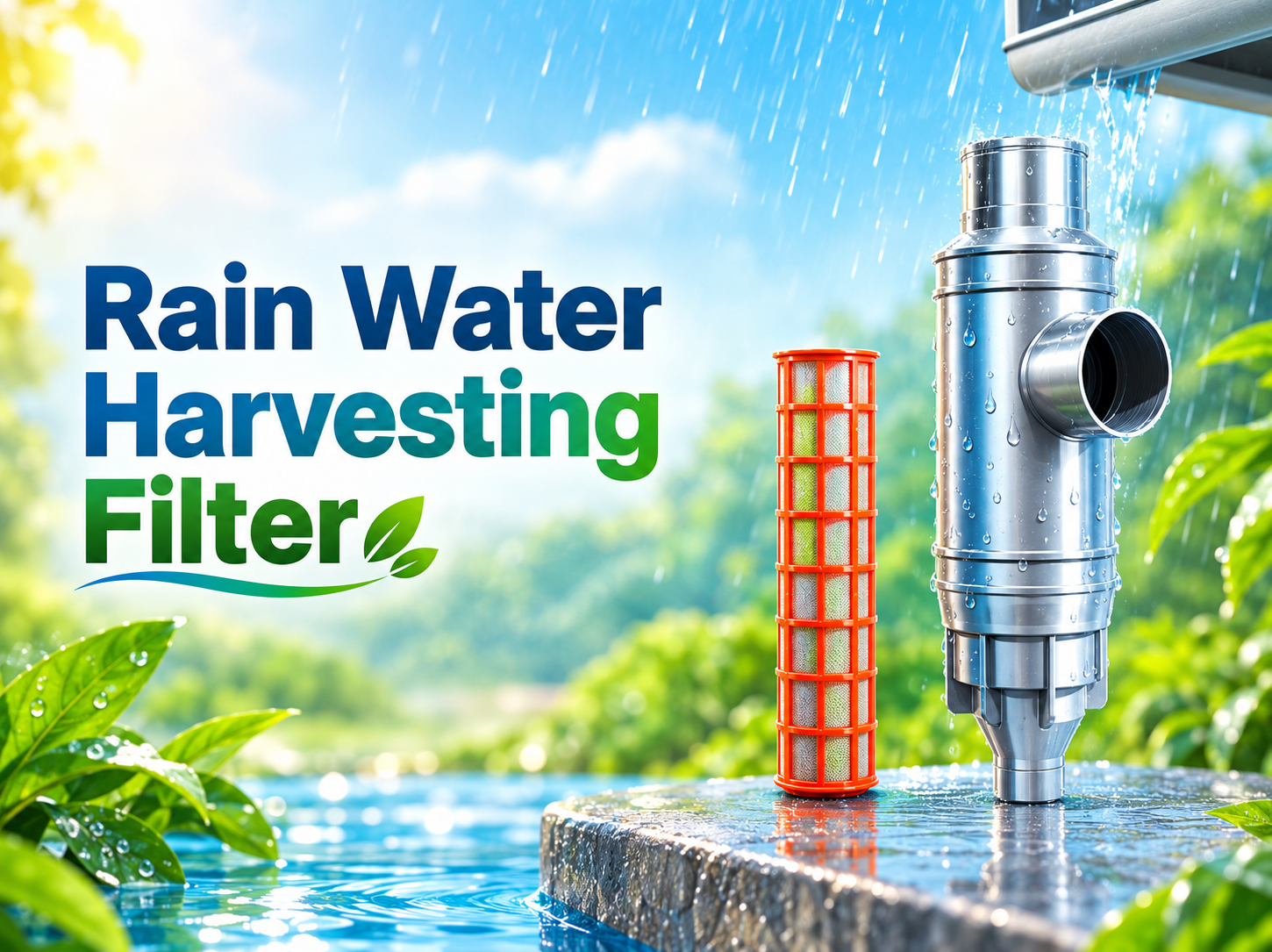
A rain water harvesting filter is a filtration device installed in a rooftop rainwater harvesting system to remove unwanted particles from collected rainwater.
Rainwater may collect different materials while flowing over a roof. These can include:
- Leaves
- Dust
- Sand
- Silt
- Small stones
- Organic debris
- Insects
- Suspended particles
- Other rooftop impurities
A suitable filter helps separate these materials before the water moves into a storage tank or recharge structure.
The basic rainwater harvesting process can be understood as:
Roof → Gutter → Downpipe → First Flush → Filter → Storage or Recharge
The filter should be selected according to the expected water flow and the requirements of the property.
Gajanand Irrigation’s current rainwater harvesting filter product information describes its system as being designed for rooftop and surface catchment applications and lists residential, commercial, industrial, agricultural, institutional, and groundwater recharge applications.
Why Rain Water Harvesting Is Important in Ahmedabad
Ahmedabad is a growing urban area with a large number of residential buildings, apartments, commercial properties, industrial units, educational institutions, and paved surfaces.
As construction increases, more land becomes covered by concrete, tiles, roads, and other relatively impermeable surfaces. During heavy rainfall, water can therefore become surface runoff instead of naturally infiltrating into the ground.
Rainwater harvesting provides a way to capture a portion of this water from suitable surfaces.
The Central Ground Water Board explains that rainwater harvesting can support water availability, groundwater recharge, and increased infiltration, particularly in urban areas where paving has reduced natural infiltration.
A rooftop system can help property owners:
- Collect seasonal rainfall
- Reduce uncontrolled rooftop runoff
- Filter incoming rainwater
- Store water for suitable uses
- Support groundwater recharge
- Improve water management
- Reduce unnecessary water wastage
- Make better use of available rooftop space
For these reasons, rooftop rainwater harvesting can be an important part of sustainable water management in Ahmedabad.
How a Rain Water Harvesting Filter Works
Understanding the working process makes it easier to select and maintain the right system.
1. Rain Falls on the Rooftop
The roof acts as the catchment surface.
Rainwater flows across the roof and moves toward designated collection points.
The roof should be inspected before the rainy season. Leaves, dust, bird droppings, plastic waste, and other debris should be removed.
2. Gutters Collect the Water
Gutters collect rainwater from the roof and direct it toward downpipes.
The gutter system should have sufficient capacity to handle expected rainfall.
Blocked or undersized gutters can cause overflow and reduce collection efficiency.
3. First Flush Diverts Initial Runoff
The first rainfall after a dry period can wash accumulated dust and debris from the roof.
A first-flush system can divert this initial runoff away from the main storage or recharge system.
This reduces the initial contaminant load entering the filtration system.
4. Rainwater Passes Through the Filter
After the first flush, collected water moves through the filter.
The filter removes suitable solid particles and suspended debris.
The exact filtration performance depends on the filter design, mesh size, flow rate, water quality, and maintenance condition.
5. Filtered Water Moves to Storage or Recharge
After filtration, water can be directed toward:
- A rainwater storage tank
- A recharge pit
- A recharge trench
- Another appropriately designed recharge structure
The correct choice depends on the property and the intended use of harvested rainwater.
The Central Ground Water Board identifies recharge pits, recharge trenches, tubewells, and recharge wells among rooftop rainwater/stormwater harvesting approaches for urban areas.
Rain Water Harvesting Filter for Homes in Ahmedabad
A residential rainwater harvesting system does not necessarily need to be complicated.
A typical home system can include:
Roof → Gutter → First Flush → Filter → Tank or Recharge Pit
For a house, the filter should be easy to access and clean.
The system should also protect stored water from unwanted contamination.
Important residential considerations include:
- Roof cleanliness
- Gutter size
- Downpipe diameter
- First-flush arrangement
- Filter capacity
- Storage tank size
- Overflow arrangement
- Filter maintenance
- Tank cleaning
A covered storage tank can help protect stored water from sunlight, insects, animals, and external debris.
Government guidance on rainwater harvesting also emphasizes regular cleaning of filters and tanks and protecting storage from contamination.
Rain Water Harvesting Filter for Apartments
Apartment buildings can collect considerably more rooftop water than individual houses.
A housing society may have:
- Multiple roof sections
- Several downpipes
- Large collection areas
- Multiple drainage points
- Common storage tanks
- Recharge pits
For these systems, the filter should be selected according to the expected flow.
An undersized filter may restrict water movement during heavy rainfall.
A well-designed apartment system can combine several collection points into a planned filtration and recharge arrangement.
Housing societies should also assign responsibility for seasonal inspection and cleaning.
Rain Water Harvesting Filter for Commercial Buildings
Commercial buildings often have large roofs that can collect substantial amounts of rainwater.
Examples include:
- Offices
- Shopping centres
- Hotels
- Showrooms
- Warehouses
- Restaurants
- Institutions
- Business parks
A commercial rainwater harvesting system should consider peak rainfall flow.
The filter, gutters, pipes, storage tanks, and recharge structures should work together.
Maintenance access is particularly important for commercial properties because a blocked filter can affect a large collection area.
Rain Water Harvesting Filter for Industrial Buildings
Industrial properties can have very large roof surfaces.
A properly designed system can collect rainwater from suitable roof areas and direct it toward filtration and storage or recharge.
However, industrial sites require additional attention to water quality.
Before selecting a recharge arrangement, consider:
- Roof material
- Industrial dust
- Chemical exposure
- Atmospheric contaminants
- Roof coatings
- Nearby industrial processes
- Drainage conditions
If a roof or surface may contain harmful contaminants, the water should not automatically be sent to a groundwater recharge structure.
A technical assessment should be performed where contamination is possible.
Types of Rainwater Harvesting Filters
Different properties can require different filtration arrangements.
Mesh-Based Filters
Mesh filters can help stop larger materials such as leaves, insects, and roof debris.
They can be useful as an initial filtration stage.
Screen Filters
Screen filters use a screen or mesh surface to separate particles from water.
They can be suitable where relatively simple filtration and easy cleaning are required.
Multi-Stage Filters
A multi-stage arrangement can use more than one filtration stage.
For example:
Coarse filtration → Fine filtration → Storage
This approach can help manage different particle sizes.
Sand and Gravel Filtration
Sand and gravel can be used in suitably designed filtration chambers.
The design should provide adequate flow while allowing sediment and suspended particles to be reduced before water enters the next stage.
Compact Wall-Mounted Filters
Compact filters can be useful where installation space is limited.
The filter should still have adequate capacity for the connected roof area.
Recharge Filtration Systems
Where rainwater is intended for groundwater recharge, filtration can be incorporated before the water reaches the recharge structure.
The exact design should depend on site conditions.
Key Specifications to Consider When Selecting a Filter
Selecting a filter only by size is not enough.
Consider the following specifications.
Filter Size
The filter size should correspond with the pipe and expected water flow.
Flow Rate
Flow capacity is important during heavy rainfall.
Gajanand Irrigation currently lists its GRF-110 rainwater harvesting filter with a flow-rate range of 20–35 m³/h and 4-inch inlet and clean-water outlet connections.
Mesh Size
Mesh size affects the type and size of particles the filter can retain.
The Gajanand product page currently lists 60 and 120 micron mesh options for the GRF-110 model.
Installation Space
Check whether there is sufficient wall or installation space.
Cleaning Arrangement
The filter should be easy to inspect and clean.
Material
Outdoor filtration equipment should be suitable for the environmental conditions in which it will be installed.
How to Calculate Rainwater Collection Potential
A simple calculation can help estimate potential rainwater collection.
The basic formula is:
Rainwater collected = Rainfall × Roof Area × Runoff Coefficient
For example:
- Roof area = 200 m²
- Rainfall = 50 mm
- Runoff coefficient = 0.80
Convert rainfall:
50 mm = 0.05 metre
Calculation:
200 × 0.05 × 0.80 = 8 m³
Therefore:
8 m³ = 8,000 litres
This is only an example.
Actual collection will depend on:
- Rainfall intensity
- Roof material
- Roof slope
- Surface condition
- Collection efficiency
- First-flush losses
- Filter condition
- Overflow
- Pipe losses
For detailed recharge planning, site-specific calculations are preferable.
Importance of the First Flush System
The first rain after a dry period may contain accumulated rooftop contaminants.
These can include:
- Dust
- Leaves
- Bird droppings
- Small insects
- Organic debris
- Atmospheric particles
If this water enters the storage tank directly, it can increase contamination and sediment accumulation.
A first-flush arrangement diverts the initial runoff.
After the initial roof surface has been washed, cleaner runoff can be directed toward the main filtration system.
This is an important part of a complete rooftop rainwater harvesting design.
How to Install a Rain Water Harvesting Filter
Proper installation helps the filtration system operate effectively.
Step 1: Clean the Roof
Remove leaves, dust, mud, plastic, and other debris.
Step 2: Check the Drainage Path
Make sure rainwater has a clear path from the roof to the collection pipe.
Step 3: Plan the Filter Location
Select a suitable location based on:
- Available space
- Pipe direction
- Vertical alignment
- Distance from storage tank
- Distance from recharge structure
Step 4: Install Mounting Brackets
The mounting arrangement should be strong enough to support the filter and connected pipes.
Step 5: Connect the Inlet
Connect the rooftop rainwater line to the filter inlet.
Step 6: Connect the Clean-Water Outlet
Connect the filtered-water outlet to the storage or recharge line.
Step 7: Provide Drainage
A suitable drain or flushing arrangement should be available for removing collected impurities.
Step 8: Test the System
Run water through the system and check for:
- Leakage
- Overflow
- Incorrect connections
- Poor alignment
- Blockages
Gajanand Irrigation provides an installation procedure for its current rainwater harvesting filter, including wall mounting, bracket alignment, filter-body installation, and inlet/outlet connections.
Maintenance of a Rain Water Harvesting Filter
Regular maintenance is essential.
Even a high-quality filter can perform poorly if it becomes clogged.
Clean the Roof
Clean the roof before and during the rainy season.
Clean Gutters
Remove leaves and accumulated dirt.
Check Downpipes
Look for blockages or leakage.
Inspect the First Flush
Make sure the first-flush mechanism operates correctly.
Clean the Filter
Remove accumulated particles from the filtration element.
Inspect Storage Tanks
Check tanks for sediment and unwanted materials.
Check Recharge Structures
Recharge pits and other structures should be inspected for clogging.
Check Overflow Lines
Make sure excess water has a safe drainage route.
Benefits of Installing a Rain Water Harvesting Filter
A properly selected filter can provide several practical advantages.
1. Reduces Rooftop Debris
The filtration stage can remove leaves, sand, dust, and other suspended material.
2. Helps Protect Storage Tanks
Reducing debris entering the tank can make tank maintenance easier.
3. Supports Groundwater Recharge
When connected to a suitable recharge system, filtration can help prepare rooftop runoff before recharge.
4. Helps Manage Rainwater
Instead of allowing all rooftop runoff to leave the property, part of it can be captured and managed.
5. Supports Water Conservation
Rainwater harvesting makes use of seasonal precipitation.
6. Suitable for Multiple Property Types
The system can be adapted for homes, apartments, commercial buildings, industrial sites, institutions, and agricultural applications.
Rainwater Storage vs Groundwater Recharge
There are two major ways to manage harvested rainwater.
Rainwater Storage
Water is collected in a tank for suitable uses.
Potential non-potable applications can include:
- Gardening
- Landscaping
- Cleaning
- Toilet flushing
- Irrigation
Additional treatment may be required depending on the intended use.
Groundwater Recharge
Water is directed into an appropriately designed recharge structure.
This can support groundwater replenishment where site conditions are suitable.
However, groundwater recharge should not be designed without considering geology, soil, groundwater quality, and groundwater levels.
Gujarat government guidance notes that groundwater recharge needs to be critically planned because recharge depends on factors such as stratification, groundwater-table level, and groundwater quality.
Is Rainwater Harvesting Suitable for Ahmedabad?
Yes, rooftop rainwater harvesting can be a useful water-management approach in Ahmedabad when the system is properly designed.
However, there is no single design that is suitable for every building.
A small residential roof and a large industrial roof have very different flow requirements.
Similarly, a storage-based system has different requirements from a groundwater recharge system.
The Central Ground Water Board’s current publication repository includes a District Recharge Plan for Ahmedabad City, issued in 2025, showing the relevance of planned artificial recharge in the Ahmedabad context.
Why Filter Selection Matters in Gujarat
Gujarat has a strong focus on water conservation and groundwater recharge.
Government of Gujarat information describes water conservation and groundwater recharge as important water-management activities and notes the use of different water-harvesting structures based on soil, topography, and water availability.
This highlights an important point:
Rainwater harvesting should be designed according to local conditions.
The same filter or recharge design may not be appropriate for every property.
Before installation, consider:
- Roof area
- Rainfall
- Soil
- Groundwater conditions
- Water quality
- Building type
- Pipe diameter
- Expected flow
- Storage capacity
- Maintenance requirements
How Gajanand Irrigation Can Help With Rainwater Filtration
Gajanand Irrigation is based in Ahmedabad and has been operating since 1993. Its current product range includes filtration and irrigation products, and its website provides a dedicated rainwater harvesting filter product page.
The Rain Water Harvesting Filter from Gajanand Irrigation is presented for applications including residential rooftop collection, commercial and industrial buildings, groundwater recharge pits, schools, hospitals, institutions, and agricultural water storage.
Internal Link 1: For readers interested in the product, link the anchor text Rain Water Harvesting Filter to the Gajanand Irrigation product page. Rain Water Harvesting Filter product page
Internal Link 2: For readers who want to explore other filtration products, link Gajanand Irrigation Product Catalog to the company’s catalog. Gajanand Irrigation Product Catalog
Internal Link 3: For project enquiries, link Contact Gajanand Irrigation to the company’s contact page. Contact Gajanand Irrigation
These internal links help visitors move from the informational blog to relevant product and enquiry pages.
Rain Water Harvesting Filter for Sustainable Water Management
Water conservation is becoming increasingly important as cities grow.
A rooftop rainwater harvesting system provides a practical way to capture part of the rainfall that reaches a building.
The filtration stage plays an important role because collected water can carry material from the roof.
A complete system should therefore combine:
Catchment + Gutter + First Flush + Rain Water Harvesting Filter + Storage/Recharge + Maintenance
The system should be designed around the building rather than selected only on the basis of price.
Common Mistakes to Avoid
No First Flush
Allowing the first dirty runoff to enter the main system can increase contamination.
Undersized Filter
A filter with insufficient flow capacity may restrict water movement during heavy rain.
Poor Pipe Design
Incorrect pipe sizing can create overflow and reduce collection efficiency.
Ignoring Maintenance
Filters need inspection and cleaning.
Open Storage
An uncovered storage tank can allow unwanted materials and insects to enter.
Direct Recharge Without Assessment
Recharge should consider local soil, geology, groundwater, and water-quality conditions.
Assuming Filtered Rainwater Is Drinking Water
A rainwater harvesting filter is not automatically a complete drinking-water purification system.
If harvested water is intended for drinking, suitable treatment and testing should be considered.
Rain Water Harvesting Filter Maintenance Checklist
| Component | Maintenance Task |
|---|---|
| Rooftop | Remove leaves, dust and debris |
| Gutter | Check for blockages |
| Downpipe | Inspect water flow and leakage |
| First Flush | Check operation |
| Filter | Clean accumulated particles |
| Storage Tank | Inspect and clean |
| Recharge Pit | Check for sediment and clogging |
| Pipes | Check connections and leakage |
| Overflow | Ensure safe drainage |
A maintenance schedule should be prepared before the monsoon.
How to Choose the Right Rain Water Harvesting Filter
Before purchasing a filter, answer these questions:
What is the roof area?
The larger the roof, the greater the potential water flow.
What is the pipe size?
The filter should be compatible with the collection pipeline.
How much water can the filter handle?
Check the expected flow rate.
What type of debris is present?
Properties surrounded by trees may receive more leaves and organic debris.
Is water going to storage or recharge?
The filtration and downstream arrangement may differ.
Is there enough installation space?
Check the wall or chamber area.
Can the filter be cleaned easily?
Easy maintenance helps preserve long-term performance.
What are the local site conditions?
For groundwater recharge, local hydrogeological conditions matter.
Conclusion
A rain water harvesting filter is an important component of a properly designed rooftop rainwater harvesting system in Ahmedabad, Gujarat. It helps reduce leaves, dust, sand, silt, and other suspended particles before collected rainwater reaches a storage tank or suitable recharge structure.
However, the filter is only one part of the complete system.
A successful installation should combine a suitable rooftop catchment, properly sized gutters and pipes, first-flush management, filtration, storage or recharge, overflow management, and regular maintenance.
For Ahmedabad homes, apartments, commercial buildings, factories, schools, warehouses, and institutions, the right system should be selected according to the property’s actual requirements.
Gujarat government guidance emphasizes that groundwater recharge needs to be planned according to factors such as groundwater conditions and local strata, while the Central Ground Water Board provides technical guidance on rooftop rainwater harvesting and artificial recharge.
For product-specific requirements, readers can explore Gajanand Irrigation’s Rain Water Harvesting Filter and related water-filtration solutions. Explore the Rain Water Harvesting Filter