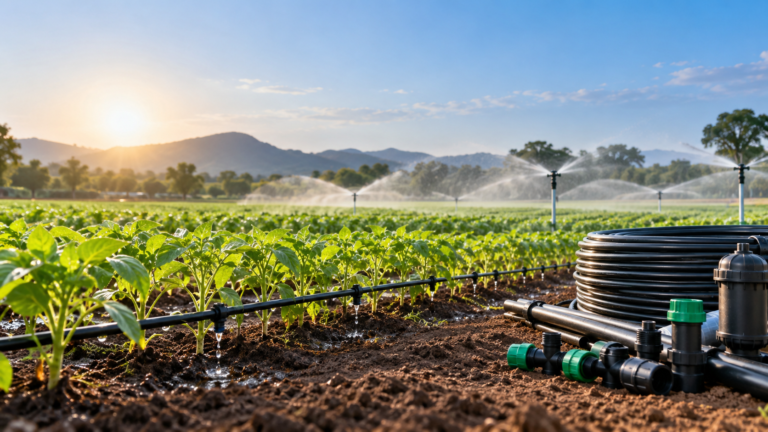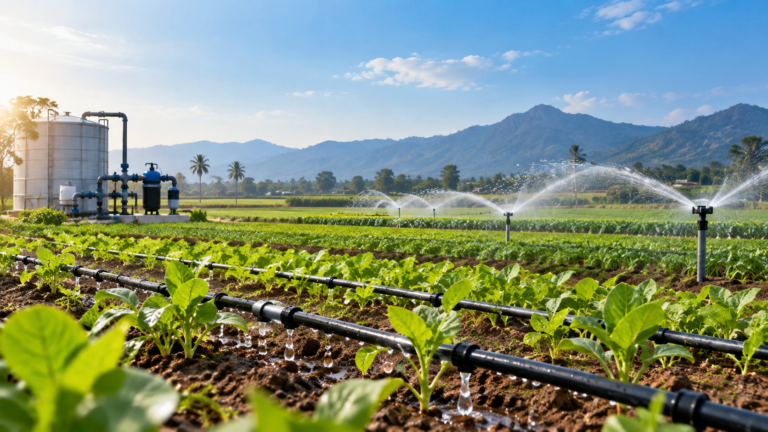
Introduction: Rice Cultivation Made Easy with Drip Irrigation
Rice cultivation made easy with drip irrigation is becoming an important approach for farmers who want better control over water application, crop nutrition, and field management. Rice traditionally requires substantial water, especially in conventional flooded cultivation. With changing rainfall patterns, rising irrigation costs, and increasing pressure on available water resources, efficient irrigation management is becoming increasingly important.
A properly planned drip irrigation system for rice delivers water closer to the crop root zone instead of distributing large quantities of water across the entire field. This can help farmers manage irrigation more precisely and reduce unnecessary water movement, evaporation, runoff, and deep percolation where conditions permit. Research on drip irrigation in rice has also examined its potential to improve water-use efficiency and crop productivity.
For farmers looking for reliable agricultural irrigation components, Gajanand Irrigation provides a range of irrigation products, including drip systems, filters, pipes, fittings, valves, and fertigation assemblies. The company is based in Ahmedabad, Gujarat, and has operated since 1993.
This guide explains how rice cultivation made easy with drip irrigation works, what components are important, how water and nutrients can be managed, and what farmers should consider before installing a system.
What Is Drip Irrigation for Rice Cultivation?
Drip irrigation is a precision irrigation method in which water is delivered through a network of pipes and irrigation lines to locations close to plant roots.
Instead of flooding the complete field, the system focuses water application around the crop’s active root zone. The objective is not simply to use less water. The objective is to apply water at the right location, in the right quantity, and at the right time.
This approach can make rice cultivation with drip irrigation easier to monitor because farmers can divide their fields into irrigation zones and control water delivery according to crop requirements.
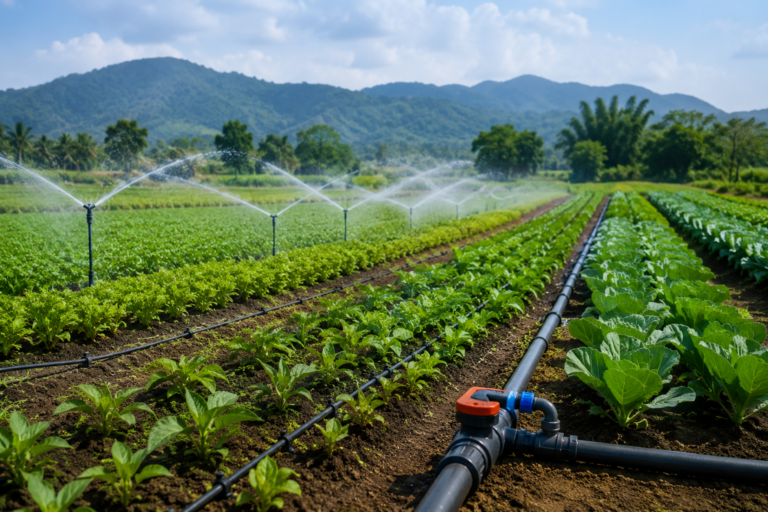
A typical agricultural drip irrigation system can include:
- Water source
- Pumping system
- Mainline
- Sub-mainlines
- Drip lines
- Filters
- Valves
- Fittings
- Pressure-control components
- Fertigation equipment
- Flush arrangements
- Other irrigation accessories
The exact design should be based on field size, soil type, water quality, crop spacing, topography, pressure requirements, and the selected cultivation method.
Why Is Drip Irrigation Important for Rice?
Rice is traditionally associated with flooded fields. However, flooding is not the only possible approach to rice water management.
The International Rice Research Institute notes that conventional irrigated lowland rice can require substantial seasonal water inputs, with requirements varying considerably according to soil, groundwater, climate, and field conditions.
Research published through ICAR has also identified water scarcity, rainfall uncertainty, labour availability, and soil-moisture management as important challenges for rice cultivation. Drip irrigation has been investigated as a way of applying water and nutrients near the root zone.
This makes drip irrigation for rice particularly interesting for farms where water availability or irrigation efficiency is a major concern.
Major advantages can include:
- More controlled water application
- Reduced unnecessary field flooding
- Better root-zone moisture management
- Potential improvement in water-use efficiency
- Possibility of fertigation
- Better control over irrigation zones
- Reduced water movement outside the target area
- Easier monitoring of irrigation
- Potential reduction in manual irrigation work
- Better integration with modern farm management
However, farmers should not assume that every rice field will achieve identical results. Performance depends on system design, crop establishment, soil conditions, irrigation scheduling, maintenance, and local climate.
How Does Rice Cultivation Made Easy with Drip Irrigation Work?
The basic principle is simple.
Water moves from the source through the main irrigation line. Filters remove unwanted particles from the irrigation water. Valves and fittings control distribution. Water then reaches the drip lines installed according to the crop layout.
The drip system applies water near the crop root zone.
This creates a controlled irrigation environment rather than applying large amounts of water across the complete field.
For rice cultivation made easy with drip irrigation, the process can generally be organized into the following steps:
1. Assess the Farm
Before installing the system, evaluate:
- Total cultivated area
- Field dimensions
- Soil type
- Water source
- Water quality
- Available pumping capacity
- Elevation differences
- Rice variety and planting method
- Crop spacing
- Expected irrigation requirement
A professional irrigation design can help determine the appropriate pipe sizes, filtration requirements, irrigation zones, and operating pressure.
2. Test the Irrigation Water
Water quality is an important consideration in drip irrigation.
Suspended particles, sand, silt, algae, and other impurities can cause clogging if they enter irrigation lines.
This is why filtration should be considered an important part of a rice irrigation system.
3. Install Filtration
Gajanand Irrigation offers screen filters designed for irrigation applications. Its product information describes these filters as being suitable for drip, sprinkler, micro-irrigation, greenhouse, horticulture, and related applications.
The company’s screen filter information also identifies sand, silt, algae, and suspended particles as contaminants that can contribute to clogging.
Gajanand Irrigation Screen Filters
4. Divide the Field into Zones
Large rice fields can be divided into manageable irrigation zones.
This allows farmers to control water delivery and operate different sections according to field requirements.
5. Install Drip Lines
Drip lines should be positioned according to crop geometry and the selected rice production method.
The design should ensure adequate wetting of the crop root zone.
6. Control Irrigation
Water should be supplied according to crop growth, soil moisture, weather conditions, and irrigation-system performance.
Avoid using a fixed irrigation schedule throughout the entire crop cycle without considering actual field conditions.
Key Components of a Rice Drip Irrigation System
A successful drip irrigation system for rice depends on more than drip lines.
Several components work together to maintain controlled water delivery.
1. Filters
Filters protect irrigation equipment from particles that may cause clogging.
Gajanand Irrigation provides different filtration solutions, including screen filters, disc filters, and hydrocyclone filters.
Explore Gajanand Irrigation Disc Filters
The appropriate filtration arrangement depends on the quality and characteristics of the available water.
2. Pipes
Mainlines and sub-mainlines transport water from the source to different sections of the field.
Proper pipe sizing is important because undersized pipes can create excessive pressure losses and uneven distribution.
3. Valves
Valves provide control over water movement.
They can be used to:
- Open or close irrigation zones
- Control individual sections
- Isolate equipment
- Support maintenance
- Manage water flow
Gajanand Irrigation’s product range includes ball valves, butterfly valves, flush valves, air-release valves, and non-return valves.
4. Irrigation Fittings
Fittings connect various parts of the irrigation network.
Reliable fittings help create a properly connected irrigation system and reduce the possibility of leakage.
Gajanand Irrigation lists poly fittings, push fittings, drip fittings, and related irrigation components within its product range.
5. Fertigation Assembly
One of the important advantages of a well-designed irrigation system is the possibility of combining irrigation and nutrient application.
Gajanand Irrigation offers a fertigation assembly for irrigation applications.
Gajanand Irrigation Fertigation Assembly
Fertigation should be carried out according to crop nutrient requirements and appropriate agricultural recommendations.
Benefits of Rice Cultivation with Drip Irrigation
Better Water Management
The most important benefit of rice cultivation made easy with drip irrigation is controlled water application.
Instead of maintaining unnecessary standing water across the entire field, irrigation can focus on the crop’s root zone.
This can be particularly useful in areas where irrigation water is limited.
Improved Water-Use Efficiency
Water-use efficiency describes how effectively available water contributes to crop production.
Research on rice under drip irrigation has evaluated different irrigation regimes and found that irrigation scheduling has a significant relationship with yield and water-use efficiency.
Therefore, installing drip equipment alone is not enough.
Good system design + correct irrigation scheduling + regular maintenance = better irrigation performance.
Root-Zone Irrigation
Traditional irrigation can distribute water over a large area.
Drip irrigation focuses application around the root zone.
This can provide farmers with greater control over the moisture environment around rice plants.
Possibility of Fertigation
Water and nutrients can potentially be managed together through fertigation.
Instead of applying nutrients separately, properly prepared soluble fertilizers can be introduced through an appropriate fertigation system.
This can help distribute nutrients with irrigation water when the system and fertilizer are suitable for such application.
Reduced Unnecessary Water Movement
When water is applied directly to the crop zone, farmers can potentially reduce water movement into areas where it does not contribute directly to crop growth.
The actual result depends on soil texture, field preparation, drip-line arrangement, irrigation duration, and drainage conditions.
Rice Irrigation Management at Different Crop Stages
A major mistake is treating the rice crop as though it has the same water requirement from planting to harvest.
Crop water demand changes throughout the growing season.
Land Preparation
Land preparation should be planned according to the selected rice establishment method.
Traditional puddled rice and aerobic or direct-seeded systems have different water-management requirements.
Drip irrigation should therefore be designed around the actual production method rather than simply copying a conventional flooded-field schedule.
Establishment Stage
During establishment, maintaining suitable moisture is important for successful crop development.
The irrigation frequency should consider:
- Soil type
- Temperature
- Rainfall
- Crop establishment method
- Root development
- Field drainage
Avoid both excessive drying and unnecessary over-irrigation.
Vegetative Growth
During vegetative growth, rice develops leaves, roots, and tillers.
Water should be supplied according to soil moisture and crop demand.
Regular field observation is important because the same irrigation duration may not be appropriate every day.
Tillering Stage
Tillering is an important phase in rice production.
Good moisture management can support healthy crop development.
With a drip system, farmers can adjust irrigation according to field observations rather than depending entirely on traditional flooding practices.
Flowering Stage
Water management becomes particularly important around flowering.
The crop should not be allowed to experience unnecessary moisture stress.
Irrigation scheduling should therefore be carefully monitored during this stage.
Research trials have demonstrated that irrigation regime can influence rice growth and yield attributes, highlighting the importance of stage-specific irrigation management.
Grain Filling and Maturity
During grain filling, irrigation should continue according to crop requirements.
As harvest approaches, irrigation management should be adjusted so that the field can reach suitable conditions for harvesting.
How to Schedule Drip Irrigation for Rice
There is no single irrigation duration that is correct for every rice field.
The irrigation schedule should be developed based on:
- Soil moisture
- Soil texture
- Weather
- Crop stage
- Rainfall
- Evapotranspiration
- Drip-line discharge
- Field size
- Irrigation-zone size
- Water availability
For example, sandy soil generally behaves differently from heavy clay soil. A field with high evaporative demand may require different irrigation management from a cooler or more humid location.
Therefore, farmers should avoid blindly following an irrigation timetable from another farm.
The goal of drip irrigation is precision, not simply frequent irrigation.
Soil Type and Drip Irrigation in Rice Farming
Soil type strongly influences water movement.
Sandy Soil
Sandy soils generally have faster drainage and lower water-holding capacity.
Shorter and more frequent irrigation applications may be required, depending on crop conditions.
Loamy Soil
Loamy soils can provide a balance between drainage and water retention.
They may allow more flexible irrigation intervals.
Clay Soil
Clay soils can retain considerable moisture but may have slower infiltration and drainage.
Excessive irrigation can create drainage problems.
This is why rice cultivation with drip irrigation should always consider the physical properties of the soil.
The Role of Filtration in Rice Drip Irrigation
Filtration is one of the most important parts of a drip irrigation system.
A blocked emitter cannot deliver the designed amount of water.
Gajanand Irrigation’s screen filters are designed to remove physical contaminants such as sand, silt, algae, and other suspended particles.
The company also provides disc filtration solutions as part of its irrigation product range.
Farmers should select filtration based on:
- Water source
- Water quality
- Suspended solids
- System flow
- Drip-line requirements
- Maintenance practices
Regular filter cleaning is also essential.
Fertigation in Rice Cultivation
Drip fertigation for rice combines irrigation and nutrient management.
The basic idea is to introduce suitable water-soluble nutrients into irrigation water through a fertigation assembly.
This can provide several management advantages:
- Controlled nutrient application
- Better timing of nutrient delivery
- Reduced manual application work
- Integration of irrigation and fertilization
- More targeted nutrient management
However, fertilizer concentration, compatibility, application timing, and crop nutrient requirements should be determined carefully.
Farmers should follow recommendations from qualified agricultural professionals and fertilizer manufacturers when planning fertigation.
How Gajanand Irrigation Supports Modern Agricultural Irrigation
Gajanand Irrigation is an Ahmedabad-based irrigation manufacturer that has been operating since 1993. Its website lists irrigation products including drip systems, filters, pipes, fittings, valves, and accessories.
The company states that it has manufacturing machines, quality-testing equipment, and a research and development team. It also describes itself as BIS-certified and lists domestic and international market presence.
Its product range includes:
- Screen filters
- Disc filters
- Hydrocyclone filters
- Irrigation fittings
- Venturi
- Ball valves
- Air-release valves
- Flush valves
- Header assemblies
- Drip fittings
- Poly fittings
- Push fittings
- Mini sprinklers
- Fertigation assemblies
- Foot valves
These components can form part of a broader agricultural irrigation infrastructure depending on the farm’s specific design requirements.
Explore Gajanand Irrigation’s Agricultural Irrigation Products
Maintenance Tips for Rice Drip Irrigation
Installing a drip system is only the first step.
Regular maintenance is necessary to maintain consistent performance.
Clean Filters Regularly
Inspect filtration equipment according to water quality and system use.
A dirty filter can increase pressure loss and reduce system performance.
Check Drip Lines
Inspect lines for:
- Leakage
- Physical damage
- Blockages
- Uneven discharge
- Loose connections
Inspect Valves
Valves should open and close properly.
Faulty valves can affect irrigation-zone operation.
Flush the System
Flushing helps remove accumulated particles from irrigation lines.
The frequency should depend on water quality and system design.
Monitor Pressure
Pressure should remain within the operating range specified for the system.
Large pressure differences between field sections can lead to uneven irrigation.
Check the Field
Technology does not replace field observation.
Farmers should regularly check:
- Soil moisture
- Plant growth
- Leaf condition
- Root-zone moisture
- Uneven crop development
- Standing water
- Dry patches
Common Mistakes to Avoid
1. Installing Without Proper Design
A drip system should not be installed simply by placing pipes across the field.
Hydraulic design matters.
2. Ignoring Water Quality
Poor water quality can increase clogging problems.
Filtration should be planned from the beginning.
3. Using the Same Schedule Every Day
Crop water demand changes.
Irrigation should respond to weather, crop stage, and soil moisture.
4. Ignoring Pressure
Uneven pressure can create uneven water application.
5. Not Maintaining Filters
A filter only protects the system when it is maintained properly.
6. Over-Irrigating
Drip irrigation is not designed to encourage excessive irrigation.
More water does not automatically mean more production.
7. Using Incorrect Fertilizers in Fertigation
Not every fertilizer is suitable for injection through irrigation equipment.
Compatibility should be checked before application.
Is Drip Irrigation Suitable for Every Rice Farm?
Drip irrigation can be suitable for many rice-production situations, but the suitability depends on the cultivation method and field conditions.
Before investing in a system, farmers should evaluate:
- Water availability
- Rice establishment method
- Soil type
- Field size
- Topography
- Water quality
- Available power
- Existing irrigation infrastructure
- Labour availability
- Crop rotation
- Budget
- Expected operating costs
A technical irrigation assessment can help determine whether drip irrigation is appropriate and how the system should be designed.
How to Make Rice Cultivation More Efficient with Drip Irrigation
Farmers can improve irrigation management by combining technology with good agricultural practices.
Step 1: Understand the Field
Map the field and identify differences in soil, elevation, and drainage.
Step 2: Analyze Water
Check the water source and quality.
Step 3: Choose Proper Filtration
Select filtration according to the water quality and irrigation-system requirements.
Step 4: Design Irrigation Zones
Divide the farm into practical sections.
Step 5: Install Quality Components
Use suitable pipes, valves, fittings, filters, and irrigation lines.
Step 6: Establish an Irrigation Schedule
Adjust irrigation according to crop stage, soil, weather, and water availability.
Step 7: Monitor the Crop
Look for dry areas, excess moisture, uneven growth, and other field indicators.
Step 8: Maintain the System
Clean filters, flush lines, inspect fittings, and check pressure regularly.
Frequently Asked Questions About Rice Cultivation Made Easy with Drip Irrigation
1. Can rice be grown using drip irrigation?
Yes. Rice can be cultivated under drip irrigation in appropriate production systems. Research has evaluated drip irrigation for rice with a focus on water management, productivity, and water-use efficiency.
2. What are the main benefits of drip irrigation for rice?
The main potential benefits include controlled water delivery, root-zone irrigation, improved irrigation management, reduced unnecessary water movement, and the possibility of fertigation. Results depend on system design, soil, climate, crop establishment, and irrigation scheduling.
3. Is filtration necessary for a rice drip irrigation system?
Yes, filtration is generally an important part of drip irrigation because suspended particles can clog irrigation components. Gajanand Irrigation provides screen and disc filtration products for irrigation applications.
4. Can fertilizer be applied through drip irrigation in rice?
Yes, suitable water-soluble nutrients can be applied through a properly designed fertigation system. Fertilizer compatibility, concentration, timing, and crop requirements should be carefully considered.
5. How often should rice be irrigated with drip irrigation?
There is no universal irrigation frequency. The schedule depends on soil type, weather, crop stage, rainfall, drip-line discharge, and field conditions. Farmers should monitor root-zone moisture and adjust irrigation accordingly.
6. How can farmers maintain a rice drip irrigation system?
Farmers should regularly inspect filters, drip lines, pipes, fittings, valves, pressure, and flushing points. Regular maintenance helps reduce clogging and leakage and supports consistent water distribution.
Conclusion: Make Rice Farming More Water-Efficient
Rice cultivation made easy with drip irrigation is based on one important principle: provide water where the crop needs it and manage the application according to actual crop conditions.
Drip irrigation can provide farmers with greater control over water delivery than conventional field-wide irrigation. When combined with appropriate filtration, irrigation fittings, valves, fertigation equipment, proper scheduling, and regular maintenance, it can become an important part of modern rice water management.
For farmers considering a drip irrigation system for rice, the first step should be a proper assessment of the farm, soil, water source, crop establishment method, and irrigation requirements.
Gajanand Irrigation provides a range of agricultural irrigation products, including filters, valves, fittings, drip-related components, and fertigation assemblies. The company states that it has been serving the irrigation sector since 1993 and operates from Ahmedabad, Gujarat.