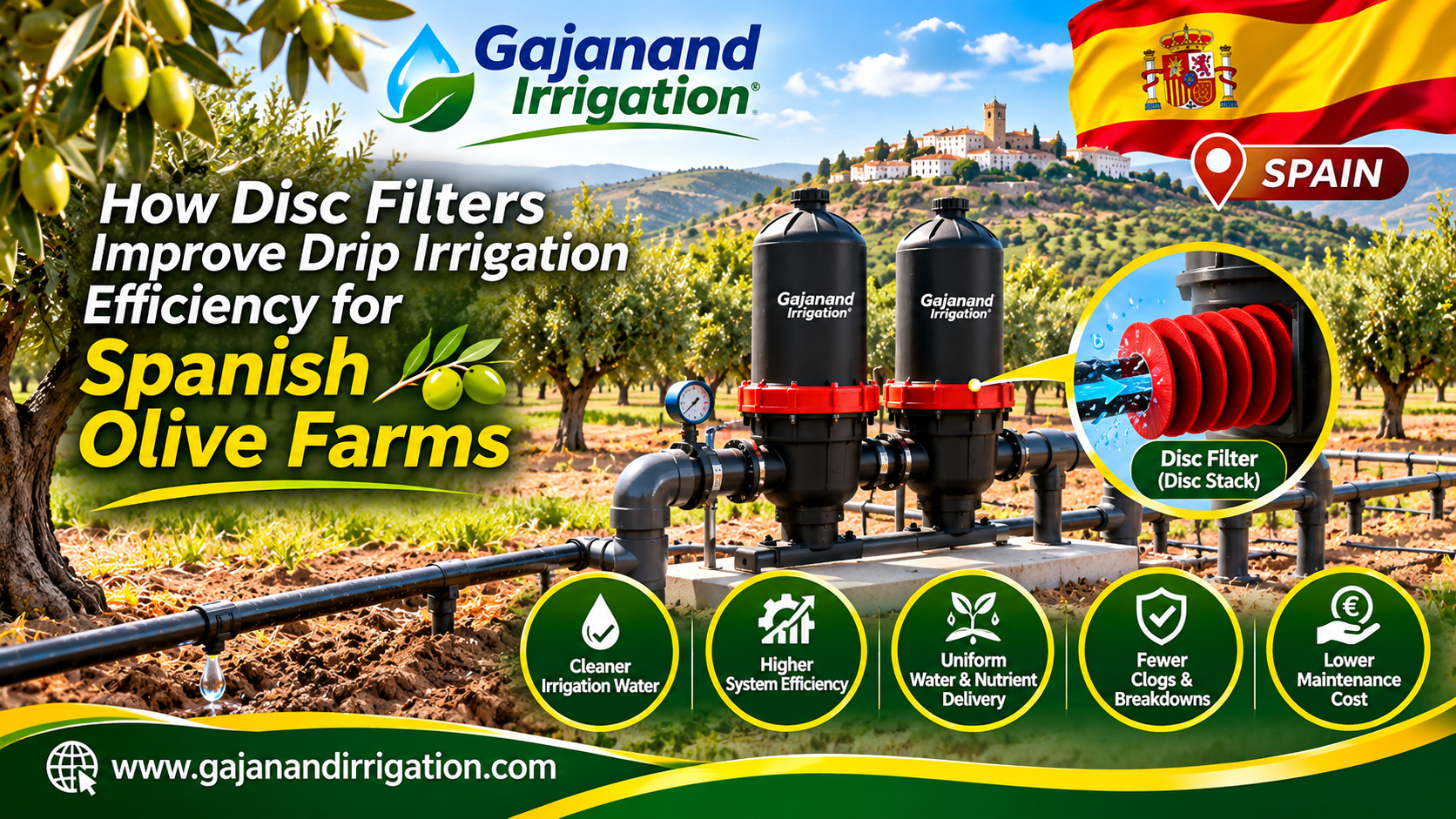
Spain is one of the world’s leading olive-producing countries. Olive farming plays an important role in its agricultural economy, particularly in regions such as Andalusia, Castilla-La Mancha, Extremadura, and Catalonia. However, olive farmers face several challenges, including water scarcity, irregular rainfall, rising irrigation costs, and the need to maintain consistent crop quality.
Efficient irrigation has become essential for modern olive cultivation. Many farms use drip irrigation to deliver water directly to the root zone of olive trees. This method helps farmers manage water carefully while supporting healthy tree growth.
However, drip irrigation systems require clean water to operate properly. Sand, silt, algae, and other suspended impurities can block small dripper openings. When this happens, water distribution becomes uneven, and some trees may receive less water than others.
This is where Disc Filters for Drip Irrigation become an important part of agricultural water management.
Disc filters help remove unwanted particles from irrigation water before it enters the drip network. They protect irrigation components, reduce the risk of clogging, and support more consistent water delivery.
For Spanish olive farms, a suitable disc filtration system can improve irrigation reliability and make daily farm management easier.
Understanding Drip Irrigation in Spanish Olive Farming
Olive trees are well adapted to Mediterranean climates. They can tolerate dry conditions better than many other fruit crops. However, commercial olive production still requires careful water management, especially during important growth and fruit development stages.
Spain experiences long, dry summers in many olive-growing regions. Rainfall may be limited during periods when trees need water for fruit development.
Traditional irrigation methods may use more water than necessary because water is distributed over a larger area. Drip irrigation offers a more controlled approach.
A drip irrigation system delivers water through small emitters installed along irrigation pipes. These emitters release water slowly near the root zone.
This approach provides several benefits:
- Water is applied close to the roots.
- Evaporation losses can be reduced.
- Farmers can control irrigation frequency.
- Water can be distributed according to crop requirements.
- Fertilizers can be applied through suitable fertigation systems.
- Irrigation can be divided into different field zones.
However, the performance of a drip irrigation system depends on several factors. These include water quality, pressure management, pipeline design, emitter selection, and regular maintenance.
Among these factors, water filtration is particularly important.
Why Water Filtration Matters for Olive Farms
Irrigation water does not always contain only dissolved minerals. It may also carry suspended particles and organic materials.
The type and quantity of impurities depend on the water source.
For example, water from an open reservoir may contain algae, leaves, organic matter, and fine sediment. Groundwater may contain sand or other mineral particles. Surface water may experience changing contamination levels after rainfall.
These impurities can enter the irrigation system and create operational problems.
1. Dripper Clogging
Drippers have small water outlets. Even a small amount of accumulated dirt can restrict water flow.
When drippers become blocked, the affected olive trees may receive insufficient water.
2. Uneven Water Distribution
A clogged dripper can create differences in water delivery between trees.
Some trees may receive the required amount of water, while others may experience water stress.
3. Increased Maintenance
Farm workers may need to inspect irrigation lines, clean emitters, and flush pipelines more frequently.
This increases maintenance time and can interrupt irrigation schedules.
4. Reduced Irrigation Reliability
When filtration is inadequate, the irrigation system may not perform consistently throughout the season.
For olive farmers, this can make irrigation planning more difficult.
A suitable filtration system helps reduce these risks by removing particles before they reach the drip network.
What Are Disc Filters for Drip Irrigation?
Disc filters for drip irrigation are water filtration devices that use a stack of specially grooved discs to remove suspended impurities.
The discs are placed inside a filter housing. Their surfaces contain fine grooves that create small filtration pathways.
When water passes through the compressed disc stack, particles are trapped between the grooves.
The filtration process helps remove impurities such as:
- Sand and fine mineral particles
- Silt and suspended sediment
- Algae and organic matter
- Other particles that may cause irrigation clogging
Disc filters are commonly used in agricultural irrigation systems, including drip irrigation, sprinkler irrigation, greenhouse irrigation, and orchard irrigation.
Their compact design makes them suitable for many agricultural applications.
For olive farms, disc filters can be installed near the irrigation water source or within the main filtration assembly, depending on the system design.
Farmers should select the filter according to water quality, required filtration level, system flow rate, and emitter specifications.
How Disc Filters Work in an Irrigation System
The working principle of a disc filter is based on mechanical filtration.
A disc filter contains multiple circular discs with fine grooves on their surfaces. These discs are stacked together and compressed inside the filter body.
The grooves create a three-dimensional filtration structure.
When water enters the filter, it passes through the spaces between the discs. Suspended particles become trapped within the grooves, while filtered water moves toward the irrigation pipeline.
The process can be explained in four steps.
Step 1: Water Enters the Filter
Water from the pump, reservoir, borewell, or another source enters the filter housing.
Step 2: Water Passes Through the Disc Stack
The water moves through the small filtration pathways created by the stacked discs.
Step 3: Impurities Are Retained
Particles larger than the effective filtration openings are captured within the disc grooves.
Step 4: Filtered Water Moves to the Drip Network
The filtered water exits the filter and travels through the mainline, sub-mainlines, and drip laterals.
This process helps reduce the amount of suspended material entering the irrigation system.
The filter must be cleaned when dirt accumulates and restricts water flow. Cleaning may be manual or automatic, depending on the filter design.
How Disc Filters Improve Drip Irrigation Efficiency
Disc filters contribute to irrigation efficiency in several ways. Their main benefit is not simply removing dirt. They also help maintain the performance of the complete irrigation network.
1. Reduce Dripper Clogging
One of the most important benefits of disc filters is their ability to reduce the risk of dripper blockage.
Olive farms often operate irrigation systems across large areas. A single field may contain hundreds or thousands of trees connected through multiple irrigation lines.
If the water contains suspended impurities, these particles can accumulate inside emitters.
Disc filters help capture suitable particles before they enter the drip laterals.
This supports more reliable water delivery and reduces the need for frequent emitter cleaning.
2. Support Uniform Water Distribution
Uniform irrigation is important for maintaining consistent tree growth.
When drippers operate properly, water can be delivered more evenly across the irrigation zone.
Disc filters help protect the emitters from physical clogging.
However, uniform irrigation also depends on correct pipe sizing, operating pressure, emitter spacing, and field design.
A filter alone cannot correct pressure differences or an incorrectly designed irrigation network.
3. Help Maintain Water-Saving Irrigation
Drip irrigation is widely used because it allows controlled water application.
However, a drip system cannot achieve its intended performance if the emitters are frequently blocked.
Disc filters help maintain the flow of water through the system.
This supports more reliable irrigation scheduling and reduces water losses associated with leaks, flushing, and inefficient operation.
The actual water savings depend on the complete irrigation design and farm management practices.
4. Reduce Maintenance Requirements
Without proper filtration, farmers may need to clean irrigation lines and emitters frequently.
Disc filters help reduce the amount of dirt entering the drip network.
This can make routine maintenance easier and reduce the time spent on cleaning individual irrigation components.
The filter itself still requires regular inspection and cleaning.
5. Protect Irrigation Components
A drip irrigation system includes several important components:
- Mainline and sub-mainline pipes
- Drip laterals
- Drippers and emitters
- Irrigation valves
- Fertigation equipment
- Connectors and fittings
When suspended particles enter the system, they may accumulate in different sections.
Disc filtration helps protect these components from particle-related problems and supports longer, more reliable operation.
6. Improve Irrigation Management
Reliable filtration allows farmers to focus more on irrigation scheduling rather than repeated cleaning.
When the system operates consistently, farmers can plan irrigation according to soil moisture, weather conditions, tree age, and crop requirements.
This is especially useful for large olive farms that operate several irrigation zones.
Why Disc Filters Are Suitable for Spanish Olive Farms
Spanish olive farms operate under different climatic and agricultural conditions.
Some farms use traditional olive groves with widely spaced trees. Others use intensive or super-intensive planting systems with closer tree spacing.
The irrigation requirements of these systems can vary considerably.
Disc filters can be suitable for many olive farming applications because they offer a compact filtration solution for agricultural water.
Mediterranean Climate Conditions
Many Spanish olive-growing regions experience hot summers and limited rainfall.
During dry periods, irrigation becomes an important part of farm management.
Water quality may change throughout the irrigation season, particularly when farmers use reservoirs or surface water sources.
Disc filters help manage suspended impurities in the irrigation supply.
Large Irrigation Networks
Commercial olive farms may contain multiple irrigation zones.
Each zone requires suitable water flow and pressure.
A properly selected disc filter can support the required filtration capacity while protecting the irrigation network.
Intensive Olive Cultivation
Intensive olive cultivation often uses carefully planned irrigation systems.
These systems depend on reliable water delivery to many trees.
Disc filtration helps reduce the risk of clogging and supports consistent irrigation performance.
Efficient Agricultural Water Management
Water availability is a major concern in many Mediterranean agricultural areas.
Farmers need irrigation systems that deliver water efficiently and operate reliably.
Disc filters support this objective by helping maintain clean irrigation water and reducing particle-related problems.
Choosing the Right Disc Filter for an Olive Farm
Selecting the correct disc filter is important for achieving effective filtration.
Farmers should not choose a filter only by its pipe connection size.
The filter must match the water quality and hydraulic requirements of the irrigation system.
1. Understand the Water Source
The first step is to identify the irrigation water source.
Different sources may require different filtration arrangements.
For example:
- Groundwater may contain sand or mineral particles.
- Reservoir water may contain algae and organic matter.
- Surface water may contain varying amounts of sediment.
- Reused water may require additional treatment.
Water testing can help identify the type and quantity of impurities.
2. Select the Correct Filtration Grade
Disc filters are available in different filtration grades.
The required grade depends on the smallest passage in the irrigation system and the quality of the water.
A common filtration requirement for drip irrigation is around 120 mesh, equivalent to approximately 130 microns. However, the exact requirement should be confirmed with the emitter manufacturer and system design.
A finer filter is not always the best choice.
If the filtration grade is unnecessarily fine, the filter may require more frequent cleaning and create additional pressure loss.
3. Check the Required Flow Rate
The filter must handle the total flow required by the irrigation zone.
An undersized filter may create excessive pressure loss and reduce system performance.
An oversized filter may increase the initial investment unnecessarily.
Farmers should calculate the irrigation flow rate before selecting the filter model.
4. Check Operating Pressure
Disc filters must operate within their specified pressure range.
The pressure should be suitable for the pump, pipeline, filter, and irrigation emitters.
Farmers should also monitor the pressure difference between the filter inlet and outlet.
An increasing pressure difference may indicate that the filter requires cleaning.
5. Consider Maintenance Requirements
A suitable filter should be easy to inspect and clean.
Farmers should consider how frequently the filter may require maintenance based on water quality and irrigation hours.
Easy access to the filter helps simplify regular cleaning.
Disc Filters vs Screen Filters for Olive Irrigation
Both disc filters and screen filters are used in drip irrigation systems.
However, their filtration mechanisms are different.
Screen filters use a mesh surface to capture particles. Disc filters use grooved discs that create multiple filtration pathways.
Disc filters provide a larger effective filtration structure and can be useful when water contains a combination of suspended mineral and organic particles.
Screen filters may be suitable for water sources with relatively low contamination levels and for applications where surface filtration is appropriate.
The best option depends on water quality, required filtration grade, flow rate, and maintenance conditions.
For some olive farms, a combination of filtration technologies may provide better protection.
Farmers can explore Gajanand Irrigation’s Screen Filters for Irrigation to understand another filtration option for agricultural applications.
Using Disc Filters with Hydrocyclone Filters
Some olive farms use groundwater that contains significant amounts of sand.
In such cases, a disc filter may not be the only filtration component required.
A hydrocyclone filter can be installed before the main filtration unit to separate heavier sand particles from water.
The hydrocyclone uses centrifugal action to separate suitable particles.
After sand separation, the water can pass through a disc filter for further filtration.
This combination can help reduce the sand load reaching the disc filter.
However, hydrocyclones do not remove every type of suspended impurity. Their effectiveness depends on particle size, density, water flow, and operating conditions.
The filtration system should be designed according to the actual water source.
Disc Filter Maintenance for Spanish Olive Farms
Regular maintenance is essential for keeping disc filters working properly.
Even a high-quality filter can lose performance if dirt accumulates inside the disc stack.
A simple maintenance routine can help farmers identify problems early.
Inspect the Filter Regularly
Check the filter housing, connections, and disc assembly.
Look for visible damage, leakage, or unusual pressure changes.
Monitor Pressure Difference
Measure the pressure before and after the filter.
If the pressure difference increases beyond the manufacturer’s recommended limit, the filter may need cleaning.
Clean the Disc Stack
Follow the manufacturer’s cleaning instructions.
For manual cleaning, the disc stack may need to be removed and rinsed.
If organic matter or algae has accumulated, additional cleaning may be required according to the filter manufacturer’s guidance.
Check the Irrigation Lines
Inspect the mainline, sub-mainlines, and drip laterals.
Flushing the lines periodically can help remove accumulated sediment.
Inspect Drippers
Check whether the emitters are delivering water consistently.
If some trees receive less water, inspect the system for clogging, pressure problems, or damaged components.
Prepare the System Before the Irrigation Season
Before starting regular irrigation, inspect the complete filtration assembly.
Clean the filter, check valves, inspect connections, and confirm that the irrigation system is operating at the required pressure.
Common Filtration Mistakes to Avoid
Farmers can improve irrigation performance by avoiding several common mistakes.
Choosing a Filter Without Water Testing
Water quality can change from one source to another.
Selecting a filter without understanding the impurities may result in inadequate filtration.
Ignoring Filter Pressure
A clogged filter can restrict water flow.
Ignoring pressure differences may lead to uneven irrigation.
Using the Wrong Filtration Grade
A filter that is too coarse may allow particles to reach the emitters.
A filter that is unnecessarily fine may require frequent cleaning.
Neglecting Regular Maintenance
Disc filters need periodic inspection and cleaning.
Leaving accumulated dirt inside the filter can reduce filtration performance.
Installing a Filter Without Considering Flow Rate
The filter must match the required irrigation flow.
Incorrect sizing can affect pressure and water distribution.
Depending on Filtration Alone
Filtration cannot solve every irrigation problem.
Poor pipeline design, incorrect emitter spacing, unsuitable pressure, and chemical precipitation may also cause clogging.
A complete irrigation management plan should consider all these factors.
How Gajanand Irrigation Supports Agricultural Filtration
Gajanand Irrigation provides irrigation components designed for agricultural and horticultural applications.
Its disc filter product range is designed to remove impurities such as sand, silt, algae, and organic particles from irrigation water.
The company’s product information describes disc filters for drip irrigation, sprinkler irrigation, micro-sprinkler irrigation, borewell and open-well irrigation, greenhouse irrigation, and high-density crop cultivation.
The disc filter range includes different connection sizes and flow capacities.
Farmers and irrigation system designers should review the product specifications carefully before selecting a suitable model.
Explore Disc Filters for Drip Irrigation by Gajanand Irrigation for product details and technical information.
For a complete irrigation setup, farmers can also explore Gajanand Irrigation’s Micro Irrigation System Guide to understand how filtration, pipelines, valves, laterals, and emitters work together.
The Role of Disc Filters in Sustainable Olive Farming
Sustainable olive farming requires careful use of water, energy, and agricultural resources.
Disc filters support sustainable irrigation by helping maintain the performance of drip irrigation systems.
When filtration is properly designed and maintained, farmers can reduce the risk of emitter clogging and improve irrigation reliability.
This can support better water management, especially in regions where rainfall is limited.
However, sustainable irrigation requires more than filtration.
Farmers should also consider soil moisture monitoring, irrigation scheduling, suitable emitter selection, pipeline maintenance, and efficient pump operation.
A well-managed irrigation system helps farmers apply water according to crop requirements rather than relying on guesswork.
For Spanish olive farms, combining suitable disc filtration with efficient drip irrigation can contribute to more reliable and responsible agricultural water management.
Frequently Asked Questions
1. What are disc filters for drip irrigation?
Disc filters for drip irrigation are filtration devices that use stacked grooved discs to remove suspended impurities from irrigation water. They help protect drippers and irrigation pipelines from particle-related clogging.
2. Why are disc filters important for Spanish olive farms?
Spanish olive farms often operate in dry Mediterranean conditions where efficient irrigation is important. Disc filters help maintain clean irrigation water, reduce dripper clogging, and support consistent water delivery.
3. Can disc filters remove sand from irrigation water?
Disc filters can capture suitable sand and suspended particles depending on their filtration grade. If the water contains significant amounts of heavy sand, a hydrocyclone sand separator may be recommended before the disc filter.
4. What filtration grade is suitable for drip irrigation?
A common filtration requirement is around 120 mesh or approximately 130 microns. However, the correct filtration grade depends on the emitter specifications, water quality, and irrigation system design.
5. Do disc filters require regular cleaning?
Yes. Disc filters require periodic inspection and cleaning. The cleaning frequency depends on water quality, irrigation duration, and the amount of dirt captured by the filter.
6. Are disc filters suitable for olive orchards?
Yes. Disc filters are commonly used in agricultural irrigation and can be suitable for olive orchards when selected according to the water source, required flow rate, filtration grade, and operating pressure.
7. Can disc filters improve irrigation efficiency?
Disc filters help reduce the risk of dripper clogging and maintain more consistent water flow. They support irrigation efficiency when used as part of a properly designed and maintained drip irrigation system.
Conclusion
Disc filters for drip irrigation are an important component of modern olive farming.
For Spanish olive farms, they help protect drippers from suspended impurities, reduce clogging risks, and support consistent water delivery across irrigation zones.
Their effectiveness depends on correct filter selection, suitable flow rate, proper pressure, and regular maintenance.
When combined with a well-designed drip irrigation system, disc filters can support efficient water management and reliable irrigation performance.
Gajanand Irrigation offers disc filtration solutions for agricultural applications. Farmers and irrigation professionals can explore its product range to identify a suitable filtration option for their irrigation requirements.
A reliable filtration system is a practical step toward maintaining efficient drip irrigation and supporting the long-term productivity of olive farms in Spain.