Introduction
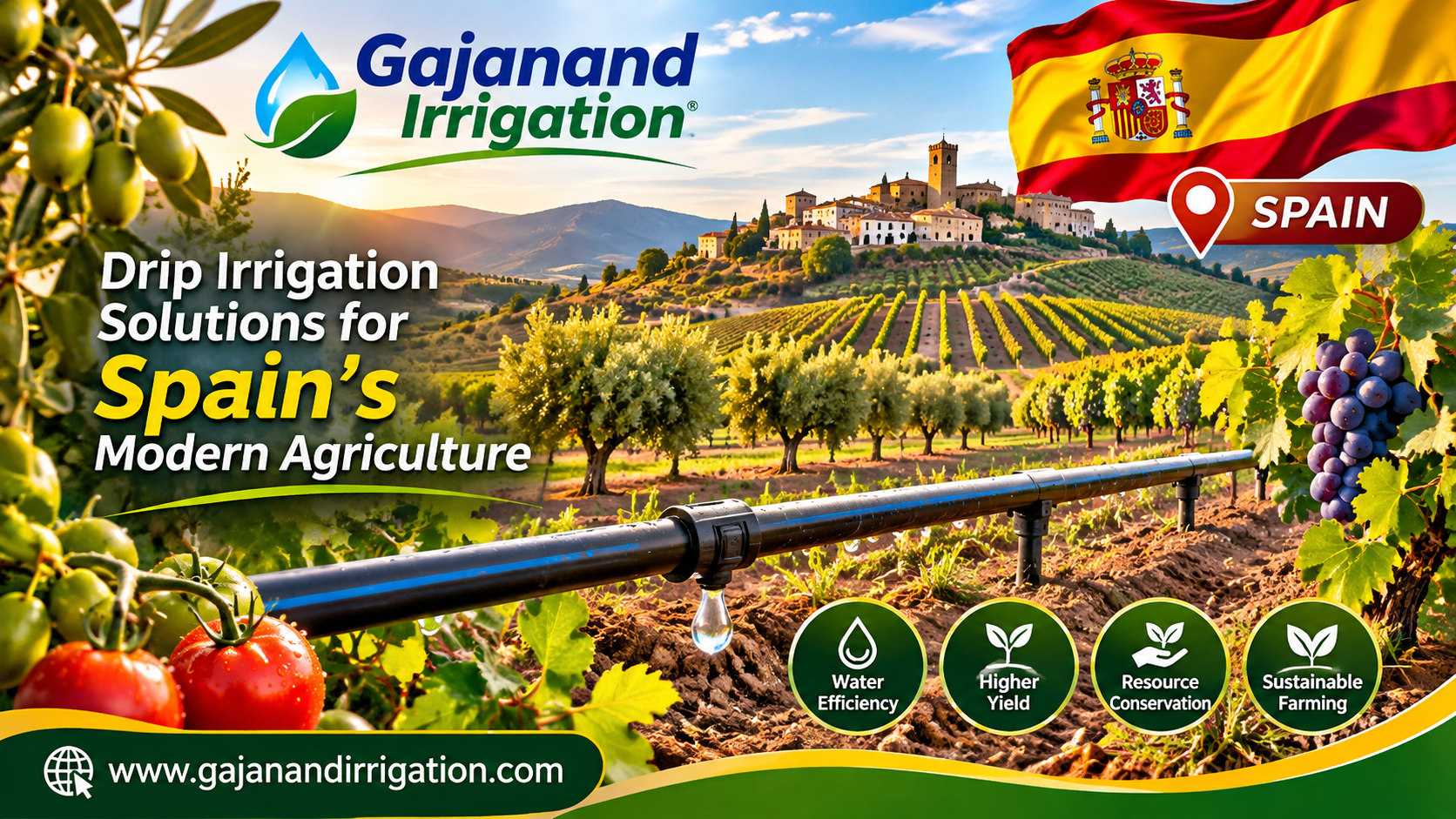
Agriculture plays an important role in Spain’s economy. The country produces a wide range of agricultural products, including olives, citrus fruits, grapes, almonds, tomatoes, and other vegetables. However, water availability remains an important challenge for farmers in several agricultural regions.
Regions such as Andalusia, Murcia, Valencia, and Castilla-La Mancha depend on efficient water management to support agricultural production. Seasonal rainfall, dry weather, and increasing irrigation requirements make water conservation an important part of modern farming.
Drip irrigation is one of the practical methods used to manage agricultural water. It delivers water directly to the root zone through pipes and emitters. This helps farmers control water application and reduce unnecessary water distribution.
However, drip irrigation systems require clean water to work properly. Water from borewells, rivers, reservoirs, and canals may contain sand, silt, algae, and other suspended particles. These impurities can block small emitter openings and affect water distribution.
This is why Agricultural Water Filtration Systems in Spain are important for modern agricultural applications.
A suitable filtration system removes unwanted physical impurities before water enters the irrigation network. It helps protect drip emitters, pipes, valves, and other irrigation components.
Different filtration technologies are available for agricultural applications. Screen filters, disc filters, and hydrocyclone filters are commonly used options. Each filter has a different working mechanism and is suitable for particular water conditions.
Gajanand Irrigation manufactures agricultural irrigation filtration products, including screen filters, disc filters, and hydrocyclone filters. These products can be considered for different irrigation requirements.
In this guide, we will explain the importance of agricultural water filtration, different filter types, their working principles, benefits, applications, and factors to consider when selecting an irrigation filtration system for Spanish agriculture.
Why Is Agricultural Water Filtration Important in Spain?
Water quality directly affects the performance of drip irrigation systems.
Even when water looks clean, it may contain fine suspended particles that can accumulate inside irrigation pipelines and emitters.
Without suitable filtration, these particles may cause several operational problems.
1. Prevents Drip Emitter Blockage
Drip emitters have small openings that release water near plant roots.
Sand, silt, algae, and other suspended particles can enter these openings and create blockages.
Blocked emitters may reduce water discharge and create uneven irrigation.
A suitable filtration system helps remove physical impurities before they enter the drip irrigation network.
2. Supports Uniform Water Distribution
Uniform water distribution is important for maintaining consistent soil moisture.
When some emitters become blocked, different plants may receive different quantities of water.
Proper filtration helps reduce this risk and supports more consistent irrigation performance.
3. Protects Irrigation Equipment
An irrigation system includes several components that work together.
These may include:
- Mainline and sub-mainline pipes
- Drip laterals
- Emitters and drippers
- Irrigation valves
- Fertigation equipment
- Pipeline connections
- Sprinklers
Unwanted particles can affect the operation of these components.
Filtration helps protect the irrigation network from physical contaminants.
4. Reduces Maintenance Requirements
Poor water quality can increase the need for cleaning and maintenance.
Farmers may need to clean filters, flush pipelines, inspect emitters, and remove accumulated sediment.
A properly selected filtration system helps control the amount of dirt entering the irrigation network.
5. Supports Efficient Water Management
Water is a valuable resource for agriculture, particularly in regions that experience seasonal water shortages.
Drip irrigation helps control water application, while filtration protects the system from unwanted particles.
Together, these practices support efficient irrigation management.
Common Water Quality Challenges in Spanish Agriculture
Different agricultural regions in Spain use different water sources. These include groundwater, rivers, reservoirs, canals, and reclaimed water.
Each source may contain different types of impurities.
Understanding these contaminants is the first step towards selecting the right filtration system.
1. Sand and Sediment
Sand is commonly found in certain groundwater and surface-water sources.
When it enters an irrigation network, it can accumulate inside pipelines and affect irrigation equipment.
Hydrocyclone filters are useful for separating heavier sand particles from water.
2. Silt and Fine Suspended Particles
Silt consists of fine mineral particles that may remain suspended in water.
These particles can pass through unsuitable filtration equipment and contribute to emitter blockage.
Disc and screen filters can be considered according to particle size and the required filtration rating.
3. Algae and Organic Matter
Surface water may contain algae, leaves, and other organic materials.
These materials can accumulate inside filters and irrigation pipelines.
A suitable filtration arrangement can help remove suspended organic particles.
4. Dissolved Minerals
Agricultural water may contain calcium, magnesium, iron, and other dissolved minerals.
Some minerals can form deposits under particular water conditions.
Ordinary screen, disc, and hydrocyclone filters do not remove dissolved salts. Water testing and specialised treatment may be necessary when chemical deposits or salinity are a concern.
5. Biological Contamination
Water from ponds, reservoirs, and other surface sources may contain microorganisms and biological material.
These contaminants may contribute to irrigation system clogging.
Farmers should assess water quality and consider suitable additional treatment when required.
Types of Agricultural Water Filtration Systems
Selecting the right filter is an important part of irrigation system planning.
Different filters are designed to handle different types of physical impurities.
The following are important filtration options for agricultural drip irrigation.
1. Screen Filters for Agricultural Irrigation
Screen filters are commonly used in drip and sprinkler irrigation systems.
They use a mesh screen to remove suspended particles from water.
When water passes through the screen, particles larger than the mesh openings remain trapped inside the filter.
The filtered water then moves towards the irrigation network.
How Do Screen Filters Work?
The working process is simple:
- Water enters the filter housing.
- Water passes through the mesh screen.
- Suspended particles are retained on the screen.
- Filtered water exits the filter.
- Accumulated dirt is removed during cleaning.
Benefits of Screen Filters
- Simple filtration mechanism.
- Suitable for agricultural irrigation.
- Helps remove sand, silt, and debris.
- Easy to inspect and clean.
- Available in different sizes.
- Suitable for drip and sprinkler systems.
- Compact installation design.
- Helps protect irrigation emitters.
Applications of Screen Filters
Screen filters can be used in:
- Drip irrigation systems
- Sprinkler irrigation systems
- Greenhouse irrigation
- Micro-irrigation systems
- Horticulture
- Floriculture
- Agricultural water distribution
Gajanand Irrigation offers screen filters designed for agricultural irrigation applications.
Its screen filter range includes different sizes and configurations for irrigation requirements.
Read more about Screen Filters for Drip Irrigation.
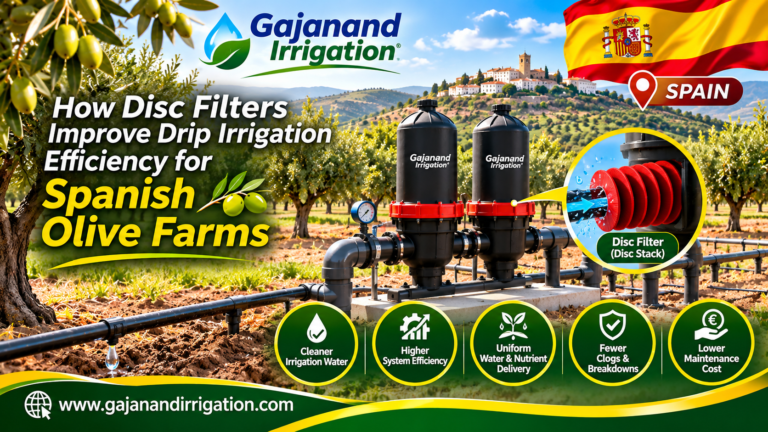
2. Disc Filters for Agricultural Water Filtration
Disc filters are another important option for modern agricultural irrigation.
They use a stack of specially grooved discs placed inside a filter housing.
When these discs are compressed together, their grooves create multiple filtration passages.
Water passes through the disc stack, and suspended particles become trapped between the grooves.
Disc filters are useful when irrigation water contains a mixture of suspended physical impurities.
How Do Disc Filters Work?
Disc filters operate through the following steps:
- Water enters the filter housing.
- Water passes through the compressed disc stack.
- Suspended particles become trapped within the grooves.
- Filtered water moves towards the irrigation system.
- The discs are cleaned periodically to remove accumulated dirt.
Benefits of Disc Filters
- Effective filtration of suspended particles.
- Multi-layer filtration structure.
- Suitable for drip irrigation.
- Helps protect small emitter openings.
- Reusable filtration discs.
- Available in different sizes.
- Suitable for agricultural and horticultural applications.
- Can be integrated into multi-stage filtration systems.
Applications of Disc Filters
Disc filters can be used in:
- Olive plantations
- Citrus orchards
- Vineyards
- Vegetable farms
- Greenhouses
- Nurseries
- Sprinkler irrigation
- Drip irrigation
Gajanand Irrigation’s disc filters feature specially designed grooves on both sides of the discs.
According to the company’s product specifications, its disc filters can filter impurities as small as 120 microns.
The product range includes different sizes and flow capacities.
Explore Disc Filters for Irrigation by Gajanand Irrigation.
3. Hydrocyclone Filters for Sand Separation
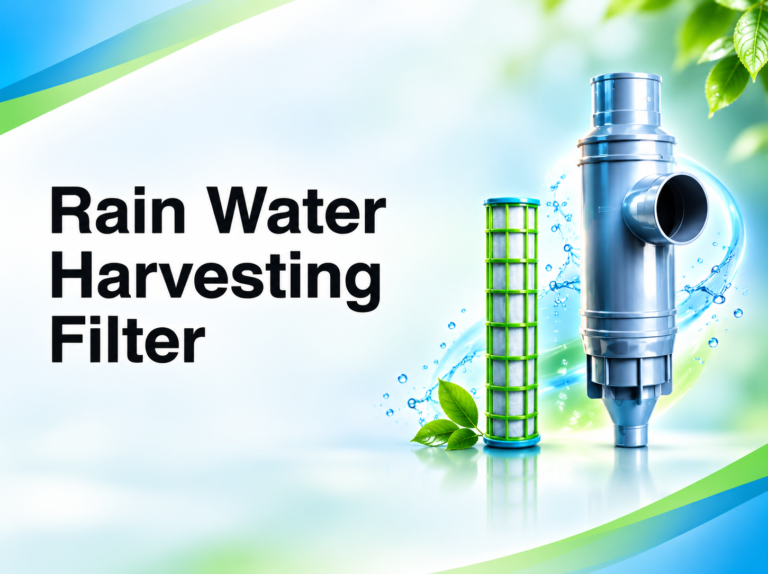
Hydrocyclone filters are designed to separate sand and other heavier particles from irrigation water.
Unlike screen and disc filters, they use centrifugal force to separate heavier particles.
When water enters the hydrocyclone chamber, it creates a rotating movement.
Heavier particles move towards the outer section due to centrifugal action. These particles then collect in the sedimentation chamber.
Cleaner water moves towards the outlet.
How Do Hydrocyclone Filters Work?
The process includes four main stages.
Stage 1: Water Entry
Water enters the hydrocyclone through the inlet.
Stage 2: Rotational Movement
The water begins rotating inside the conical chamber.
Stage 3: Sand Separation
Heavier sand particles move towards the outer wall and separate from the water.
Stage 4: Particle Collection
Separated particles collect in the sedimentation chamber, while cleaner water moves towards the outlet.
Benefits of Hydrocyclone Filters
- Effective sand separation.
- No conventional screen mesh required.
- Simple mechanical design.
- No moving parts.
- Helps reduce sediment entering secondary filters.
- Suitable for groundwater applications containing sand.
- Can be used in drip and sprinkler irrigation.
- Helps protect agricultural irrigation equipment.
Applications of Hydrocyclone Filters
Hydrocyclone filters can be considered for:
- Borewell irrigation
- Tube well water filtration
- Agricultural pump protection
- Drip irrigation systems
- Sprinkler irrigation
- Landscape irrigation
- Agricultural water treatment units
Gajanand Irrigation offers hydrocyclone filters with different sizes and specifications for agricultural applications.
Explore Hydrocyclone Filters for Irrigation.
4. Semi-Automatic Screen Filters
Semi-automatic screen filters provide another filtration option for agricultural irrigation systems.
They are designed to make filter cleaning more convenient than conventional manual cleaning arrangements.
Depending on the product design, the cleaning mechanism allows accumulated particles to be removed with less disassembly.
Benefits of Semi-Automatic Screen Filters
- Convenient cleaning process.
- Helps reduce manual cleaning effort.
- Suitable for agricultural irrigation.
- Helps maintain filtration performance.
- Useful for systems with regular sediment accumulation.
Farmers should review the filter’s operating instructions and cleaning mechanism before installation.
Gajanand Irrigation also offers Semi-Automatic Screen Filters for agricultural filtration requirements.
Comparison of Agricultural Water Filtration Systems
Choosing between different filtration technologies can be confusing.
The following comparison explains their main functions.
| Filter Type | Main Function | Suitable Application |
|---|---|---|
| Screen Filter | Removes particles through a mesh | Suitable water with removable suspended particles |
| Disc Filter | Captures particles through grooved discs | Water containing mixed suspended impurities |
| Hydrocyclone Filter | Separates heavier particles using centrifugal force | Water containing sand |
| Semi-Automatic Screen Filter | Provides screen filtration with convenient cleaning | Irrigation systems requiring easier filter maintenance |
No single filtration system is suitable for every water source.
The final selection should depend on water quality, particle size, irrigation flow rate, and emitter specifications.
How to Choose the Best Agricultural Water Filtration System in Spain
Selecting the right agricultural water filtration system requires proper planning.
Farmers should evaluate their irrigation requirements before purchasing filtration equipment.
1. Identify the Water Source
The first step is identifying the source of irrigation water.
Different sources contain different types of impurities.
| Water Source | Common Contaminants | Filtration Considerations |
|---|---|---|
| Borewell | Sand and suspended particles | Hydrocyclone and secondary filtration |
| Open well | Sand, silt, and organic matter | Disc or screen filtration |
| River | Sediment and organic particles | Suitable multi-stage filtration |
| Reservoir | Algae and suspended material | Disc or screen filtration |
| Canal | Soil particles and debris | Appropriate primary and secondary filtration |
These are general guidelines. Actual filtration requirements should be established through water testing.
2. Conduct Water Quality Testing
Water testing helps identify the contaminants present in irrigation water.
Farmers should consider testing:
- pH level
- Electrical conductivity
- Total dissolved solids
- Suspended solids
- Sand and sediment concentration
- Iron and manganese
- Calcium and magnesium
- Organic matter
The results help determine whether physical filtration is sufficient or whether additional treatment is required.
3. Check the Required Filtration Rating
The filtration rating indicates the particle size that a filter is designed to retain.
It is commonly measured in microns.
The correct rating depends on the irrigation system and emitter specifications.
Farmers should consider:
- Emitter passage size
- Dripper discharge rate
- Water quality
- Filter design
- Manufacturer recommendations
A suitable filtration rating helps protect the irrigation system without creating unnecessary pressure loss.
4. Calculate the Required Flow Rate
Flow rate is the volume of water passing through a filter over a particular period.
It is commonly measured in cubic metres per hour.
The filter should handle the required irrigation flow rate.
Before purchasing equipment, calculate:
- Total irrigation area
- Number of irrigation zones
- Number of emitters
- Emitter discharge
- Pump capacity
- Required operating hours
Selecting an undersized filter can create excessive pressure loss and affect irrigation performance.
5. Check Operating Pressure
Operating pressure is important for maintaining proper water movement throughout the irrigation system.
Farmers should check the filter’s maximum working pressure and recommended operating conditions.
Pressure gauges installed before and after the filtration unit can help monitor pressure differences.
An increasing pressure difference may indicate that the filter requires cleaning.
6. Consider Maintenance Requirements
Maintenance is an important factor when choosing agricultural water filters.
Farmers should understand:
- Cleaning frequency
- Availability of replacement components
- Cleaning mechanism
- Backwashing requirements, where applicable
- Ease of inspection
- Manufacturer maintenance instructions
A suitable filter should be practical to operate and maintain.
Agricultural Water Filtration for Major Crops in Spain
Spain produces different agricultural crops across several climatic regions.
Each crop has its own irrigation requirements. However, the filtration system should be selected mainly according to water quality and irrigation design.
1. Olive Farming
Olive cultivation is particularly important in Andalusia.
Many olive farms use drip irrigation to manage water application around the root zone.
Water containing sand or suspended particles can affect drip emitter performance.
Suitable filtration considerations include:
- Hydrocyclone filtration for sand separation.
- Disc filters for suspended particles.
- Screen filters for suitable water conditions.
- Regular irrigation pipeline flushing.
2. Citrus Farming
Valencia and Murcia are important citrus-producing regions.
Orange, lemon, and mandarin orchards may use drip irrigation for controlled water application.
Filtration helps reduce the risk of emitter blockage.
Suitable filtration options may include disc filters and screen filters, depending on the water source.
3. Vineyard Irrigation
Spain has an established grape and wine-producing agricultural sector.
Vineyards may use drip irrigation to manage water distribution across rows.
A suitable filtration system helps protect emitters and maintain consistent water flow.
Farmers should regularly inspect filters and irrigation pipelines.
4. Vegetable Farming
Regions such as Murcia and Almería are known for vegetable production.
Tomatoes, peppers, cucumbers, and other vegetables may require carefully managed irrigation.
Filtration helps reduce physical contaminants entering drip irrigation equipment.
Disc and screen filters can be considered according to the water quality.
5. Almond Farming
Almond cultivation is another important agricultural activity in Spain.
Drip irrigation can help farmers manage water application in almond plantations.
Where groundwater contains sand, hydrocyclone filtration may be considered as a primary filtration stage.
Secondary filtration may also be necessary.
What Is a Multi-Stage Agricultural Water Filtration System?
A multi-stage filtration system uses more than one filtration technology to remove different types of physical impurities.
It can be useful when irrigation water contains sand, silt, and other suspended materials.
A typical arrangement may include:
Water Source → Pump → Hydrocyclone Filter → Disc or Screen Filter → Irrigation Network
The arrangement depends on actual water quality.
Stage 1: Primary Filtration
A hydrocyclone filter can separate heavier sand particles from water.
This reduces the sediment load entering downstream filters.
Stage 2: Secondary Filtration
A disc or screen filter provides additional filtration before water reaches the irrigation pipelines.
The filter should have a suitable filtration rating for the selected drip irrigation system.
Stage 3: Water Distribution
After filtration, water moves through the mainline and sub-mainline pipelines.
It is then distributed through drip laterals and emitters.
Stage 4: Fertigation
Some farms also use fertigation systems to apply soluble fertilisers through irrigation water.
Fertiliser compatibility and water chemistry should be checked to avoid unwanted precipitation and blockages.
Gajanand Irrigation offers a Fertigation Assembly for Irrigation Systems for agricultural fertigation applications.
Common Problems Caused by Poor Water Filtration
Poor filtration can affect the entire irrigation network.
Understanding these problems helps farmers maintain their systems more effectively.
1. Frequent Emitter Blockage
Sand, silt, and organic particles may accumulate inside emitter openings.
This can reduce water discharge.
Solution: Test water quality and select suitable filtration equipment.
2. Uneven Water Distribution
Blocked emitters may cause some plants to receive less water than others.
Solution: Inspect emitters regularly and maintain proper filtration.
3. Pressure Problems
Accumulated dirt inside filters can increase pressure loss.
Solution: Monitor inlet and outlet pressure and clean filters when required.
4. Sediment Accumulation
Sand and soil particles may collect inside irrigation pipelines.
Solution: Use appropriate primary filtration and flush irrigation lines periodically.
5. Increased Maintenance
Poorly selected filtration equipment may require frequent cleaning.
Solution: Select a filter according to water quality, flow rate, and operating requirements.
Maintenance Tips for Agricultural Water Filtration Systems
Regular maintenance helps maintain filtration performance.
Farmers should follow the manufacturer’s instructions for each filter type.
1. Clean Filters Regularly
Remove accumulated dirt from the filter according to the recommended cleaning procedure.
2. Monitor Pressure Difference
Check the pressure before and after the filtration unit.
A significant increase may indicate filter blockage.
3. Inspect Filter Components
Check the filter housing, mesh, discs, seals, and connections.
Replace damaged components when required.
4. Flush Irrigation Pipelines
Open the flushing valves and remove accumulated sediment from the pipelines.
5. Check for Leakage
Inspect joints, valves, and filter connections to identify possible leakage.
6. Maintain Hydrocyclone Filters
Remove accumulated sand from the collection chamber as recommended by the manufacturer.
7. Maintain a Cleaning Schedule
Maintain records of filter cleaning, pressure readings, water quality tests, and replacement activities.
A regular maintenance schedule helps identify problems before they affect the irrigation system.
Why Choose Gajanand Irrigation for Agricultural Water Filtration Products?
Choosing suitable irrigation filtration equipment is important for agricultural projects.
Gajanand Irrigation is an Ahmedabad-based irrigation products manufacturer that has been operating since 1993.
The company provides different agricultural irrigation products, including screen filters, disc filters, hydrocyclone filters, valves, fittings, and fertigation components.
Its product range supports different irrigation applications.
1. Range of Agricultural Filtration Products
Gajanand Irrigation offers different filtration products for agricultural applications.
These include:
- Screen filters
- Disc filters
- Hydrocyclone filters
- Semi-automatic screen filters
- Y-type screen and disc filters
Farmers and irrigation professionals can explore suitable products according to their water quality and system requirements.
2. Experience in Irrigation Manufacturing
Gajanand Irrigation has been serving the irrigation industry since 1993.
The company highlights its manufacturing machinery and quality-testing infrastructure.
3. Different Irrigation Components
Apart from filtration equipment, Gajanand Irrigation offers products such as:
- Poly fittings
- Push fittings
- Ball valves
- Air release valves
- Flush valves
- Fertigation assemblies
- Mini sprinklers
- Header assemblies
- Foot valves
These products are used in different agricultural irrigation applications.
4. Domestic and International Market Presence
Gajanand Irrigation serves domestic and international markets.
Its website highlights its presence in markets including the UAE, Iraq, Kenya, Mali, Zimbabwe, Nigeria, and the USA.
5. Product Information and Technical Specifications
The company’s product pages provide information about filter sizes, applications, operating pressure, and other specifications.
This helps irrigation professionals understand available product options before selecting equipment.
To explore the complete product range, visit the Official Gajanand Irrigation Website.
Future of Agricultural Water Filtration in Spain
Agricultural water management continues to develop as farmers look for better ways to manage available water resources.
Several developments are becoming important in modern irrigation.
1. Smart Irrigation Monitoring
Modern irrigation systems can use sensors to monitor soil moisture, water flow, and operating pressure.
These technologies help farmers make better irrigation decisions.
2. Automatic Filter Cleaning
Automatic and semi-automatic filtration systems can reduce manual cleaning requirements.
They can be useful for irrigation installations that operate for long periods.
3. Improved Water Quality Management
Regular water testing helps farmers understand changes in water quality.
This is important when water comes from seasonal or variable sources.
4. Sustainable Water Reuse
Treated wastewater can be reused for agricultural irrigation when it meets applicable regulations.
Proper treatment, filtration, and monitoring are important for safe agricultural water reuse.
5. Integrated Filtration Solutions
Modern irrigation projects may combine different filtration technologies.
For example, hydrocyclone filters can separate heavier sand particles, while disc or screen filters provide additional filtration.
The correct combination depends on the water source and irrigation requirements.
Conclusion
Agricultural water filtration plays an important role in maintaining efficient drip irrigation systems.
For Spanish farmers, selecting suitable filtration equipment can help reduce emitter blockage, protect irrigation components, and support consistent water distribution.
Different filtration technologies serve different purposes.
Screen filters remove suitable suspended particles through a mesh. Disc filters capture particles through a grooved disc structure. Hydrocyclone filters separate heavier particles such as sand through centrifugal force.
The best Agricultural Water Filtration Systems in Spain depend on water quality, irrigation flow rate, emitter specifications, and farm requirements.
Farmers should conduct water quality testing before selecting filtration equipment. They should also monitor operating pressure, clean filters regularly, and maintain irrigation pipelines.
Gajanand Irrigation offers screen filters, disc filters, hydrocyclone filters, and other irrigation products for agricultural applications.
With its experience in irrigation manufacturing since 1993, Gajanand Irrigation provides different filtration options for farmers and irrigation professionals.
Choosing the right filtration system is an important step towards reliable irrigation, effective water management, and long-term agricultural system performance.
Frequently Asked Questions (FAQs)
1. What are the best agricultural water filtration systems in Spain?
The best filtration systems depend on water quality and irrigation requirements. Screen filters, disc filters, and hydrocyclone filters are commonly used options for agricultural drip irrigation.
2. Why is water filtration important for drip irrigation?
Water filtration removes unwanted physical particles that can block drip emitters. It helps protect irrigation equipment and supports consistent water distribution.
3. Which filter is best for removing sand from agricultural water?
A hydrocyclone filter is suitable for separating heavier sand particles from water. It uses centrifugal force and can be installed before secondary filtration equipment.
4. What is the difference between a disc filter and a screen filter?
A disc filter uses stacked grooved discs to capture suspended particles. A screen filter uses a mesh surface to retain particles. The correct choice depends on water quality and filtration requirements.
5. Are disc filters suitable for agricultural drip irrigation?
Yes. Disc filters are suitable for many agricultural drip irrigation applications. They help remove suspended particles and reduce the risk of emitter blockage when properly selected.
6. Can hydrocyclone filters remove fine suspended particles?
Hydrocyclone filters mainly separate heavier particles such as sand. Additional filtration may be required to remove finer suspended particles.
7. How often should agricultural water filters be cleaned?
Cleaning frequency depends on water quality, filter type, and operating conditions. Farmers should monitor pressure differences and follow the manufacturer’s cleaning instructions.
8. Can agricultural water filters remove dissolved salts?
Ordinary screen, disc, and hydrocyclone filters do not remove dissolved salts. Specialised water treatment may be required for salinity and dissolved mineral problems.
9. Which filtration system is suitable for olive farms in Spain?
The selection depends on the irrigation water source. Hydrocyclone filters may be suitable for sand separation, while disc and screen filters can provide additional filtration.
10. What should farmers check before buying an irrigation filter?
Farmers should check water quality, flow rate, operating pressure, filtration rating, emitter specifications, maintenance requirements, and product compatibility.
11. What is a multi-stage agricultural water filtration system?
A multi-stage filtration system combines different filtration technologies to remove different types of impurities. For example, it may use a hydrocyclone filter followed by a disc or screen filter.
12. Does Gajanand Irrigation manufacture agricultural filtration products?
Yes. Gajanand Irrigation offers agricultural filtration products, including screen filters, disc filters, and hydrocyclone filters, along with other irrigation components.