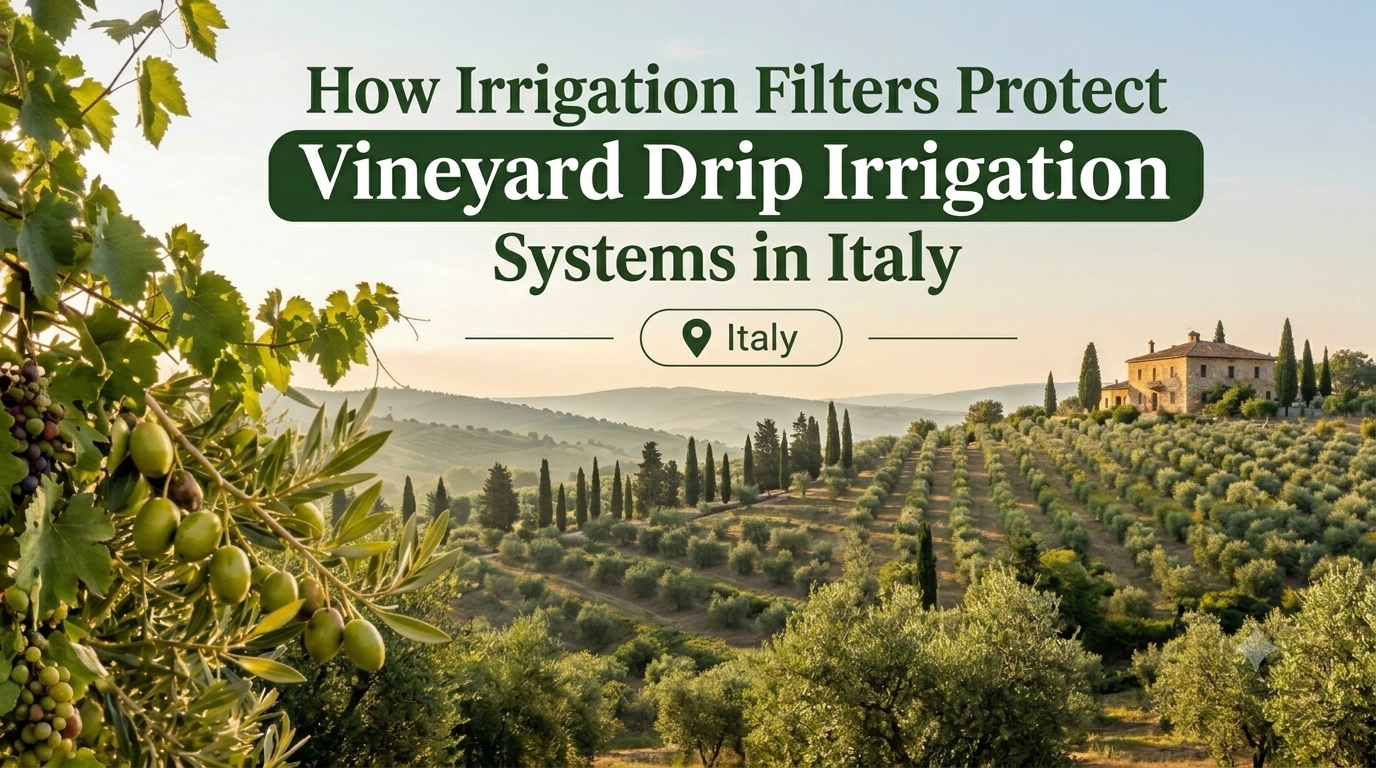
Italy is one of the world’s most recognised wine-producing countries, with vineyards spread across several regions, including Tuscany, Veneto, Piedmont, Sicily, Puglia, and Lombardy. Wine production is an important part of Italian agriculture, and maintaining healthy grapevines requires proper vineyard management, efficient irrigation, and reliable water distribution.
Water plays an essential role in grapevine growth. It supports nutrient transportation, plant development, photosynthesis, and grape production. However, providing the right amount of water to every plant is not always easy, particularly when vineyards use modern drip irrigation systems.
Drip irrigation has become an important agricultural solution because it delivers water directly to the root zone of plants. It helps farmers manage water consumption, improve irrigation efficiency, and maintain more consistent soil moisture. However, drip irrigation systems contain small emitters and narrow water passages that can become blocked by sand, silt, algae, organic matter, and other suspended particles.
This is where irrigation filters for vineyard drip irrigation systems in Italy become essential.
Irrigation filters remove unwanted particles from water before it enters the drip irrigation network. They protect pipelines, valves, drip lines, and emitters from clogging, helping maintain consistent water flow throughout the vineyard.
Whether a vineyard uses groundwater, surface water, a reservoir, or another irrigation source, choosing the correct agricultural water filtration system can make a significant difference in the long-term performance of its irrigation infrastructure.
In this guide, we will explore how irrigation filters work, why vineyard filtration is important in Italy, which filtration technologies are suitable for drip irrigation, and how farmers can maintain efficient vineyard irrigation systems.
1. Understanding Drip Irrigation Systems in Italian Vineyards
Drip irrigation is a micro-irrigation method that supplies water slowly and directly to the soil near the roots of plants. Instead of distributing water across the entire field, the system delivers controlled quantities through small outlets called emitters or drippers.
In Italian vineyards, drip irrigation can help growers manage water distribution according to vineyard size, soil conditions, grape variety, climate, and seasonal requirements.
A typical vineyard drip irrigation system includes:
- Water source: Groundwater, surface water, reservoirs, or other available irrigation sources.
- Pump: Provides the required pressure to move water through the irrigation network.
- Filtration system: Removes suspended particles and impurities from irrigation water.
- Main pipeline: Transports filtered water throughout the vineyard.
- Sub-main pipelines: Distribute water to different vineyard sections.
- Drip lines: Carry water along the rows of grapevines.
- Emitters: Release controlled quantities of water near plant roots.
- Control valves: Regulate water flow and pressure in different irrigation zones.
Every component plays an important role in maintaining irrigation performance. However, filtration is particularly important because even small particles can block the narrow openings inside drip emitters.
Without suitable filtration, sediment and organic impurities may accumulate inside the irrigation network. This can lead to uneven water distribution, increased maintenance requirements, and reduced irrigation efficiency.
For this reason, installing an appropriate irrigation filtration system is an important step when designing or upgrading a vineyard drip irrigation network.
2. Why Irrigation Filters Are Important for Vineyards in Italy
Italy has diverse agricultural landscapes and climatic conditions. Vineyard irrigation requirements can differ significantly between northern, central, and southern regions.
For example, vineyards in Tuscany and Piedmont may experience different rainfall patterns and soil conditions compared with vineyards in Sicily, Puglia, or other southern regions.
During dry periods, vineyards may depend more heavily on irrigation to maintain suitable soil moisture. When water availability becomes limited, efficient irrigation management becomes even more important.
However, the quality of irrigation water is just as important as its availability.
Water collected from wells, rivers, lakes, storage tanks, or reservoirs may contain suspended particles and organic materials. If this water enters drip irrigation pipelines without proper filtration, it can affect the performance of the complete system.
Here are some important reasons why irrigation filters are necessary for Italian vineyards.
2.1 Prevent Drip Emitter Clogging
Drip emitters contain small internal passages that control the amount of water released near grapevine roots.
Sand, silt, clay particles, algae, and other suspended materials can enter these passages and cause blockages.
When emitters become clogged, some grapevines may receive less water than required, while other sections continue receiving normal water flow.
Irrigation filters capture particles before they reach the emitters, helping reduce clogging and maintain more uniform water distribution.
2.2 Maintain Consistent Water Distribution
A vineyard may contain hundreds or thousands of grapevines connected through a network of drip lines.
If some emitters become blocked, water distribution can become uneven across the vineyard.
This can create differences in soil moisture and water availability between plants.
A properly selected filtration system helps maintain cleaner irrigation water and supports consistent water delivery throughout the irrigation network.
2.3 Reduce Irrigation System Maintenance
Without adequate filtration, sediment can accumulate inside pipelines, valves, connectors, and emitters.
Farmers may need to flush pipelines frequently, clean individual components, or replace damaged irrigation equipment.
Installing suitable irrigation water filters helps reduce the amount of unwanted material entering the system, potentially lowering routine maintenance requirements.
2.4 Protect Irrigation Equipment
Drip irrigation systems involve pumps, pressure regulators, valves, pipelines, connectors, and emitters.
Although not every type of filter removes every contaminant, suitable filtration can protect downstream irrigation components from suspended particles.
This supports better equipment performance and can help extend the useful service life of the irrigation infrastructure.
2.5 Improve Water Management
Efficient water distribution is important for vineyards, particularly in regions experiencing seasonal water shortages or irregular rainfall.
Filtration supports reliable drip irrigation by helping maintain the water flow required for controlled irrigation.
When combined with proper irrigation scheduling, soil moisture monitoring, and pressure management, filtration contributes to more effective vineyard water management.
3. Common Water Quality Problems in Vineyard Drip Irrigation
Before selecting an irrigation filter, vineyard owners should understand the possible contaminants present in their irrigation water.
Different water sources have different filtration requirements. A groundwater source may contain sand and mineral particles, while an open reservoir may contain algae, leaves, and other organic materials.
Understanding these contaminants helps farmers choose the right agricultural water filtration equipment.
3.1 Sand and Silt
Sand and silt are common physical impurities found in groundwater and surface water.
These particles can enter irrigation pipelines and settle inside pipes, valves, and drip emitters. Larger particles may cause immediate blockages, while smaller particles can gradually accumulate.
Sand and silt removal is particularly important for vineyards using drip irrigation because emitter openings are relatively small.
3.2 Algae and Organic Matter
Water stored in open reservoirs, ponds, and tanks may contain algae, leaves, plant debris, and other organic materials.
These contaminants can enter drip lines and create blockages. Organic matter can also contribute to biological growth inside irrigation pipelines.
Proper filtration helps remove suspended organic particles before they enter the irrigation network.
3.3 Clay and Fine Suspended Particles
Some agricultural water sources contain fine clay particles and suspended solids.
These particles may pass through basic filtration equipment, depending on their size and the filter design.
Fine particles can accumulate inside emitters and affect water distribution over time.
A suitable filtration system should be selected according to the actual water quality and the requirements of the drip irrigation equipment.
3.4 Mineral Deposits and Chemical Precipitation
Irrigation water may contain dissolved minerals such as calcium, magnesium, and iron.
Under certain water chemistry and operating conditions, these substances can form deposits inside irrigation pipelines and emitters.
It is important to understand that ordinary screen and disc filters do not remove dissolved minerals. Mineral-related problems may require water testing, chemical treatment, flushing, or other specialised water management methods.
3.5 Bacterial and Biological Contamination
Water sources containing organic material may also support microbial growth.
Biofilm can develop inside pipelines, particularly when water conditions encourage bacterial activity.
Physical filters can capture some suspended biological material, but they do not guarantee the removal of microorganisms or dissolved biological contaminants.
For vineyards experiencing these problems, water testing and appropriate treatment methods should be considered alongside filtration.
4. Types of Irrigation Filters Used in Vineyard Drip Irrigation Systems
Selecting the right irrigation filter is one of the most important decisions when installing an agricultural drip irrigation system.
Different filter technologies are designed to remove different types of impurities. The choice depends on water source, particle size, contamination level, flow rate, and the specifications of the irrigation equipment.
The following filtration technologies are commonly used in agricultural irrigation applications.
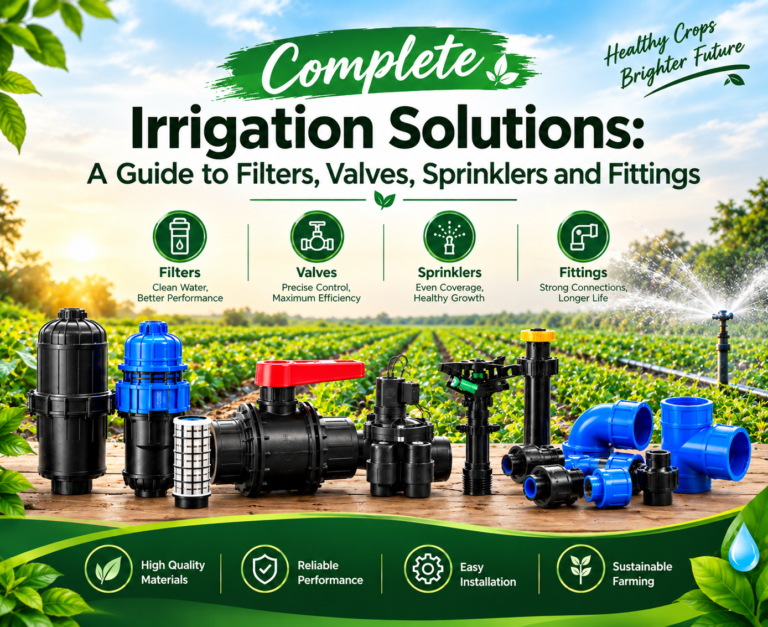
4.1 Screen Filters for Vineyard Irrigation
Screen filters are mechanical filtration devices that use a mesh screen to capture suspended particles from irrigation water.
Water passes through the screen, while particles larger than the selected filtration opening are retained.
Screen filters are suitable for applications where irrigation water contains relatively low concentrations of suspended solids.
Key benefits of screen filters:
- Remove sand and larger suspended particles.
- Provide straightforward filtration for agricultural water.
- Offer a compact and practical filtration solution.
- Are available in different filtration ratings.
- Can be cleaned and reused, depending on the design.
- Help protect drip irrigation emitters from physical blockages.
For smaller vineyards or irrigation systems with relatively clean water, screen filters may provide a suitable filtration option.
However, when water contains significant quantities of algae or organic matter, screen filters may require frequent cleaning.
4.2 Disc Filters for Drip Irrigation
Disc filters are widely used in agricultural irrigation systems because they provide effective filtration for different types of suspended particles.
These filters contain multiple grooved discs stacked together. Water passes through the small spaces between the discs, trapping particles during the filtration process.
Disc filters can be useful when irrigation water contains sand, silt, organic particles, and other suspended impurities.
Advantages of disc filters:
- Provide effective particle removal.
- Offer a large filtration surface area.
- Are suitable for many drip irrigation applications.
- Can handle different agricultural water conditions.
- Are available in manual and automatic cleaning configurations.
- Help reduce the risk of emitter clogging.
For Italian vineyards using drip irrigation, disc filtration can be considered when water quality varies or when the water source contains a combination of suspended particles.
The correct filtration rating should always be selected according to the emitter manufacturer’s recommendations and water quality analysis.
4.3 Sand Media Filters for Agricultural Irrigation
Sand media filters are designed for irrigation water containing high levels of organic matter and suspended particles.
These systems use specially selected filtration media through which water passes. Contaminants become trapped within the media bed while filtered water moves towards the irrigation network.
Sand media filtration is particularly useful for water sources such as open reservoirs, ponds, and canals where organic contamination may be higher.
Main advantages:
- Effective for removing suspended organic material.
- Suitable for agricultural water with higher contamination levels.
- Can handle relatively high water flow rates when correctly designed.
- Support filtration for large irrigation installations.
- Can be cleaned through backwashing.
For larger vineyards or agricultural operations using surface water, sand media filtration may be an important part of the overall irrigation filtration arrangement.
4.4 Automatic Self-Cleaning Irrigation Filters
Automatic self-cleaning filters are designed to clean the filtration element without requiring the entire system to be manually dismantled.
These systems monitor operating conditions, often through differential pressure, and initiate a cleaning cycle when a predefined threshold is reached.
Depending on the design, cleaning may involve flushing, suction scanning, or other mechanical cleaning arrangements.
Benefits of automatic irrigation filters:
- Reduce manual cleaning requirements.
- Support continuous irrigation operations.
- Help maintain filtration performance.
- Reduce the need for frequent operator intervention.
- Are suitable for larger agricultural irrigation networks.
- Can be integrated into automated irrigation control systems.
Automatic filtration can be especially beneficial for commercial vineyards where irrigation networks cover large areas and operate for extended periods.
However, the system should be selected according to water quality, flow requirements, available pressure, and maintenance capabilities.
5. How Irrigation Filters Work in a Vineyard Drip Irrigation System
An irrigation filter operates as a protective stage between the water source and the drip irrigation network.
Its main purpose is to prevent unwanted suspended particles from entering the pipelines and reaching sensitive irrigation components.
The filtration process generally follows these steps:
Step 1: Water Collection
Water is collected from a suitable source, such as a groundwater well, reservoir, canal, or storage tank.
Step 2: Pumping
A pump moves water into the irrigation system and provides the pressure required for filtration and distribution.
Step 3: Filtration
Water enters the filtration unit. The screen, disc, or media filtration mechanism captures particles according to its filtration design.
Step 4: Filtered Water Distribution
After filtration, water moves through the main pipeline towards the vineyard’s irrigation zones.
Step 5: Controlled Drip Irrigation
Filtered water travels through drip lines and exits through emitters positioned near grapevine roots.
Step 6: Filter Cleaning
Over time, captured particles accumulate inside the filtration equipment. The filter must be cleaned manually or through an automatic cleaning cycle, depending on its design.
This process helps maintain suitable water quality before irrigation water reaches the drip emitters.
6. Importance of Irrigation Filtration Across Different Wine-Producing Regions of Italy
Italy has a diverse wine-growing landscape. Climate, soil conditions, rainfall, vineyard size, and water availability vary between different regions.
Consequently, irrigation requirements and filtration needs can also differ.
6.1 Tuscany
Tuscany is internationally recognised for its vineyards and wine-producing areas, including Chianti and Montalcino.
During dry periods, irrigation management can be important for maintaining suitable soil moisture, depending on local regulations and vineyard management practices.
Filtration helps protect drip irrigation networks from suspended particles and supports consistent water delivery.
6.2 Veneto
Veneto is another important wine-producing region, known for wines such as Prosecco, Valpolicella, and Soave.
Vineyards may use different irrigation arrangements depending on location, soil characteristics, and water availability.
For drip irrigation installations, suitable filtration helps prevent sediment and organic matter from entering the emitter network.
6.3 Piedmont
Piedmont is famous for premium wines, including Barolo and Barbaresco.
Water management is an important part of vineyard planning, especially when environmental conditions change during the growing season.
Reliable filtration can support irrigation system performance by helping prevent particle-related blockages.
6.4 Sicily
Sicily has a Mediterranean climate, with hot, dry summers in many areas.
Water availability and efficient irrigation management are important considerations for agricultural activities in the region.
Drip irrigation combined with suitable filtration can help farmers distribute available water more efficiently.
6.5 Puglia
Puglia is an important agricultural region in southern Italy, with extensive cultivation of grapes and other crops.
In areas where irrigation water contains suspended solids, agricultural filtration systems can help protect drip irrigation infrastructure.
Choosing the correct filter according to the source water quality is essential for maintaining reliable irrigation performance.
Important consideration: Irrigation requirements and water-use permissions vary by location. Vineyard owners should follow applicable Italian regional and national water regulations when planning irrigation installations.
7. How to Choose the Right Irrigation Filter for Italian Vineyards
Choosing an irrigation filter should not be based only on price or filter size. Farmers should evaluate the complete irrigation system and understand the quality of their water source.
Here are some important factors to consider.
7.1 Analyse Irrigation Water Quality
The first step is to test the water source.
Water analysis can help identify:
- Suspended solids.
- Sand and silt concentration.
- Organic matter.
- Water turbidity.
- Dissolved minerals.
- Iron and other relevant chemical constituents.
- Biological contamination, where applicable.
These results help determine the type of filtration and any additional treatment required.
7.2 Understand the Required Filtration Rating
Filtration ratings are commonly expressed in microns or mesh.
The correct filtration rating depends on the size and design of drip emitters, water quality, and filter specifications.
A filter that is too coarse may allow particles to reach the emitters, while an unnecessarily fine filter may increase pressure loss and cleaning requirements.
Therefore, vineyard owners should follow the recommendations of their drip irrigation equipment manufacturer.
7.3 Check the Required Flow Rate
The filtration system must handle the total water flow required by the irrigation network.
An undersized filter may create excessive pressure loss and restrict water delivery.
Before purchasing a filter, consider:
- Total irrigation flow rate.
- Number of irrigation zones.
- Pump capacity.
- Operating pressure.
- Future expansion requirements.
Selecting the correct filter capacity supports reliable irrigation operations.
7.4 Consider Manual or Automatic Cleaning
Manual filters can be appropriate for smaller irrigation systems with relatively clean water and manageable cleaning requirements.
Automatic self-cleaning filters may be more suitable for larger vineyards or systems where frequent manual cleaning would be inconvenient.
The decision should consider operational costs, labour availability, water quality, and the expected cleaning frequency.
7.5 Evaluate Filter Material and Durability
Agricultural filtration equipment operates in different environmental conditions.
Vineyard owners should consider the filter housing material, corrosion resistance, operating pressure, temperature range, and compatibility with the irrigation water.
Choosing durable filtration equipment can support long-term performance and reduce replacement requirements.
8. Benefits of Installing High-Quality Irrigation Filters in Vineyards
A properly designed filtration system provides several operational benefits for vineyard owners and agricultural businesses.
8.1 Better Irrigation Efficiency
Filtered water helps reduce particle-related blockages in drip emitters. This supports more consistent water distribution and helps farmers manage irrigation according to crop requirements.
8.2 Reduced Maintenance Costs
When suspended particles are removed before entering the drip irrigation network, the likelihood of frequent cleaning and repairs caused by sediment accumulation can be reduced.
8.3 Longer Equipment Service Life
Pipelines, valves, connectors, and emitters can experience operational problems when exposed to continuous particle accumulation.
Suitable filtration helps protect these components and supports the long-term performance of the irrigation infrastructure.
8.4 Improved Vineyard Management
A reliable irrigation system gives farmers better control over water distribution.
When filtration is combined with proper irrigation scheduling and monitoring, vineyard operators can manage water more effectively throughout the growing season.
8.5 Support for Sustainable Agriculture
Water conservation is an important consideration for modern agriculture, particularly in regions experiencing seasonal drought conditions.
Drip irrigation and suitable filtration can contribute to responsible water management by supporting controlled water delivery and reducing unnecessary irrigation interruptions.
However, filtration alone does not guarantee water savings. Actual savings depend on irrigation design, scheduling, soil conditions, crop requirements, and system management.
9. Common Irrigation Filter Problems and Their Solutions
Even high-quality filtration equipment requires proper operation and maintenance.
Understanding common filter problems helps vineyard owners maintain their irrigation systems.
| Common Problem | Possible Cause | Recommended Solution |
|---|---|---|
| Frequent filter clogging | High suspended particle concentration | Analyse water quality and select suitable filtration |
| Low water pressure | Filter blockage or undersized equipment | Clean the filter and check system capacity |
| Uneven water distribution | Clogged emitters or pressure differences | Inspect drip lines and pressure regulators |
| Organic matter accumulation | Algae and biological particles | Consider suitable media filtration and water treatment |
| Mineral deposits | Dissolved minerals and precipitation | Conduct water analysis and apply suitable treatment |
| Frequent manual cleaning | High contamination levels | Evaluate automatic self-cleaning filtration |
One important point is that filtration problems should not always be solved by installing a finer filter. Sometimes, the actual problem may involve dissolved minerals, biological growth, incorrect pressure, or unsuitable irrigation design.
Identifying the root cause helps avoid unnecessary equipment expenses.
10. Maintenance Tips for Vineyard Irrigation Filtration Systems
Regular maintenance is essential for keeping irrigation filters in good working condition.
Even the best agricultural filtration equipment may lose efficiency if accumulated particles are not removed.
Here are some useful maintenance practices for Italian vineyard owners.
1. Inspect Filters Regularly
Check filtration equipment for visible damage, leakage, and excessive dirt accumulation.
2. Monitor Pressure Difference
Monitor the pressure before and after the filter. An increasing pressure difference may indicate that the filtration element requires cleaning.
3. Clean Filter Elements
Screen and disc filters should be cleaned according to manufacturer recommendations and actual operating conditions.
4. Check Automatic Cleaning Systems
For automatic filters, inspect the cleaning mechanism, valves, sensors, and control system to ensure proper operation.
5. Flush Irrigation Pipelines
Periodically flush drip irrigation pipelines to remove accumulated sediment and other deposits.
6. Inspect Drip Emitters
Check representative emitters across different irrigation zones to identify uneven water flow or possible blockages.
7. Conduct Water Quality Testing
Water quality may change throughout the year. Periodic testing helps determine whether the existing filtration arrangement remains suitable.
8. Maintain Proper Operating Pressure
Ensure that the pump, pressure regulators, and filtration system operate within their recommended pressure ranges.
Following these practices can help vineyard operators maintain consistent irrigation performance and reduce unexpected system interruptions.
11. Why Automatic Self-Cleaning Filters Are a Smart Choice for Large Vineyards
As agricultural operations become more advanced, vineyard owners increasingly look for filtration solutions that reduce manual work and support reliable irrigation management.
Automatic self-cleaning irrigation filters are designed to meet these operational requirements.
Unlike conventional filters that generally require manual cleaning, automatic systems can initiate cleaning cycles when the pressure difference reaches a predefined level.
This helps remove accumulated particles from the filter element while allowing the irrigation system to continue operating, depending on the filter design and cleaning configuration.
For large vineyard installations, automatic filtration offers several advantages:
- Reduced manual cleaning frequency.
- More convenient filtration management.
- Consistent filtration performance when properly maintained.
- Suitability for demanding agricultural applications.
- Integration with automated irrigation systems.
- Reduced operational interruptions associated with manual filter cleaning.
Automatic filtration systems can be particularly useful for vineyards operating multiple irrigation zones or using water sources with changing suspended-solid concentrations.
However, the correct model should be selected after evaluating the water source, required flow rate, operating pressure, contamination level, and available cleaning water.
12. The Role of Advanced Filtration in the Future of Italian Vineyard Agriculture
Agriculture is continuously evolving through improved irrigation technology, automation, and efficient resource management.
Italian vineyards are also part of this transformation, as farmers seek better ways to manage water resources, maintain crop quality, and improve agricultural operations.
Modern vineyard irrigation systems can combine drip irrigation, water filtration, pressure monitoring, automated valves, and irrigation controllers.
These technologies allow farmers to manage different vineyard zones according to their individual water requirements.
For example, a vineyard may divide its irrigation network into several sections based on soil conditions, grapevine age, slope, and water requirements.
A properly designed filtration system supports these arrangements by supplying cleaner water to the distribution network.
In the future, the combination of advanced agricultural water filtration and automated irrigation management can become increasingly important for vineyards looking to improve operational efficiency.
Investing in appropriate irrigation filtration is therefore not simply about preventing blocked emitters. It is also about developing a reliable irrigation infrastructure that supports long-term agricultural management.
13. Why Choosing the Right Agricultural Filtration Partner Matters
Selecting suitable irrigation filtration equipment is important, but choosing a reliable filtration solution provider is equally valuable.
Every vineyard has different water requirements. A filtration system designed for one agricultural installation may not be appropriate for another.
A professional filtration provider should understand the importance of:
- Water quality analysis.
- Filtration technology selection.
- Required micron rating.
- Flow rate and operating pressure.
- Filter cleaning requirements.
- Equipment durability.
- Installation and maintenance support.
Vineyard owners should look for filtration solutions that match their actual agricultural requirements rather than selecting equipment based only on initial purchasing costs.
A properly selected irrigation filtration system can support better water distribution, reduce maintenance challenges, and protect valuable drip irrigation infrastructure.
Frequently Asked Questions (FAQs)
1. Why are irrigation filters important for vineyard drip irrigation systems in Italy?
Irrigation filters remove suspended particles such as sand, silt, algae, and organic matter before water enters drip irrigation pipelines. They help prevent emitter clogging, maintain consistent water distribution, and protect irrigation equipment.
2. Which irrigation filter is best for vineyards?
The best irrigation filter depends on water quality, contamination levels, required flow rate, and drip emitter specifications. Screen filters are suitable for relatively clean water, disc filters handle various suspended particles, and sand media filters are useful for water containing significant organic matter.
3. What type of filter is suitable for drip irrigation systems?
Disc filters, screen filters, and sand media filters are commonly used in drip irrigation systems. The appropriate filtration technology should be selected after analysing the irrigation water and checking the emitter manufacturer’s filtration recommendations.
4. Do irrigation filters prevent drip emitter clogging?
Yes. Properly selected irrigation filters help reduce clogging caused by suspended physical particles. However, they may not prevent clogging caused by dissolved minerals, chemical precipitation, or biological growth. Additional water treatment may be necessary for these problems.
5. Are automatic self-cleaning filters suitable for large vineyards?
Yes. Automatic self-cleaning filters can be suitable for large vineyards because they reduce manual cleaning requirements and support continuous filtration operations. Their suitability depends on water quality, flow rate, pressure, and cleaning system design.
6. How often should vineyard irrigation filters be cleaned?
Cleaning frequency depends on water quality, filter type, contamination levels, and operating conditions. Filters should be inspected regularly, and cleaning should follow manufacturer recommendations and pressure-difference readings.
7. Can irrigation filters improve water efficiency in Italian vineyards?
Irrigation filters support efficient water distribution by reducing particle-related emitter blockages. When combined with drip irrigation, proper scheduling, and pressure management, they can contribute to better vineyard water management.
8. Do irrigation filters remove dissolved salts from agricultural water?
No. Conventional screen, disc, and sand media filters primarily remove suspended particles. Dissolved salts require specialised treatment processes, such as reverse osmosis or other appropriate water treatment technologies, depending on the water chemistry and agricultural requirements.
9. What factors should be considered before purchasing an irrigation filtration system?
Important factors include water quality, suspended solids concentration, required filtration rating, flow rate, operating pressure, filter material, cleaning mechanism, and compatibility with the existing irrigation network.
10. Why should Italian vineyard owners invest in quality irrigation filtration equipment?
Quality irrigation filtration equipment helps protect drip irrigation infrastructure, reduce particle-related blockages, support consistent water distribution, and simplify irrigation maintenance. It can contribute to reliable vineyard operations over the long term.
Conclusion
Efficient water management is an important part of modern vineyard agriculture in Italy. As drip irrigation becomes an increasingly valuable solution for controlled water distribution, protecting the irrigation network from suspended particles and contamination becomes essential.
Irrigation filters for vineyard drip irrigation systems in Italy play an important role in preventing emitter clogging, maintaining consistent water flow, protecting irrigation components, and reducing maintenance requirements.
From screen and disc filters to sand media and automatic self-cleaning filtration systems, different technologies are available to address different agricultural water quality challenges.
The right filtration solution depends on the water source, contamination level, vineyard size, irrigation requirements, and equipment specifications.
By investing in suitable agricultural water filtration equipment and following regular maintenance practices, vineyard owners can develop more reliable irrigation systems and support responsible water management.
For Italian vineyards looking to improve drip irrigation performance, choosing the right filtration technology is an important step towards efficient, reliable, and sustainable agricultural operations.