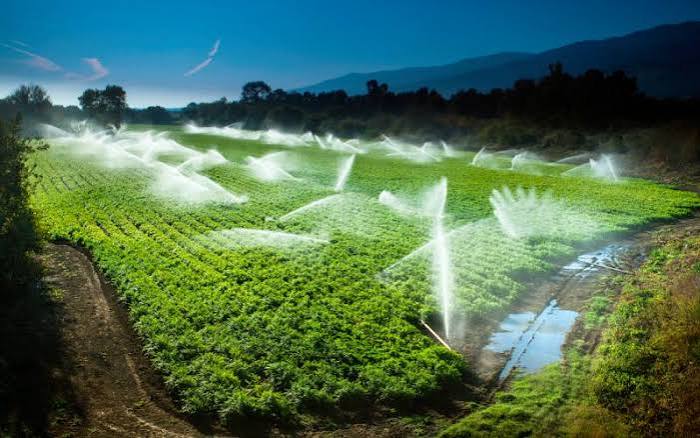
Introduction
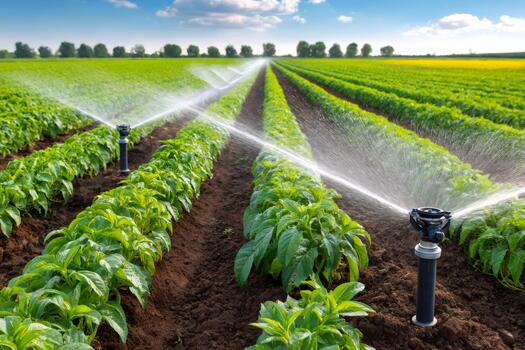
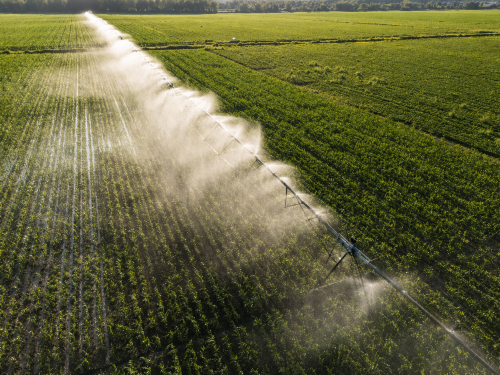
How much water should your crop be given? This is an important question for every farmer who wants healthy crops, better production and efficient water management. The correct amount of irrigation water is not the same for every crop or every farm. It depends on several factors, including soil type, crop type, crop growth stage, weather conditions, rainfall, soil moisture and evapotranspiration.
Giving too little water can cause water stress, poor plant growth, flower and fruit drop and reduced crop yield. Giving too much water can waste valuable water, increase pumping costs, cause nutrient loss and create problems in the root zone.
Understanding how much water should your crop be given helps farmers make better irrigation decisions. Modern irrigation management uses crop water requirements, soil moisture, weather information and evapotranspiration to decide when and how much water should be applied.
According to the FAO CROPWAT system, crop water and irrigation requirements can be estimated using crop, soil and climate information.
This complete guide explains how much water should your crop be given, what affects crop water requirements, how to calculate irrigation requirements and how drip irrigation can help improve water management.
What Determines How Much Water Your Crop Needs?
There is no single irrigation quantity that works for every crop. The amount of water required depends on the conditions in the field.
The main factors include:
- Crop type
- Crop growth stage
- Soil type
- Root-zone depth
- Temperature
- Humidity
- Wind speed
- Solar radiation
- Rainfall
- Soil moisture
- Evapotranspiration
- Irrigation method
- Irrigation system efficiency
Farmers should consider these factors before deciding how much water should your crop be given.
Why Is Proper Crop Irrigation Important?
Water is essential for photosynthesis, nutrient transport, cell development and overall plant growth. However, irrigation must be managed carefully.
Problems Caused by Too Little Water
Insufficient irrigation can result in:
- Plant wilting
- Slow growth
- Leaf curling
- Reduced flowering
- Flower and fruit drop
- Poor fruit development
- Lower crop quality
- Reduced yield
Water stress can become particularly important during sensitive crop growth stages.
Problems Caused by Too Much Water
Excessive irrigation can also create problems.
These may include:
- Water wastage
- Higher electricity or fuel costs
- Nutrient leaching
- Poor soil aeration
- Root-zone problems
- Runoff
- Deep percolation
- Increased disease risk in some conditions
Therefore, efficient irrigation means applying the right amount of water at the right time.
How Does Soil Type Affect Crop Water Requirements?
Soil is one of the most important factors when planning irrigation.
Different soils have different water-holding and drainage characteristics.
Heavy Soil
Heavy or clay-rich soil can retain a significant amount of water. Water generally moves through it more slowly than through sandy soil.
Because of this, irrigation may not need to be as frequent. However, excessive irrigation can cause poor drainage and waterlogging.
Medium Soil
Medium-textured soil can provide a balance between water retention and drainage.
Irrigation requirements still depend on the crop, weather and available soil moisture.
Light or Sandy Soil
Sandy soil generally drains faster and may store less plant-available water.
Crops growing in sandy soil may therefore require closer monitoring and potentially more frequent irrigation with suitable application amounts.
This is why soil type should always be considered when deciding how much water should your crop be given.
How Does Crop Type Affect Water Requirements?
Every crop has a different water requirement.
Cereals, vegetables, fruits, cotton, sugarcane and other crops have different growth patterns and water-use characteristics.
Crop water requirements can also change according to the variety and production environment.
The FAO crop evapotranspiration methodology uses crop characteristics and crop coefficients to estimate crop water use.
Therefore, farmers should avoid applying one fixed irrigation schedule to every crop.
How Does Crop Growth Stage Affect Water Requirements?
A crop does not require the same amount of water from planting to harvest.
Initial Growth Stage
During the early stage, plants have a relatively small canopy and root system.
Water should be managed carefully around the developing root zone.
Vegetative Growth Stage
As leaves and plant canopy develop, water use generally increases.
Flowering Stage
Water management can be especially important during flowering for many crops.
Water stress during sensitive reproductive stages can affect crop development.
Fruit Development Stage
Fruit and seed development can require careful moisture management, depending on the crop.
Maturity Stage
Water demand can change as the crop approaches maturity and harvest.
Therefore, how much water should your crop be given should be reviewed throughout the growing season rather than decided only at planting.
How Does Weather Affect Crop Irrigation?
Weather has a major influence on crop water use.
Important weather factors include:
- Temperature
- Wind
- Humidity
- Solar radiation
- Rainfall
Hot and dry conditions can increase water loss through evapotranspiration.
Cooler and more humid conditions can reduce atmospheric water demand.
This is why farmers should adjust irrigation according to weather conditions instead of following the same schedule throughout the year.
How Does Temperature Affect Crop Water Requirements?
Temperature influences evaporation and plant transpiration.
During hot weather, water can be lost more quickly from soil and plants.
Higher temperatures can therefore increase irrigation demand.
However, temperature should not be considered alone.
Farmers should also consider:
- Humidity
- Wind
- Solar radiation
- Soil moisture
- Crop stage
- Rainfall
Together, these factors provide a better understanding of crop water demand.
What Is Evapotranspiration?
Evapotranspiration, commonly called ET, is the combination of two processes:
Evaporation is the loss of water from soil and other surfaces.
Transpiration is the release of water vapour from plants through their leaves.
Together, evaporation and transpiration represent an important part of crop water use.
Understanding evapotranspiration helps farmers estimate how quickly crops are using available water.
What Is Reference Evapotranspiration?
Reference evapotranspiration, or ETo, represents atmospheric water demand from a standardized reference surface.
Weather information can be used to estimate ETo.
The FAO ETo Calculator provides a tool for calculating reference evapotranspiration.
ETo is useful because it provides a standard measurement that can then be adjusted for individual crops.
What Is the Crop Coefficient?
The crop coefficient, represented as Kc, helps adjust reference evapotranspiration according to the crop and its development stage.
Different crops have different Kc values.
The value can also change during:
- Initial growth
- Crop development
- Mid-season
- Late season
This is why crop water requirements change throughout the growing season.
How to Calculate Crop Water Requirements
A commonly used formula is:
ETc = ETo × Kc
Where:
- ETc = Crop evapotranspiration
- ETo = Reference evapotranspiration
- Kc = Crop coefficient
Example Calculation
Suppose:
ETo = 5 mm/day
and:
Kc = 0.8
Then:
ETc = 5 × 0.8
ETc = 4 mm/day
The estimated crop evapotranspiration is therefore 4 mm/day.
This calculation provides an estimate of crop water use. It does not automatically mean that exactly 4 mm of irrigation should be applied every day.
Rainfall, existing soil moisture, root-zone storage and irrigation efficiency must also be considered.
How Much Water Is 1 mm of Irrigation?
A useful conversion for farmers is:
1 mm of water over 1 hectare = 10,000 litres
Therefore:
| Water Depth | Water per Hectare |
|---|---|
| 1 mm | 10,000 litres |
| 2 mm | 20,000 litres |
| 3 mm | 30,000 litres |
| 4 mm | 40,000 litres |
| 5 mm | 50,000 litres |
| 6 mm | 60,000 litres |
| 10 mm | 100,000 litres |
For example, if a calculated requirement is 4 mm over one hectare:
4 × 10,000 = 40,000 litres
This conversion makes it easier to understand irrigation quantities.
What Is Pan Evaporation?
Pan evaporation is the measurement of water evaporated from an open water pan during a specific period.
It provides an indication of atmospheric evaporative demand.
When pan evaporation increases, atmospheric demand for water may also be higher.
However, pan evaporation should not be used by itself to determine irrigation quantities.
Farmers should also consider:
- Crop type
- Crop stage
- Soil type
- Soil moisture
- Rainfall
- Irrigation efficiency
The FAO irrigation and evapotranspiration guidance explains methods for estimating crop water requirements and evapotranspiration.
How Does Rainfall Affect Irrigation?
Rainfall can provide a significant amount of water to crops.
However, the total rainfall amount is not always equal to the amount available to plant roots.
Some rainwater may:
- Run off
- Evaporate
- Move below the root zone
- Remain temporarily unavailable
Therefore, farmers should consider effective rainfall when planning irrigation.
If sufficient rain has already supplied water to the root zone, additional irrigation may not be required immediately.
How Does Soil Moisture Affect Irrigation?
Soil acts as a water storage system for crops.
Before irrigation, farmers should determine how much moisture remains in the root zone.
If enough water is available, irrigation can potentially be delayed.
If the soil has become too dry, irrigation may be required.
Soil moisture can be checked using:
- Manual soil inspection
- Soil moisture sensors
- Tensiometers
- Other soil-water monitoring equipment
Monitoring soil moisture can make irrigation decisions more accurate than simply following a fixed calendar.
How Much Water Should Your Crop Be Given With Drip Irrigation?
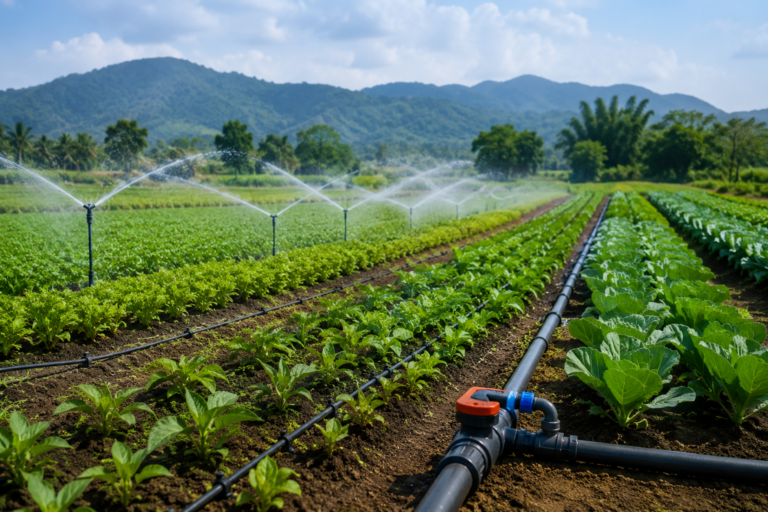
How much water should your crop be given with drip irrigation depends on crop demand, emitter flow rate, irrigation duration, spacing, soil and weather.
Drip irrigation delivers water close to the crop root zone.
A properly designed system can help control:
- Water flow
- Irrigation duration
- Application frequency
- Water distribution
- Root-zone moisture
Gajanand Irrigation provides irrigation products and solutions for agricultural water management. You can explore the company’s drip irrigation solutions for more information.
How to Calculate Drip Irrigation Time
Suppose the required water volume is:
40,000 litres
and your irrigation system delivers:
20,000 litres per hour
The theoretical operating time is:
40,000 ÷ 20,000 = 2 hours
Therefore, the system would theoretically need to operate for approximately 2 hours to deliver 40,000 litres.
However, actual irrigation duration should be adjusted according to:
- Soil moisture
- Crop demand
- Rainfall
- System efficiency
- Distribution uniformity
- Root-zone conditions
How to Schedule Irrigation for Your Crop
Good irrigation scheduling answers two questions:
When should irrigation be applied?
How much water should be applied?
A practical scheduling process includes the following steps.
Step 1: Identify the Crop
Know the crop and its water-use characteristics.
Step 2: Identify the Growth Stage
Determine whether the crop is in the initial, vegetative, flowering, fruiting or maturity stage.
Step 3: Check Soil Moisture
Determine whether sufficient water remains in the root zone.
Step 4: Check Weather
Look at:
- Temperature
- Rainfall
- Wind
- Humidity
- Solar radiation
Step 5: Estimate Crop Water Use
Use evapotranspiration information when available.
Step 6: Consider Rainfall
Account for effective rainfall before applying additional irrigation.
Step 7: Check the Irrigation System
Inspect:
- Filters
- Pipes
- Valves
- Emitters
- Pressure
- Flow rate
Step 8: Apply the Required Water
Operate the system for the required duration.
Step 9: Monitor the Field
Check soil moisture and crop condition after irrigation.
How Much Water Should Your Crop Be Given in Summer?
During summer, high temperatures and dry conditions can increase crop water demand.
Farmers should monitor soil moisture more frequently and consider current weather conditions.
However, simply increasing irrigation because the weather is hot is not always the correct approach.
Use:
- Soil moisture
- Crop stage
- Weather
- Evapotranspiration
- Rainfall
to determine the irrigation requirement.
How Much Water Should Your Crop Be Given During Monsoon?
During the monsoon, rainfall can provide a substantial amount of crop water.
Farmers should check:
- Rainfall quantity
- Soil moisture
- Drainage
- Root-zone moisture
- Weather forecast
Avoid unnecessary irrigation when sufficient rainfall has already supplied the crop’s requirement.
At the same time, do not assume every rainfall event completely eliminates irrigation needs.
How Much Water Should Your Crop Be Given in Winter?
Winter weather can reduce evaporation and atmospheric water demand in many situations.
However, crops still require adequate soil moisture.
The correct irrigation schedule depends on:
- Crop type
- Growth stage
- Soil
- Rainfall
- Temperature
- Soil moisture
Common Irrigation Mistakes to Avoid
Using the Same Amount of Water Every Day
Crop water requirements change according to weather and growth stage.
Ignoring Soil Type
Different soils store and drain water differently.
Ignoring Rainfall
Rainfall should be included when determining irrigation requirements.
Over-Irrigating
More water does not automatically mean more production.
Waiting Until Severe Wilting
Visible water stress can indicate that the crop has already experienced moisture shortage.
Ignoring Irrigation Equipment
Blocked emitters, leaks and pressure problems can cause uneven irrigation.
How Can Farmers Save Irrigation Water?
Farmers can improve water management through several practices.
Use Drip Irrigation
Drip irrigation can deliver water close to the crop root zone.
Monitor Soil Moisture
Soil moisture information can help determine when irrigation is actually required.
Check Weather Conditions
Adjust irrigation according to temperature, rainfall and atmospheric demand.
Maintain Irrigation Equipment
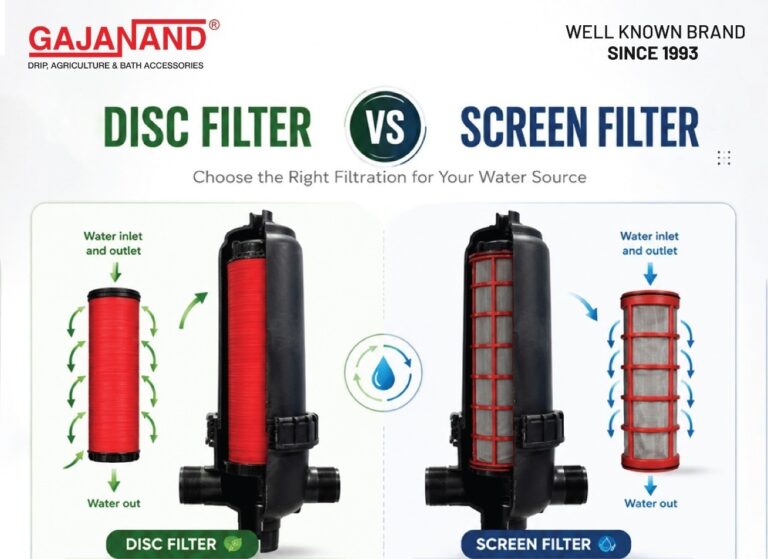
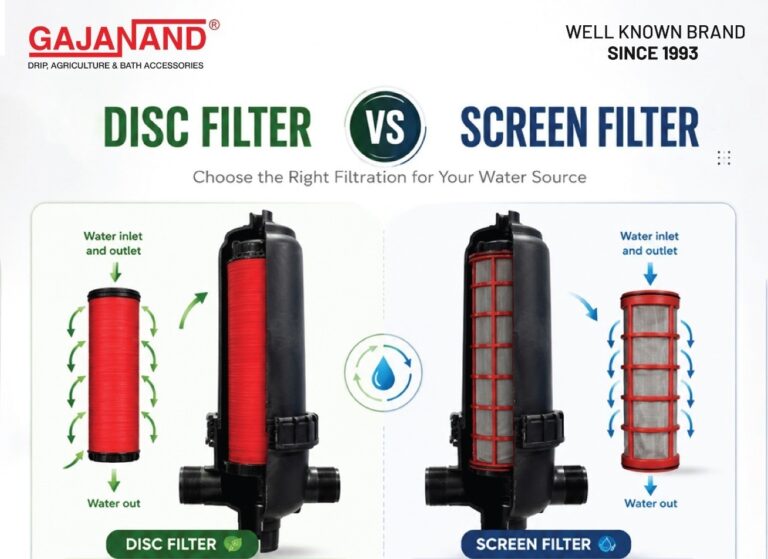
Clean filters and inspect pipes, valves and emitters regularly.
For example, appropriate irrigation filtration systems can help protect drip irrigation systems from particles that may contribute to emitter clogging.
Avoid Unnecessary Irrigation
Do not irrigate simply because a certain number of days have passed.
How Does Irrigation Efficiency Affect Water Requirements?
The amount of water needed by the crop and the amount of water that needs to be supplied through an irrigation system are not always identical.
Some water can be lost through:
- Runoff
- Deep percolation
- Uneven distribution
- Evaporation
- System leakage
Therefore, irrigation system performance should be considered when calculating the actual application requirement.
A properly maintained irrigation system can help deliver water more consistently.
How Technology Can Improve Irrigation Management
Modern agricultural technology can help farmers make better irrigation decisions.
Useful technologies include:
- Soil moisture sensors
- Weather stations
- Flow meters
- Automated irrigation controllers
- Irrigation timers
- Remote monitoring systems
- Evapotranspiration data
- Computerized irrigation scheduling
The FAO CROPWAT tool can be used to calculate crop water requirements and irrigation requirements using crop, soil and climate data.
Technology does not replace field observation, but it can make irrigation decisions more accurate.
Signs That Your Crop May Need More Water
Possible signs of insufficient water include:
- Wilting leaves
- Drooping plants
- Dry soil
- Leaf curling
- Slow growth
- Reduced flowering
- Poor fruit development
- Reduced crop vigor
However, these symptoms can also be caused by disease, root damage, pests or other environmental problems.
Always check soil moisture and overall plant health before increasing irrigation.
Signs of Over-Irrigation
Possible signs of excessive irrigation include:
- Water remaining on the soil surface
- Persistently wet soil
- Poor drainage
- Nutrient leaching
- Root-zone problems
- Increased disease pressure
- Runoff
If these conditions occur, review the irrigation schedule and drainage conditions.
Best Practices for Crop Water Management
For better irrigation management, farmers should follow these basic practices:
- Understand the crop’s water requirement.
- Identify the soil type.
- Monitor crop growth stage.
- Check soil moisture.
- Monitor weather conditions.
- Consider rainfall.
- Use evapotranspiration information when available.
- Maintain irrigation equipment.
- Avoid excessive irrigation.
- Review and adjust the irrigation schedule regularly.
Frequently Asked Questions
How much water should your crop be given?
How much water should your crop be given depends on crop type, crop growth stage, soil type, weather, rainfall, soil moisture and irrigation-system efficiency. There is no single amount suitable for every crop.
How often should crops be irrigated?
There is no universal irrigation frequency. Irrigation should be based on soil moisture, crop water demand, weather conditions and root-zone requirements.
What is crop water requirement?
Crop water requirement is the amount of water needed by a crop to support its growth and development, primarily related to water lost through evapotranspiration.
What is the formula for crop water requirement?
A commonly used formula is:
ETc = ETo × Kc
where ETc is crop evapotranspiration, ETo is reference evapotranspiration and Kc is the crop coefficient.
Does soil type affect irrigation?
Yes. Soil type affects water storage, drainage and the frequency and amount of irrigation required.
What is pan evaporation?
Pan evaporation is the measurement of water evaporated from an open water pan during a specific period. It can indicate atmospheric evaporative demand.
Can drip irrigation reduce water wastage?
Drip irrigation can provide controlled water application close to the crop root zone. Actual water savings depend on system design, maintenance and correct irrigation scheduling.
Should crops be irrigated every day?
Not necessarily. Some crops and conditions may require frequent irrigation, while others may require less frequent applications. Soil moisture and crop water demand should guide the schedule.
Does rainfall reduce irrigation requirements?
Yes. Effective rainfall can reduce the amount of additional irrigation required. Farmers should check soil moisture after rainfall before irrigating again.
How can farmers improve irrigation efficiency?
Farmers can improve irrigation efficiency by monitoring soil moisture, maintaining irrigation equipment, adjusting irrigation after rainfall and using suitable irrigation scheduling methods.
Conclusion
How much water should your crop be given? The answer depends on the crop, soil, weather, growth stage, rainfall and irrigation system.
There is no single water quantity that can be recommended for every farm. A good irrigation strategy considers crop evapotranspiration, soil moisture and current weather conditions.
The basic crop water calculation is:
ETc = ETo × Kc
Farmers can combine this information with soil moisture monitoring, rainfall data and irrigation-system performance to make better decisions.
Drip irrigation can also help provide controlled water delivery near the crop root zone. However, the system must be correctly designed, maintained and scheduled.
The goal of efficient irrigation is simple:
Right amount of water + right time + right place = better crop water management.
By understanding crop water requirements and avoiding both under-irrigation and over-irrigation, farmers can manage water more efficiently and create better growing conditions for their crops.