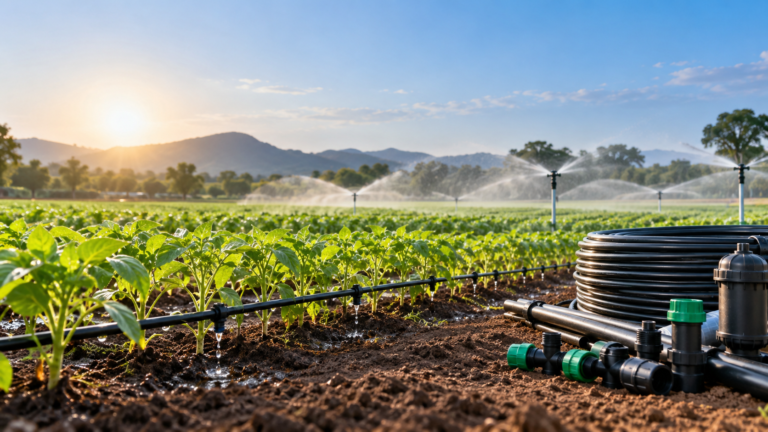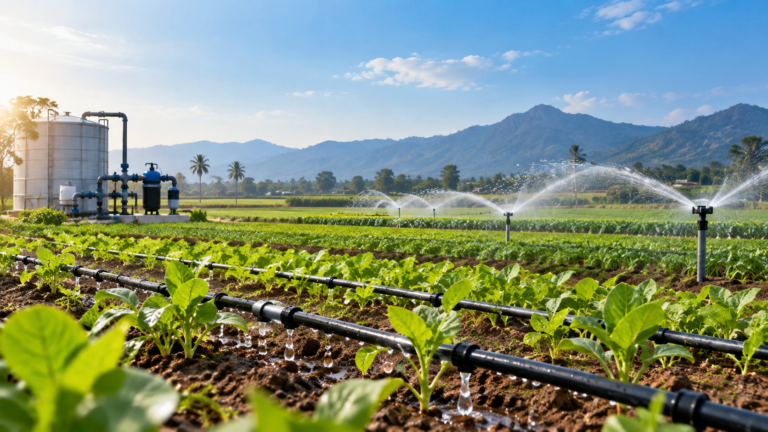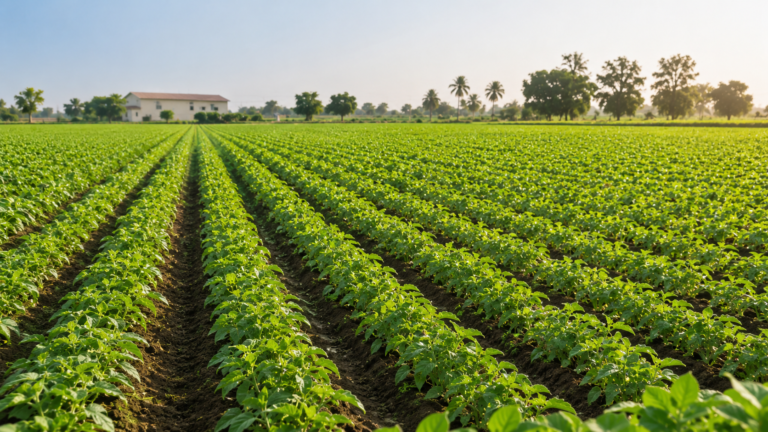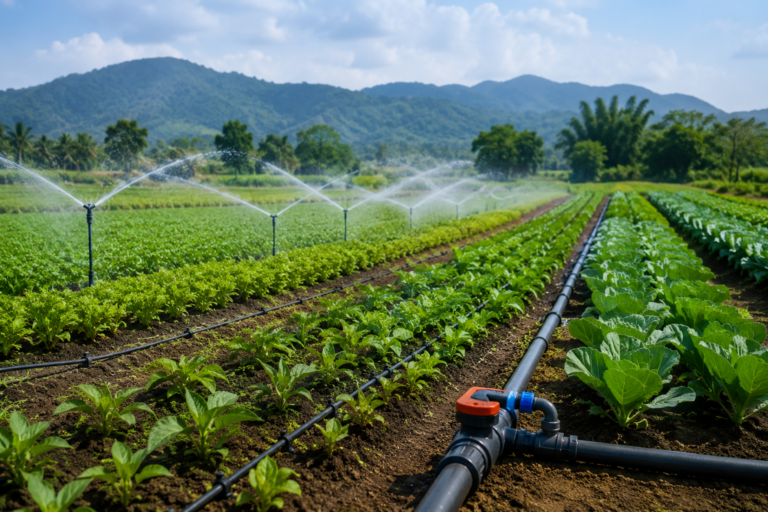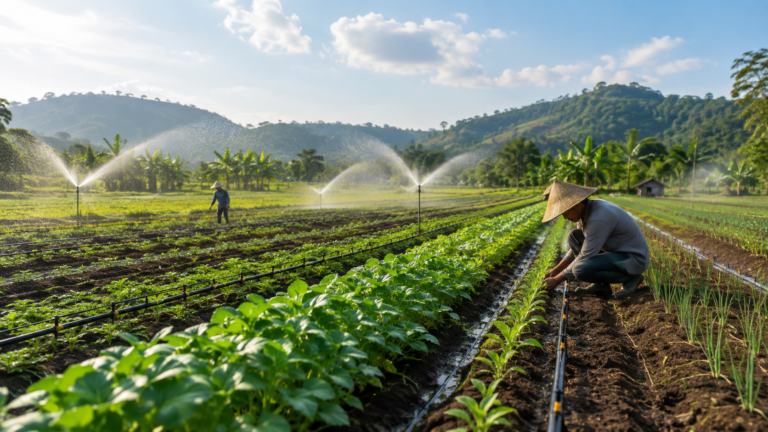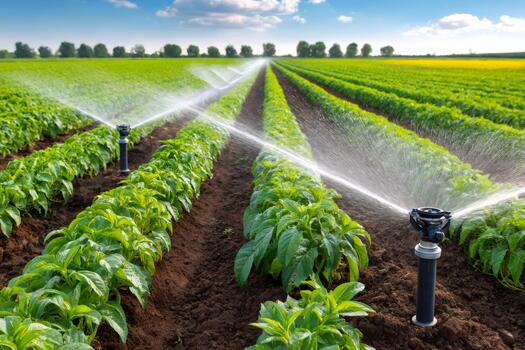
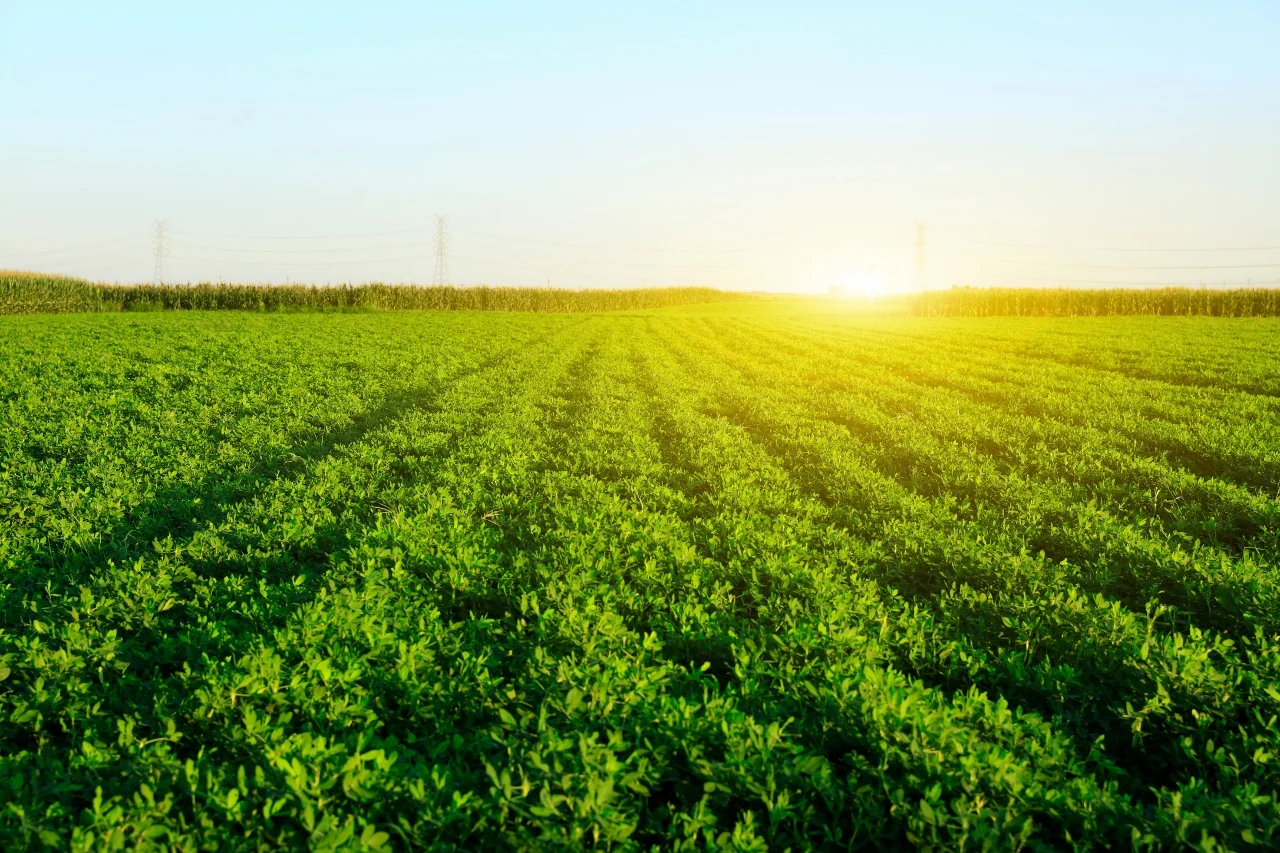
Groundnut, also known as peanut, requires careful water management throughout its growing cycle. Optimizing Drip Irrigation for Groundnut (Peanut) Crops can help farmers manage water more precisely by delivering irrigation close to the crop root zone. Proper scheduling, filtration, pressure management, fertigation and regular maintenance are important parts of an efficient groundnut irrigation system.
Drip irrigation does not mean simply installing pipes and drippers in a field. The system should be designed according to soil type, crop spacing, water quality, field conditions, weather and crop growth stage. Research from the ICAR-Indian Institute of Groundnut Research provides different drip irrigation recommendations for groundnut under different locations and production conditions.
For agricultural irrigation infrastructure, Gajanand Irrigation provides products such as filters, fittings, valves, fertigation assemblies and other irrigation components. The company is based in Ahmedabad, Gujarat, and states that it has been operating since 1993.
What Is Drip Irrigation for Groundnut?
Drip irrigation is a method of applying water through a network of pipes and controlled outlets so that water reaches the crop root zone.
For groundnut farming, the purpose is to maintain suitable soil moisture while avoiding unnecessary irrigation losses. The exact system design depends on:
- Soil type
- Groundnut variety
- Row spacing
- Field size
- Water source
- Water quality
- Weather conditions
- Crop growth stage
- Dripper discharge
- Lateral spacing
- Available pressure
A properly planned drip irrigation system for groundnut can provide controlled irrigation and make it easier to adjust water application according to crop demand.
According to ICAR-IIGR, different locations have different recommended drip irrigation practices. For example, its research recommendations include 80% evapotranspiration-based irrigation on alternate days with 60 cm lateral spacing for a particular production zone, while other recommendations vary according to location.
Therefore, farmers should not use one fixed irrigation schedule for every groundnut field.
Why Optimizing Drip Irrigation for Groundnut Crops Matters
Groundnut production depends on effective management of water, nutrients and soil conditions.
Poor irrigation can create two major problems.
Under-irrigation can cause moisture stress and affect crop development.
Over-irrigation can waste water and may create unfavorable soil conditions.
Optimized irrigation aims to provide enough water when the crop needs it.
Better Water Management
Drip irrigation gives farmers greater control over water application. Instead of applying water across the entire field at once, water can be delivered closer to the crop root zone.
Improved Water-Use Efficiency
ICAR-IIGR has reported groundnut drip irrigation practices associated with improved water-use efficiency under specific research and production conditions.
The actual result on a farm depends on soil, climate, irrigation design, rainfall and management.
Controlled Irrigation
Drip systems can make it easier to divide a field into irrigation zones. This allows farmers to operate different sections according to field conditions.
Support for Fertigation
A properly designed irrigation network can also be used for fertigation, where suitable soluble nutrients are applied through irrigation water.
ICAR-IIGR research has reported that drip fertigation can improve fertilizer-use efficiency in specific groundnut production systems.
Groundnut Irrigation Requirements
A common question is:
How much water does groundnut need?
There is no single water requirement that applies to every groundnut field.
Water demand depends on:
- Temperature
- Humidity
- Wind
- Solar radiation
- Rainfall
- Soil type
- Crop growth stage
- Evapotranspiration
- Field conditions
Therefore, groundnut irrigation management should be based on crop and environmental conditions rather than a fixed daily quantity.
Germination and Establishment
During establishment, adequate soil moisture supports uniform germination and early plant development.
The soil should remain sufficiently moist without creating excessive wetness.
Vegetative Growth
During vegetative growth, the crop develops its leaves, stems and root system.
Irrigation should be adjusted according to soil moisture and weather conditions.
Flowering
Flowering is an important stage in groundnut production. Water stress during sensitive reproductive periods can affect crop development.
Pegging and Pod Development
Pegging and pod development are critical stages for groundnut.
Maintaining suitable moisture during these stages is an important part of peanut irrigation management.
Pod Filling and Maturity
As the crop approaches maturity, irrigation should be adjusted according to crop condition, soil moisture and harvesting requirements.
Avoiding unnecessary irrigation near maturity can help prevent excess moisture and unnecessary water use.
How to Optimize Drip Irrigation for Groundnut
Optimizing Drip Irrigation for Groundnut (Peanut) Crops requires attention to the complete irrigation system rather than just the drippers.
The following steps can help farmers plan an efficient system.
1. Evaluate the Field
Before designing the irrigation network, evaluate:
- Total field area
- Soil type
- Field slope
- Crop row spacing
- Water source
- Water quality
- Pump capacity
- Existing pipeline
- Expected irrigation requirement
This information helps determine the appropriate irrigation layout.
2. Test the Irrigation Water
Water quality can influence filtration and system maintenance requirements.
Check for:
- Sand
- Silt
- Suspended particles
- Organic matter
- Salinity
- Other contaminants
Water testing can help determine the appropriate filtration arrangement.
3. Select Appropriate Filtration
Filtration is one of the most important components of a drip irrigation system.
Gajanand Irrigation offers filtration products including:
- Screen filters
- Disc filters
- Hydrocyclone filters
Its disc-filter product information describes applications for drip irrigation and filtration of particles such as sand, silt and organic impurities.
For water containing significant sand, a hydrocyclone filter may be considered as part of a suitable filtration arrangement. Gajanand Irrigation describes its hydrocyclone filters as designed for separating heavier particles such as sand from irrigation water.
4. Plan the Mainline and Submain
The mainline carries water from the source toward the field.
Submain pipelines distribute water to individual irrigation zones.
Proper sizing is important because undersized pipelines can create pressure and flow problems.
5. Use Suitable Valves
Valves help control water flow and irrigation zones.
Gajanand Irrigation lists products such as ball valves, air-release valves, flush valves, butterfly valves and non-return valves in its irrigation product range.
6. Plan Drip Laterals
Drip laterals should be positioned according to crop rows, soil conditions and the selected irrigation design.
ICAR-IIGR provides different lateral-spacing recommendations for groundnut depending on the production environment.
This is why farmers should avoid choosing lateral spacing without considering the actual field.
Groundnut Drip Irrigation Schedule
A proper groundnut drip irrigation schedule should consider crop stage, soil moisture, weather and evapotranspiration.
A fixed schedule may work under one set of conditions but may not be appropriate under another.
Irrigation Based on Evapotranspiration
Evapotranspiration, commonly called ET, represents water lost through evaporation and plant transpiration.
ET-based irrigation allows irrigation management to respond to weather and crop demand.
ICAR-IIGR reports groundnut recommendations involving evapotranspiration-based drip irrigation under different locations and production systems.
Irrigation After Rainfall
Rainfall should also be considered.
If rainfall provides adequate moisture to the root zone, irrigation may need to be reduced or delayed.
Monitoring Soil Moisture
Farmers should observe soil moisture regularly.
Useful observations include:
- Soil appearance
- Soil feel
- Crop condition
- Recent rainfall
- Weather
- Irrigation history
More advanced farms can also use soil-moisture monitoring tools.
Drip Irrigation for Peanut Crops and Water Conservation
One major reason for using drip irrigation is improved water management.
However, water savings depend on system design and operation.
A well-maintained system can help farmers:
- Deliver water closer to the root zone
- Reduce unnecessary water application
- Adjust irrigation according to crop requirements
- Improve irrigation control
- Reduce losses caused by poor distribution
ICAR-IIGR reports that specific drip irrigation practices in groundnut production have produced water-saving and water-use-efficiency benefits under defined experimental conditions.
Farmers should therefore treat research figures as location- and system-specific rather than guaranteed results.
Filtration for Groundnut Drip Irrigation
Filtration is essential because drip emitters contain relatively small water passages.
Suspended particles can contribute to clogging and uneven water distribution.
Screen Filters
Screen filters use a mesh surface to capture suspended particles.
They can be used in agricultural irrigation systems when their filtration rating is suitable for the water and irrigation equipment.
Disc Filters
Disc filters use stacked grooved discs to filter suspended particles.
Gajanand Irrigation’s disc filters are listed for agricultural drip and sprinkler applications and are available in different sizes and flow-rate configurations.
Hydrocyclone Filters
Hydrocyclone filters can be useful for separating heavier particles such as sand before water reaches finer filtration equipment.
Gajanand Irrigation describes hydrocyclone filtration as suitable for irrigation water containing sand and other heavy particles.
Groundnut Fertigation Through Drip Irrigation
Fertigation means applying suitable nutrients through irrigation water.
For groundnut, fertigation should be based on soil testing, crop requirements and locally recommended nutrient management.
Gajanand Irrigation lists Fertigation Assembly among its irrigation products.
Benefits of Proper Fertigation Management
A well-managed fertigation program can help:
- Deliver soluble nutrients through irrigation
- Improve nutrient-use efficiency
- Reduce unnecessary fertilizer application
- Apply nutrients according to crop growth stages
- Integrate irrigation and nutrient management
ICAR-IIGR states that soluble or liquid fertilizer through drip irrigation can increase fertilizer-use efficiency and yield of groundnut in semi-arid conditions where the facility is available.
Fertigation Precautions
Farmers should:
- Use compatible fertilizers.
- Check fertilizer solubility.
- Follow recommended quantities.
- Avoid mixing incompatible materials.
- Maintain proper filtration.
- Monitor system pressure.
- Flush the system according to the irrigation plan.
Managing Pressure in a Groundnut Drip System
Pressure management is important for uniform water distribution.
If pressure varies significantly between field sections, different areas may receive different amounts of water.
A properly designed system should consider:
- Pump capacity
- Mainline size
- Submain size
- Lateral length
- Elevation differences
- Dripper discharge
- Valve configuration
- Operating pressure
Farmers should follow the operating requirements of the selected irrigation components.
Role of Valves and Fittings
Valves and fittings connect and control the irrigation network.
Common components include:
- Ball valves
- Flush valves
- Air-release valves
- Non-return valves
- Irrigation fittings
- Poly fittings
- Push fittings
- Header assemblies
Gajanand Irrigation’s current product range includes these types of irrigation components.
Correctly selected fittings can help create a reliable irrigation network and simplify maintenance.
How to Prevent Dripper Clogging
Clogging is one of the most common maintenance concerns in drip irrigation.
Use Proper Filtration
Select filtration according to water quality and emitter requirements.
Clean Filters Regularly
A filter that is not cleaned properly cannot provide effective filtration.
Flush Irrigation Lines
Flushing can help remove accumulated particles from pipelines and laterals.
Monitor Pressure
Changes in pressure may indicate clogging or another system problem.
Check Dripper Performance
If some areas of the field appear wetter or drier than others, inspect the irrigation network.
Common Groundnut Irrigation Mistakes
Using the Same Irrigation Schedule Every Day
Weather and crop water requirements change.
Ignoring Soil Type
Sandy and heavier soils have different water-holding characteristics.
Applying Too Much Water
More water does not automatically mean better crop growth.
Poor Filtration
Inadequate filtration can increase clogging risk.
Ignoring Pressure
Uneven pressure can result in uneven irrigation.
Neglecting Maintenance
Filters, valves, pipelines and laterals require regular inspection.
Overusing Fertilizer
Fertigation should follow crop and soil requirements.
Ignoring Rainfall
Effective rainfall should be considered when planning irrigation.
Gajanand Irrigation Products for Efficient Irrigation
Gajanand Irrigation is an Ahmedabad-based irrigation manufacturer that states it has been operating since 1993. Its website describes a product range covering irrigation filters, pipes, fittings, valves and accessories.
For groundnut irrigation systems, relevant product categories include:
- Screen Filters
- Disc Filters
- Hydrocyclone Filters
- Irrigation Fittings
- Poly Fittings
- Push Fittings
- Ball Valves
- Air Release Valves
- Flush Valves
- Header Assemblies
- Fertigation Assemblies
These components can form parts of an irrigation system depending on the field design and water source.
For more information about the company’s filtration products, see the Gajanand Irrigation Disc Filters page.
Farmers and irrigation professionals can also review the Gajanand Irrigation product catalog for its listed irrigation products.
For enquiries, the Gajanand Irrigation Contact Us page provides the company’s contact information.
A Practical Groundnut Irrigation Checklist
Before starting an irrigation cycle, check the following.
Field
- Is the soil moisture adequate?
- What is the current crop stage?
- Has there been recent rainfall?
- What are the current weather conditions?
Filtration
- Is the filter clean?
- Is the filter pressure normal?
- Is there visible sediment?
- Does the water quality require additional filtration?
Pipeline
- Are there leaks?
- Are valves working correctly?
- Is the pressure within the required range?
- Are laterals properly connected?
Drippers
- Are emitters delivering water uniformly?
- Are any emitters blocked?
- Are some sections receiving less water?
Fertigation
- Is the fertilizer suitable for fertigation?
- Is it fully soluble?
- Is the quantity based on the crop requirement?
- Does the system require flushing afterward?
Frequently Asked Questions
What is the best irrigation method for groundnut?
Drip irrigation can provide controlled root-zone water application for groundnut when the system is properly designed and managed. The appropriate method depends on soil, climate, water availability, crop arrangement and farm conditions.
How often should groundnut be irrigated with drip irrigation?
There is no universal schedule. Irrigation frequency should consider soil moisture, crop growth stage, rainfall, weather and evapotranspiration. ICAR-IIGR has published different groundnut drip irrigation schedules for different production conditions.
Can drip irrigation be used for peanut crops?
Yes. Groundnut and peanut are the same crop, and drip irrigation can be used when the system is properly designed for the crop, soil and field conditions.
Can fertilizer be applied through groundnut drip irrigation?
Yes. Suitable soluble fertilizers can be applied through a properly designed fertigation system. Fertilizer selection and application rates should follow soil and crop requirements. Gajanand Irrigation offers fertigation assemblies as part of its irrigation product range.
Why is filtration important for groundnut drip irrigation?
Filtration helps protect irrigation components from suspended particles that may contribute to clogging. Gajanand Irrigation offers screen, disc and hydrocyclone filtration products for irrigation applications.
How can farmers improve water efficiency in groundnut cultivation?
Farmers can improve water efficiency through appropriate drip-system design, irrigation scheduling, soil-moisture monitoring, filtration, pressure management, rainfall-based adjustments and regular maintenance.
What should be considered before installing drip irrigation for groundnut?
Important factors include soil type, crop spacing, field size, water source, water quality, pump capacity, lateral spacing, dripper discharge, pressure requirements and irrigation scheduling.
What products are useful in a groundnut drip irrigation system?
Depending on the design, a system may require filtration, pipes, fittings, valves, laterals, fertigation equipment and other irrigation accessories. Gajanand Irrigation lists these product categories on its website.
Conclusion
Optimizing Drip Irrigation for Groundnut (Peanut) Crops requires proper planning, installation, operation and maintenance. A drip irrigation system should be designed around the field rather than using the same configuration for every farm.
Farmers should consider soil type, rainfall, evapotranspiration, crop growth stage, water quality, filtration, pressure, lateral arrangement and fertigation requirements.
ICAR-IIGR research shows that drip irrigation and drip fertigation can improve water-use efficiency and influence groundnut production under specific conditions. However, irrigation schedules and system specifications should be adapted to local field conditions.
Gajanand Irrigation provides irrigation components including filters, valves, fittings and fertigation assemblies that can be incorporated into agricultural irrigation systems according to the required design. The company is based in Ahmedabad, Gujarat, and states that it has been serving the irrigation sector since 1993.
The key to successful groundnut irrigation is simple: apply the right amount of water at the right time, maintain uniform distribution, and keep the irrigation system properly filtered and maintained.