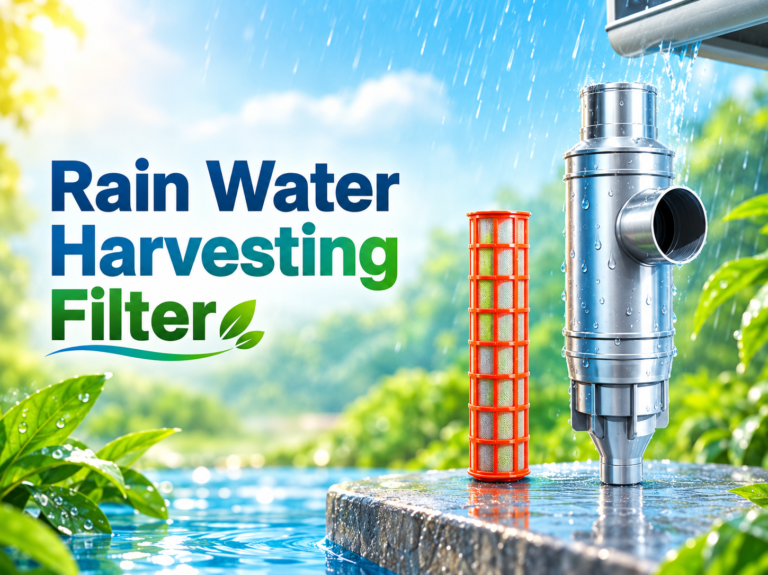
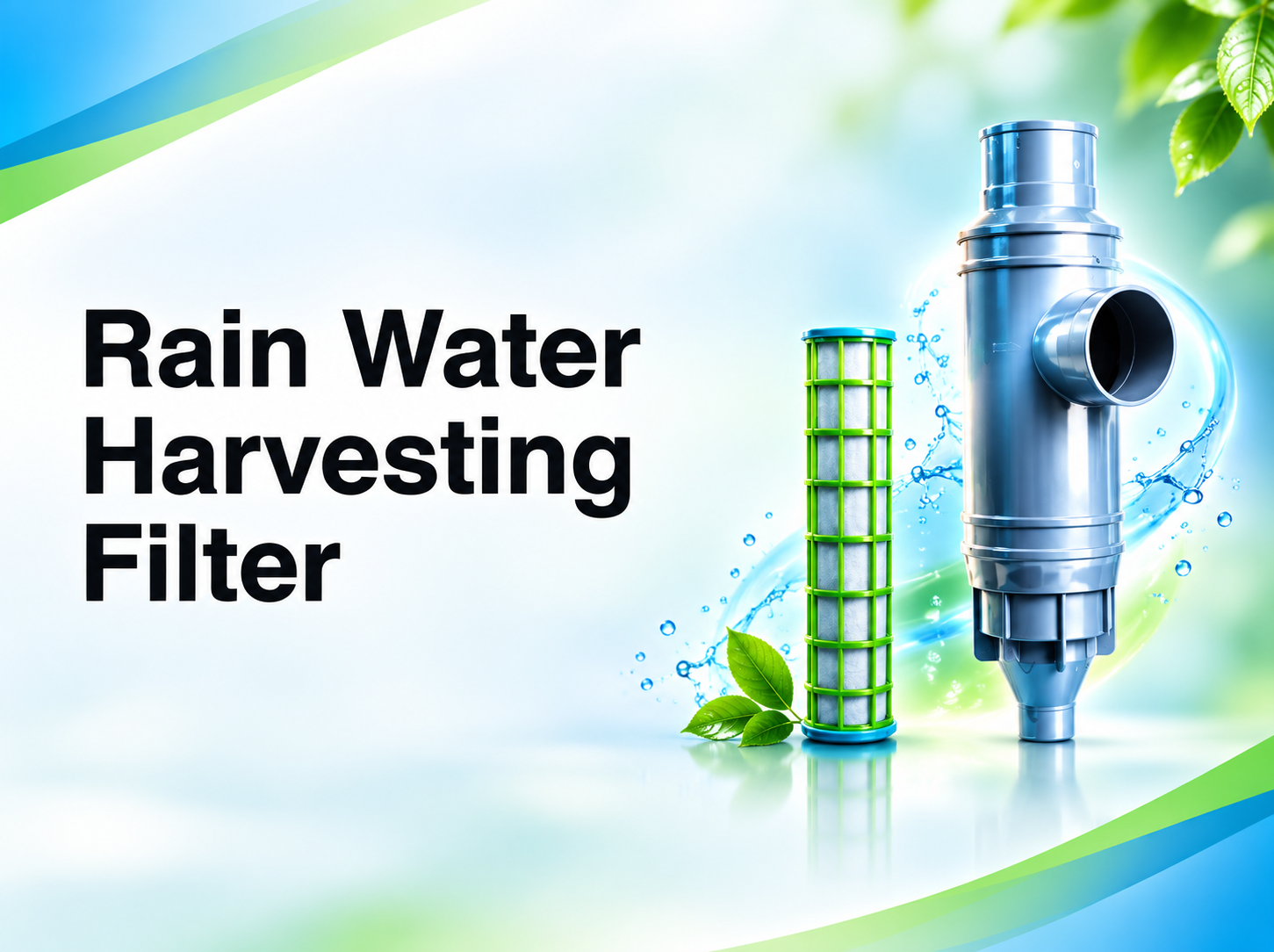
A rainwater harvesting filter is a device or filtration chamber that removes leaves, dust, sand, suspended particles, and other unwanted materials from collected rainwater before it enters a storage tank or groundwater recharge structure.
A typical rooftop rainwater harvesting system includes a roof catchment, gutters or pipes, a leaf screen, a first-flush device, a filter, and a storage or recharge arrangement. The filter is an important part of the system, but it does not automatically make rainwater safe for drinking. Potable use requires suitable treatment and water-quality testing.
What Is Rainwater Harvesting?
Rainwater harvesting is the process of collecting rainwater from rooftops, paved surfaces, or other suitable catchments and directing it toward storage or groundwater recharge. Instead of allowing rainfall to flow away as runoff, a harvesting system captures a portion of it for useful purposes.
In India, rooftop rainwater harvesting can support water conservation in residential buildings, schools, commercial properties, agricultural areas, and industrial premises. The Central Ground Water Board and government water-conservation programmes provide guidance on collecting rainwater, filtering it, storing it, and recharging groundwater where appropriate.
How does rooftop rainwater harvesting work?
The basic process is simple:

1. Rooftop catchment
Rain falls on a suitable roof and flows toward collection points.
Collection and transport

2. First-flush diversion
The initial flow of rainwater is diverted to reduce the entry of accumulated roof dust and debris.
Pre-filtration and filtration

3. Rainwater harvesting filter
A screen, mesh, filter chamber, or other suitable unit reduces suspended solids and debris.
Final collection

4. Storage or groundwater recharge
Filtered water moves into a storage tank or a properly designed recharge structure.
This sequence follows the broad rooftop harvesting approach described by Indian government water-management guidance.
Why Are Rainwater Harvesting Filters Important in India?
India experiences different rainfall patterns, from heavy monsoon rainfall in parts of western and southern India to seasonal rainfall in many northern and central regions. In cities, rainwater can quickly run over rooftops and paved surfaces before entering drains. A well-designed harvesting system helps capture some of this water for later use or recharge.
A rainwater harvesting filter is important because rooftops may collect:
- Dust and airborne particles.
- Dry leaves and small pieces of plant material.
- Sand and silt.
- Insects and other organic debris.
- Sediment accumulated during dry periods.
- Contaminants from unsuitable roof surfaces or nearby activities.
The filter helps control physical impurities, but the overall water quality also depends on the roof, pipes, first-flush system, storage tank, and maintenance. A filter should never be treated as a complete solution for chemical or microbiological contamination.
Why is rainwater harvesting useful for Indian homes?
Many homes depend on municipal water, borewells, tankers, or a combination of sources. Rainwater harvesting can provide an additional water resource for suitable non-potable uses and can help reduce the amount of rainwater lost as runoff.
Possible uses include:
- Garden irrigation.
- Landscape maintenance.
- Outdoor cleaning.
- Toilet flushing, where the plumbing system is designed for it.
- Washing vehicles, subject to appropriate water-quality considerations.
- Storage for other approved household uses.
- Groundwater recharge through a suitable, properly maintained structure.
The correct use depends on the quality of collected water and the treatment provided. Government guidance recommends appropriate filtering before recharge and emphasizes keeping the catchment and system clean.
How Does a Rainwater Harvesting Filter Work?
A rainwater harvesting filter works by allowing water to pass through a screening or filtration medium while retaining unwanted solid particles. The exact process depends on the filter design, the size of the mesh, the filter media, and the amount of water entering the system.
A properly designed rooftop system generally uses several stages rather than relying on one filter alone.
Stage 1: Collecting rainwater from the roof
The roof acts as the catchment surface. Rainwater flows toward gutters, roof drains, or collection outlets. Sloping roofs can help water flow naturally into collection pipes.
The catchment should be kept clean. Dust, bird droppings, leaves, and other contaminants can affect water quality. Government guidance recommends inspecting the roof and collection system before and during the rainy season.
Stage 2: Removing leaves and large debris
A mesh screen or leaf guard is placed near the roof drain or gutter outlet. It helps stop large materials from entering the downpipe.
This step is useful because leaves and debris can:
- Block pipes.
- Reduce water flow.
- Increase sediment in the filter.
- Create unpleasant odours.
- Increase cleaning requirements.
A leaf screen is not a replacement for a proper filtration system. Smaller particles can still pass through it.
Stage 3: Diverting the first rainwater
During dry weather, dust and other material may accumulate on the roof. The first rain after a dry period can wash some of this material into the collection pipes.
A first-flush diverter temporarily sends the initial flow away from the storage tank or recharge system. Once the initial flow has been diverted, the remaining rainwater can be directed toward filtration.
The first-flush arrangement should be designed according to the roof area, local rainfall, catchment conditions, and system capacity.
Stage 4: Filtering the collected water
After the initial flow has been diverted, water enters the rainwater harvesting filter. Depending on the design, the unit may use:
- Stainless steel mesh.
- Plastic screening.
- Gravel and sand.
- Sponge or other filter media.
- A combination of filtration stages.
The filter reduces physical impurities and suspended solids. However, the effectiveness of the unit depends on its construction, maintenance, flow rate, and the quality of the incoming water.
Stage 5: Storage or recharge
After filtration, water can be directed to a storage tank or a suitable groundwater recharge structure. The storage tank should have an appropriate inlet, overflow, access for cleaning, and protection against contamination.
Groundwater recharge requires special care. Water should not be diverted into a recharge structure without considering the local soil, geology, groundwater conditions, and potential contamination risks.
Main Components of a Rooftop Rainwater Harvesting System
A rainwater harvesting filter is only one part of a complete harvesting solution. Each component has a different purpose.

1. Roof catchment
The roof collects rainfall. Its material, condition, slope, and cleanliness affect the quality and quantity of water entering the system.

2. Gutters and downpipes
These carry rainwater from the roof to the first-flush unit, filter, tank, or recharge structure. Their size should suit the expected flow.

3. Leaf screen
A screen prevents large debris from entering the pipes and helps reduce blockages.

4. First-flush device
This diverts the initial flow of rainwater, helping reduce the entry of accumulated roof contaminants.

5. Rainwater harvesting filter
The filter removes or retains physical impurities using mesh, screens, filter media, or a combination of stages.

6. Storage tank or recharge structure
The final destination stores water for later use or directs it into a properly designed groundwater recharge system.
These components reflect the general rooftop rainwater harvesting arrangement described in government guidance.
Types of Rainwater Harvesting Filters in India
Different buildings and rainfall conditions require different filtration arrangements. The best choice depends on the roof area, water usage, installation space, expected flow, and maintenance plan.
1. Mesh rainwater harvesting filter
A mesh filter uses a screen with openings designed to retain leaves, dirt, and other physical particles.


6
Features:
- Simple physical filtration.
- Useful for removing larger particles.
- Available in different designs and materials.
- Can be used as a pre-filter.
- Requires regular cleaning when debris accumulates.
Mesh filters are especially useful near collection outlets and as an initial barrier before a finer filtration stage.
2. Stainless steel rainwater harvesting filter
A stainless steel rainwater filter uses stainless steel components, often including a mesh or screening element. Stainless steel can be useful in outdoor water systems because the material can offer good resistance to corrosion, depending on its grade and the surrounding conditions.

Potential advantages:
- Durable construction when a suitable grade is selected.
- Easy-to-clean surfaces in many designs.
- Suitable for some residential, commercial, and industrial installations.
- Can be designed for different pipe sizes and flow requirements.
The actual performance depends on the filter design, mesh size, weld quality, sealing, and installation. Stainless steel alone does not guarantee that water is safe to drink.
3. PVC rainwater harvesting filter
PVC filters are commonly used in small-scale rainwater collection systems. They may be constructed as inline units, vertical filter chambers, or simple filter assemblies.

Potential benefits:
- Lightweight construction.
- Convenient integration with PVC pipelines.
- Suitable for many residential installations.
- Easy access to some simple filter arrangements.
- Can be used as part of a multi-stage system.
When selecting a PVC filter, check the material suitability, connection size, sealing, UV exposure, and expected water flow.
4. Sand and gravel filter
A sand and gravel filter uses layers of filter media to reduce suspended particles. Water passes through the media, while some of the solids are retained.

This type of filtration can be useful in larger or fixed installations where a filter chamber can be constructed and maintained.
Important considerations:
- The media must be selected and arranged correctly.
- The chamber needs access for cleaning.
- Sediment can reduce flow over time.
- The system should have an appropriate outlet and overflow arrangement.
- Filter media must be cleaned or replaced as required.
A sand and gravel filter should be designed for the expected flow rather than filled randomly with materials.
5. Sponge filter
A sponge filter is a basic filtration arrangement that uses sponge material to retain some suspended impurities. Government rainwater harvesting guidance identifies simple sponge filters as one type of basic filtration method.

Sponge filters may be suitable for simple, low-flow applications, but they require regular cleaning. They should not be assumed to remove dissolved contaminants, pathogens, or all fine particles.
6. First-flush filter and diverter combination
Some harvesting systems combine first-flush diversion with a filtration arrangement. The first-flush component removes the initial flow, while the filter handles physical impurities in the remaining water.
This arrangement can be useful where roofs collect substantial dust during dry periods. The two functions should remain clear: first-flush diversion is not the same as filtration.
7. Recharge pit filter
A recharge pit filter is part of a system designed to direct suitable rainwater into the ground. It may include layers of gravel, sand, or other appropriate materials to reduce sediment before recharge.

Recharge structures must be designed carefully. The filtration arrangement should not allow polluted water to enter groundwater. Site-specific technical guidance is important, especially where groundwater is shallow or contamination risks exist.
Comparison of common rainwater harvesting filters
| Filter type | Typical role | Maintenance |
|---|---|---|
| Mesh filter | Removes leaves and larger debris | Clean screen regularly |
| Stainless steel filter | Physical filtration and screening | Inspect mesh and clean housing |
| PVC filter | Inline or chamber-based filtration | Check connections and filter media |
| Sand and gravel filter | Reduces suspended solids | Clean or replace media |
| Sponge filter | Basic low-flow filtration | Wash or replace sponge |
| Recharge pit filter | Helps reduce sediment before recharge | Inspect and remove accumulated silt |
The appropriate choice depends on the complete system design rather than the filter name alone.
Benefits of Installing a Rainwater Harvesting Filter
A properly designed rainwater harvesting filter can improve the operation of a water collection system. Its benefits extend beyond simple dirt removal.
1. Reduces physical impurities
The primary purpose of a rainwater filter is to reduce unwanted physical material in collected water. This can include dust, leaves, sand, and suspended particles.
Cleaner incoming water can help reduce sediment accumulation in storage tanks and lower the frequency of pipe blockages.
2. Helps protect storage tanks
When large debris and excess sediment enter a storage tank, they can collect at the bottom. A suitable filtration arrangement helps reduce the amount of material entering the tank.
However, storage tanks still require inspection and cleaning.
3. Supports efficient water collection
Blocked gutters and pipes can reduce the amount of water entering a harvesting system. A leaf screen and appropriate filtration can help maintain water flow when regularly maintained.
The filter should be correctly sized for the collection area and expected rainfall intensity.
4. Helps reduce maintenance problems
A well-planned multi-stage system can make maintenance easier. Separating leaf screening, first-flush diversion, and finer filtration allows each part to be inspected and cleaned according to its function.
5. Supports water conservation
Rainwater harvesting allows a portion of rainfall to be collected instead of immediately becoming runoff. A functional filter supports the system by helping prepare collected water for suitable storage or recharge.
6. Can be used in different applications
Rainwater harvesting filters can be incorporated into systems for:
- Residential buildings.
- Apartments and housing societies.
- Schools and colleges.
- Offices and commercial buildings.
- Farms and agricultural premises.
- Warehouses and factories.
- Institutions and public buildings.
The filtration arrangement should be selected according to the water’s intended use and the site’s conditions.
7. Supports responsible groundwater recharge
When combined with a suitable recharge structure, a rainwater harvesting filter can help reduce sediment entering the recharge system. This can support the proper operation of a recharge arrangement.
It is essential to distinguish between filtering sediment and ensuring groundwater safety. Only appropriate, non-polluted water should be directed toward recharge.
How to Choose the Right Rainwater Harvesting Filter in India
Choosing a filter only by price or appearance can result in poor performance. The filter should match the building and the expected water flow.
1. Consider the rooftop area
A small house and a large factory can collect very different amounts of rainwater. A filter designed for a small roof may not handle the flow from a large commercial roof.
Before selecting a filter, determine:
- Total catchment area.
- Number of roof outlets.
- Pipe diameter.
- Expected peak rainfall flow.
- Available installation space.
- Storage or recharge capacity.
2. Check the filter material
Common materials include PVC, stainless steel, plastic mesh, and other suitable filter media.
For outdoor installations, consider:
- Resistance to weather exposure.
- Corrosion resistance.
- Strength and durability.
- Ease of cleaning.
- Compatibility with the water system.
- Availability of replacement parts.
A material should be selected for the actual site conditions rather than based only on its appearance.
3. Match the filter to the water flow
A filter must be able to handle the water entering the system. If the filter is too small, water may overflow, bypass the filtration stage, or create excessive pressure and blockages.
Ask the supplier for the recommended flow capacity and the conditions under which that capacity applies.
4. Consider the roof condition
A roof that collects a large amount of dust, leaves, or other debris may require more than one filtration stage.
For example, a system may use:
- A leaf screen.
- A first-flush diverter.
- A rainwater harvesting filter.
- A storage tank with an accessible cleaning point.
5. Choose an accessible design
A filter should be easy to inspect and clean. A design that is difficult to open may be neglected, reducing system performance.
Look for:
- Easy access to the filter element.
- Secure covers.
- Suitable inlet and outlet connections.
- Provision for removing collected debris.
- A practical installation position.
6. Check the intended water use
Water collected for gardening or outdoor cleaning may require a different treatment arrangement from water intended for drinking.
If rainwater is intended for potable use, filtration alone is insufficient. The system needs treatment appropriate to the source and water-quality testing to verify safety.
7. Consider local rainfall conditions
Rainfall patterns differ across India. A building in Ahmedabad may experience different roof runoff conditions from a property in Kerala, Assam, Rajasthan, or Maharashtra.
The filter and collection system should be selected using local rainfall patterns, catchment area, and expected flow.
8. Compare total ownership cost
The initial purchase price is only one part of the cost. Also consider:
- Installation.
- Pipe modifications.
- Filter cleaning.
- Replacement media.
- Spare parts.
- Labour.
- Periodic inspection.
A filter that is easy to maintain may be more practical over its operating life, even when its initial price is higher.
Rainwater Harvesting Filter Installation Process
A rainwater harvesting filter should be installed as part of a complete collection system. The exact installation method depends on the filter model, pipe arrangement, building design, and whether the water is being stored or used for recharge.
Step 1: Inspect the rooftop
Before installation, inspect the roof and identify suitable collection points. Check for:
- Roof slope.
- Drain outlets.
- Existing gutters.
- Dust and debris.
- Roof coatings or materials that may affect water quality.
- Safe access for maintenance.
The roof should be suitable for collecting rainwater.
Step 2: Plan the pipe layout
The collection pipes should carry rainwater from the roof to the filtration system. The pipe size and routing should be suitable for the expected flow.
Avoid unnecessary bends and ensure that the arrangement can be cleaned when required.
Step 3: Install a leaf screen
A leaf screen can be placed at the roof drain or gutter outlet. This reduces the entry of large debris into the downpipe.
The screen should be accessible for cleaning.
Step 4: Install the first-flush arrangement
A first-flush diverter should be installed before the storage tank or recharge system. Its purpose is to divert the initial roof runoff.
The required arrangement depends on the catchment area and local conditions.
Step 5: Install the rainwater harvesting filter
The filter should be fitted according to the manufacturer’s installation instructions. Check the inlet, outlet, seals, supports, and flow direction.
A vertical or horizontal filter may be suitable depending on the design and available space.
Step 6: Connect the storage tank or recharge structure
Filtered water can be directed to an appropriate tank or recharge arrangement. The system should include suitable overflow provisions.
For groundwater recharge, the structure must be designed to avoid contamination and excessive sediment entry.
Step 7: Test the system
Before regular use, inspect the system and check:
- Water flows through the intended route.
- Connections do not leak.
- The filter is securely installed.
- The first-flush arrangement operates correctly.
- Overflow is directed safely.
- The storage tank is protected from contamination.
Step 8: Establish a maintenance schedule
The system should be inspected before the monsoon and after periods of heavy debris accumulation. Cleaning frequency depends on rainfall, roof conditions, and filter design.
Government guidance recommends cleaning filter media and checking the roof, pipes, first-flush device, filters, and tanks regularly.
Rainwater Harvesting Filter Maintenance and Cleaning
Regular maintenance is essential for keeping a rainwater harvesting system functional. Even a high-quality filter can become blocked if it is not cleaned.
Before the monsoon
Before the rainy season begins:
- Clean the rooftop.
- Remove leaves and debris from gutters.
- Inspect the downpipes.
- Clean the filter screen or media.
- Check the first-flush device.
- Inspect tank covers and inlet screens.
- Remove sediment from the storage tank.
- Check for damaged pipes or leaks.
During the rainy season
Inspect the system after heavy rainfall and whenever water flow appears reduced.
Look for:
- Slow drainage.
- Overflow near the filter.
- Blocked screens.
- Excessive sediment.
- Damaged mesh.
- Leaking joints.
- Unusual odours.
- Contaminated roof runoff.
After a long dry period
Dust and debris can accumulate on the roof during dry weather. The system should be inspected before the next rainfall event.
The first-flush arrangement should be functional so that initial runoff can be diverted appropriately.
Cleaning the filter
The cleaning process depends on the filter design. A basic screen may be removed and washed, while a media filter may need sediment removal or replacement of filter material.
Always follow the manufacturer’s instructions. Do not damage the mesh, seals, or filter housing during cleaning.
Why is maintenance important?
Poor maintenance can lead to:
- Reduced water flow.
- Pipe blockages.
- Overflow.
- Sediment accumulation.
- Damage to the filter.
- Contamination of stored water.
- Poor recharge performance.
A maintenance plan is as important as choosing the correct filter.
Rainwater Harvesting Filter Price in India
The price of a rainwater harvesting filter in India depends on its construction, capacity, material, design, and installation requirements. A simple screen and a complete filtration unit are not equivalent products.
Instead of relying on a single price, buyers should request a project-specific quotation.
Factors that affect the price
| Factor | How it affects cost |
|---|---|
| Filter material | Construction material and grade influence cost |
| Filter capacity | Larger flow requirements may need larger units |
| Filter design | Inline, vertical, chamber, and multi-stage designs differ |
| Mesh or media | Filter element type and quality affect cost |
| Pipe size | Larger connections may require different components |
| Installation | Labour, supports, and pipe modifications add cost |
| Maintenance | Replacement media and spare parts affect ongoing expenses |
| Project size | Residential and industrial systems have different requirements |
What should a quotation include?
When requesting a quotation for a rainwater harvesting filter, ask for:
- Filter model and technical specifications.
- Material and construction details.
- Recommended flow capacity.
- Compatible pipe sizes.
- Installation requirements.
- Cleaning procedure.
- Warranty terms, if applicable.
- Spare-part availability.
- Delivery and installation charges.
- Applicable taxes.
For a project in Ahmedabad, Gujarat, or another Indian city, the supplier should consider the local site conditions and the complete collection system before recommending a product.
Rainwater Harvesting in Different Regions of India
Rainwater harvesting is useful across India, but the design should reflect regional rainfall and building conditions.
Ahmedabad and Gujarat
Ahmedabad and other parts of Gujarat experience seasonal rainfall, making monsoon water collection useful for suitable properties. Dust accumulation on rooftops can be an important design consideration.
A harvesting system in this region may benefit from:
- Regular rooftop cleaning.
- Effective leaf screening.
- A suitable first-flush diverter.
- Accessible filtration.
- Storage or recharge planning based on the site.
- Protection from dust entering the collection system.
For industrial or commercial properties, the filter capacity should be assessed according to roof size and drainage design.
Maharashtra
Many areas of Maharashtra experience seasonal monsoon rainfall. Residential buildings, housing societies, farms, and commercial properties may use rooftop collection systems to capture rainfall.
The design should consider roof size, rainfall intensity, storage capacity, and the quality of the collection surface.
Rajasthan
In parts of Rajasthan, water conservation is especially important because rainfall is often limited or seasonal. Rainwater harvesting can support water management when designed for local conditions.
Storage capacity, evaporation, roof catchment, and maintenance should be considered carefully.
Kerala
Kerala receives substantial rainfall in many areas, and heavy rainfall events can create high runoff volumes. Rainwater harvesting systems should be designed to handle the expected flow.
Strong drainage planning, suitable filtration, and safe overflow arrangements are important.
Tamil Nadu
Rooftop rainwater harvesting has been promoted in Tamil Nadu for water conservation and groundwater recharge. Buildings using harvesting systems should follow applicable local requirements and ensure that the collection and recharge arrangements are properly maintained.
Northern and central India
Many regions of northern and central India experience seasonal rainfall. Rainwater harvesting can help collect runoff during the rainy period for suitable storage or recharge.
The filter selection should be based on local roof conditions, rainfall patterns, and intended water use.
Important: Local building regulations, groundwater conditions, and technical requirements may differ between states and municipalities. Check the relevant local authority before installing a new system or modifying a recharge structure.
Applications of Rainwater Harvesting Filters
Rainwater harvesting filters can be used in many types of properties. The filtration arrangement should be selected according to the size of the building, the available water collection area, and the intended use of the collected water.
1. Residential buildings
Homes can collect rainwater from terraces and sloping roofs. A suitable filter helps reduce leaves, dust, and suspended particles before the water reaches a storage tank.
A typical home system may include a roof screen, first-flush diverter, rainwater harvesting filter, and storage tank.
2. Apartment buildings and housing societies
Large residential complexes may have several rooftops and multiple downpipes. A properly designed filtration system can help manage collected water from different collection points.
The system should be designed according to the total catchment area, drainage arrangement, storage requirements, and maintenance access.
3. Agricultural farms
Farm buildings, sheds, greenhouses, and other structures can collect rainwater for suitable agricultural uses.
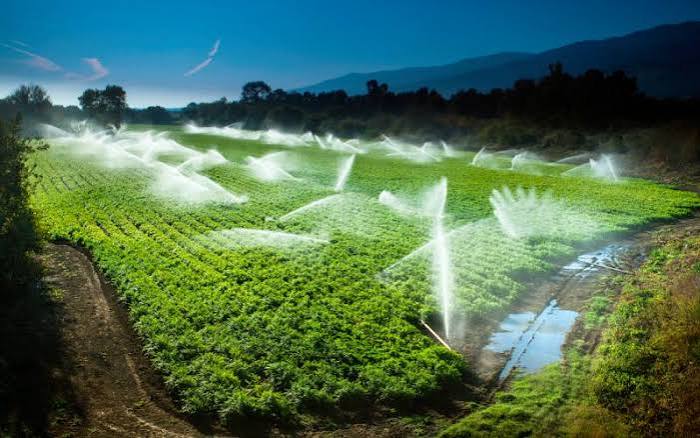
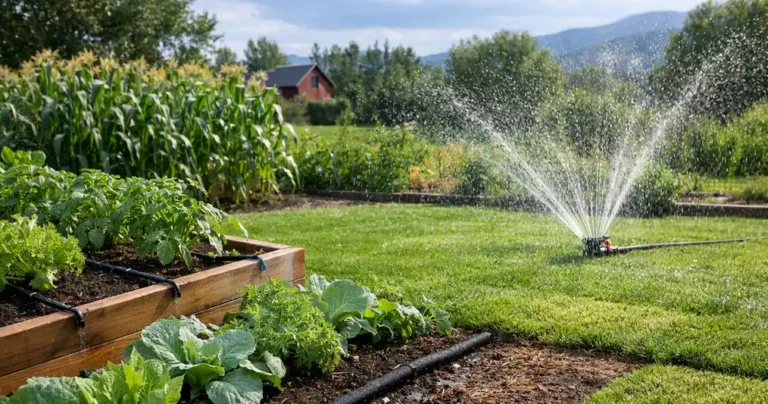
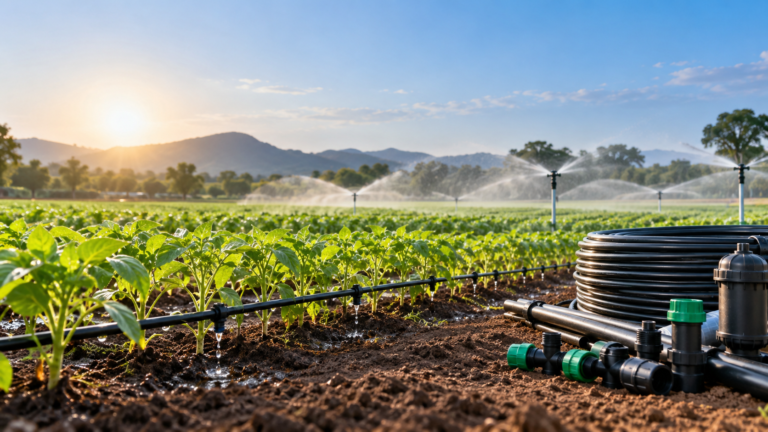
Collected rainwater may support irrigation or other farm activities, subject to water quality and storage requirements. Rainwater harvesting can complement irrigation systems, but it does not replace the need for proper irrigation planning.
4. Schools and colleges
Educational institutions can use rainwater harvesting systems to demonstrate water conservation. Filtered rainwater may be collected for suitable non-potable applications, depending on the system design.
Visible filter chambers and collection pipes can also help students understand water management.
5. Commercial buildings
Offices, shopping complexes, hotels, and other commercial properties may have large roof areas that can contribute to rainwater collection.
A commercial installation generally needs careful planning for pipe capacity, filtration, overflow, storage, and maintenance.
6. Industrial buildings
Factories and warehouses may use rainwater harvesting systems to collect roof runoff. Industrial sites need special attention to roof materials, nearby chemicals, industrial dust, and possible contamination.
Rainwater from a potentially polluted catchment should not be used or directed into groundwater without appropriate assessment and treatment.
7. Public and institutional properties
Hospitals, government buildings, community facilities, and other institutions may use rainwater harvesting as part of broader water-conservation efforts.
The design should account for the building’s water needs, roof area, applicable regulations, and maintenance responsibilities.
Common Mistakes to Avoid When Installing a Rainwater Harvesting Filter
A rainwater harvesting system may perform poorly if its individual components are not planned together.
Mistake 1: Installing only a filter
A filter cannot replace the roof screen, first-flush arrangement, proper piping, and safe storage. A complete harvesting system needs all the necessary stages.
Mistake 2: Ignoring the first rain
The first runoff after a dry period may contain accumulated dust and debris. A first-flush diverter helps reduce this material entering the main collection system.
Mistake 3: Choosing a filter that is too small
A filter with insufficient capacity may cause overflow and poor water flow. Always check the recommended capacity and the expected flow from the roof.
Mistake 4: Not cleaning the roof
Even an efficient filter can become blocked if the roof and gutters are full of leaves, dust, or other debris.
Mistake 5: Using unsuitable roof materials
Some roof coatings and materials may release unwanted substances into collected water. The catchment surface should be assessed before harvesting.
Mistake 6: Directing polluted water into groundwater
Rainwater collected from polluted surfaces should not be sent directly into a recharge pit or borewell. Recharge systems need appropriate site assessment and filtration.
Mistake 7: Assuming filtered rainwater is drinking water
Physical filtration does not necessarily remove bacteria, viruses, dissolved chemicals, or heavy metals. Drinking-water use requires suitable treatment and testing.
Mistake 8: Making the filter difficult to access
If cleaning is difficult, maintenance may be neglected. Choose a design that can be opened, inspected, and serviced safely.
Mistake 9: Ignoring overflow
Storage tanks need suitable overflow arrangements. Excess rainwater should be directed safely so that it does not damage the building or surrounding property.
Mistake 10: Failing to check local requirements
Some states and local authorities have specific rainwater harvesting provisions. Check the applicable rules before starting installation.
Rainwater Harvesting Filter: A Simple Example
Consider a residential building with a rooftop catchment area of 100 square metres.
Suppose the site receives 600 millimetres of annual rainfall. The theoretical volume of rain falling on the roof can be estimated as:
Rainwater volume=Roof area×Rainfall
=100×0.6=60 cubic metres
This equals approximately 60,000 litres of rainfall before accounting for runoff losses, roof conditions, first-flush diversion, and system efficiency.
The actual amount collected will be lower or different depending on:
- The roof’s runoff characteristics.
- Rainfall distribution.
- Water lost during the first flush.
- Overflow.
- Leaks.
- Filter and pipe performance.
- Storage capacity.
This example shows why roof area and local rainfall are important when planning a rainwater harvesting system. It is not a guarantee of the amount of water a particular property will collect.
Why Choose Gajanand Irrigation for Rainwater Harvesting Solutions?

What to ask before purchasing a filter
When contacting Gajanand Irrigation about a rainwater harvesting filter, provide the following information:
- City and installation location.
- Type of building.
- Approximate rooftop area.
- Number of downpipes.
- Existing pipe diameter.
- Intended use of the collected water.
- Storage tank or recharge requirements.
- Expected maintenance arrangements.
These details can help a supplier understand the application and recommend a suitable solution.
Conclusion
A rainwater harvesting filter in India is an important component of a well-designed rooftop rainwater collection system. It helps reduce physical impurities, supports cleaner water storage, and can improve the operation of systems used for suitable non-potable applications or groundwater recharge.
The right solution depends on the rooftop area, local rainfall, pipe capacity, filter material, installation space, and maintenance requirements. A filter should always be combined with suitable roof screening, first-flush diversion, safe storage, and appropriate water-quality practices.
For your next step, visit Gajanand Irrigation to explore the company’s water-management and irrigation information, then contact the company for verified rainwater harvesting filter specifications and project-specific guidance.